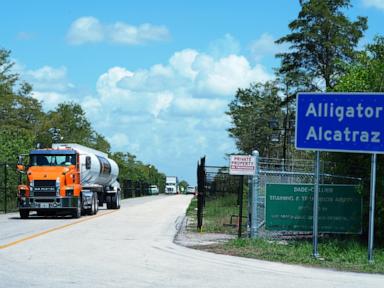
The transition of a temporary processing facility into a permanent detention hub represents a failure of operational forecasting and a breakdown in the scalable logic of border management. In the case of the "Alligator Alcatraz" facility—a moniker used by Florida Governor Ron DeSantis to describe the migrant processing center located in the Everglades—the discrepancy between intended utility and actual usage reveals a systemic reliance on "temporary" solutions to manage permanent migration flows. This reliance creates a fiscal and logistical bottleneck characterized by high maintenance costs, degraded humanitarian standards, and legal volatility.
The Lifecycle Decay of Temporary Assets
Governmental agencies frequently deploy modular or soft-sided facilities to address sudden spikes in human transit. These assets are conceptually designed for a 90-to-180-day operational window. When use cases extend beyond this threshold, the facility undergoes a phase shift from an agile response tool to a liability.
Infrastructure Fatigue and Maintenance Ratios
Temporary structures lack the thermal insulation and structural integrity of permanent builds. In high-humidity environments like the Florida Everglades, the rate of mechanical failure for HVAC systems increases exponentially after the first six months of continuous operation. The cost-per-occupant rises as reactive maintenance replaces preventative care. We categorize this as the Obsolescence Gradient: as the facility stays open longer, the efficiency of every dollar spent on operations decreases while the risk of system-wide failure (sanitation, power, security) increases.
The Elasticity of Demand vs. Fixed Capacity
The primary justification for "Alligator Alcatraz" was its role as a surge relief valve. However, border logistics suffer from a "Parkinson’s Law" of infrastructure: migrant processing volume expands to fill the available capacity. By maintaining a temporary site as a permanent fixture, the state incentivizes the federal government to bypass more efficient, permanent processing hubs in favor of these high-cost, low-visibility outposts.
The Three Pillars of Detention Gridlock
To understand why a facility intended to be ephemeral becomes entrenched, we must examine the intersection of legal, economic, and political feedback loops.
1. The Fiscal Sunk-Cost Trap
Once millions of dollars are invested in site preparation, security perimeters, and specialized staffing contracts, shutting down a site becomes a political liability. Decision-makers often fall victim to the sunk-cost fallacy, choosing to "optimize" a failing temporary site rather than absorbing the high upfront costs of a permanent, sustainable facility elsewhere. This results in a hybrid infrastructure that possesses neither the cost-effectiveness of a tent city nor the security of a hardened prison.
2. Legal Precedent and Jurisdictional Friction
Temporary facilities often operate under a different set of regulatory standards than permanent federal prisons. This "regulatory grey zone" allows for faster deployment but creates a target for litigation. When a site like the Everglades center remains active past its expiration date, it enters a state of legal vulnerability. Plaintiffs argue that the lack of permanent medical wings, educational facilities, and legal counsel rooms violates the due process rights of the detainees. The resulting litigation costs often exceed the savings gained by using temporary structures.
3. The Logistical Distance Penalty
The location of "Alligator Alcatraz" introduces a geographic inefficiency. Remote sites require complex supply chains for food, water, and personnel transport. The "Distance Penalty" is calculated by the ratio of logistics costs to processing throughput. In remote Everglades locations, the cost of transporting a single detainee to a court hearing or medical facility can be 40% higher than in urban-adjacent centers.
The Mechanics of Processing Throughput
The fundamental metric for evaluating any detention center is Throughput Velocity—the time it takes for an individual to enter the system, undergo vetting, and reach a final disposition (deportation, asylum hearing, or release).
Bottleneck Identification
Temporary facilities almost always lack on-site judicial capacity. This necessitates a "Transport-and-Return" cycle. Each time a detainee must be moved to a permanent facility for a hearing, the risk of security breaches and administrative errors rises. These micro-delays aggregate into a macro-bottleneck where the average length of stay (ALOS) increases. When ALOS increases in a temporary facility, the physical environment deteriorates faster, leading back to the infrastructure fatigue mentioned earlier.
Data Siloing and Information Lag
A major friction point in the DeSantis-led critique of federal management is the lack of real-time data sharing between state and federal agencies. Temporary sites often use "lite" versions of processing software or rely on manual data entry that isn't fully integrated into the national criminal database. This information lag creates security risks where individuals with high-threat profiles might be processed with the same protocols as low-risk families simply because the local tech stack cannot handle high-speed biometric cross-referencing.
Operational Risk Assessments
Operating a high-capacity detention center in an ecologically sensitive and harsh environment like the Everglades introduces variables that are often ignored in standard policy debates.
- Environmental Hazards: High heat indices and hurricane risks necessitate robust evacuation protocols. A temporary facility lacks the hardened shelters required to protect thousands of people during a Category 3 or higher storm.
- Staffing Burnout: Remote locations lead to higher turnover rates among security personnel. High turnover correlates directly with an increase in use-of-force incidents and administrative errors.
- Public Perception and Optics: The "Alcatraz" framing signals a shift from humanitarian processing to punitive detention. This change in brand identity affects everything from local zoning cooperation to the quality of NGOs willing to provide support services.
Strategic Realignment of Border Assets
The current model of maintaining "Alligator Alcatraz" is unsustainable. A data-driven strategy requires moving away from the "Crisis-Response" loop toward a "Fixed-Modular" architecture.
Implementation of Scalable Hardened Hubs
Instead of soft-sided tents that rot in the Florida sun, the state and federal government should invest in Hardened Modular Units (HMUs). These are pre-fabricated, steel-reinforced structures that can be deployed rapidly but possess the lifespan of a permanent building (20+ years).
Decentralized Judicial Processing
The primary cause of detention overcrowding is the judicial backlog. The strategy must shift toward "On-Site Adjudication." By integrating tele-courtrooms and on-site judge chambers into the initial design of processing centers, the need for long-term detention is minimized. The goal is to reduce ALOS from months to days.
The Automated Intake Protocol
To eliminate the Information Lag, intake facilities must be equipped with AI-augmented biometric screening. This is not about surveillance, but about Classification Efficiency. By instantly identifying individuals with previous deportations or criminal records, the system can bifurcate the population into "Fast-Track" and "High-Security" streams, preventing the general population from being bogged down by a few complex cases.
The persistence of "temporary" facilities is a symptom of a strategy that prioritizes short-term political visibility over long-term operational stability. True mastery of border logistics requires acknowledging that migration flows are a permanent feature of the modern geopolitical environment. Any facility built to handle this reality must be engineered for durability, legal compliance, and high-velocity throughput. Failing to do so ensures that every "temporary" solution will eventually become an expensive, permanent problem.
The immediate tactical play is a mandatory audit of the facility’s Total Cost of Ownership (TCO) compared to a permanent facility of equal capacity. If the 24-month TCO of the temporary site exceeds the construction cost of a permanent HMU-based center, the site must be decommissioned and transitioned to a hardened hub model immediately.