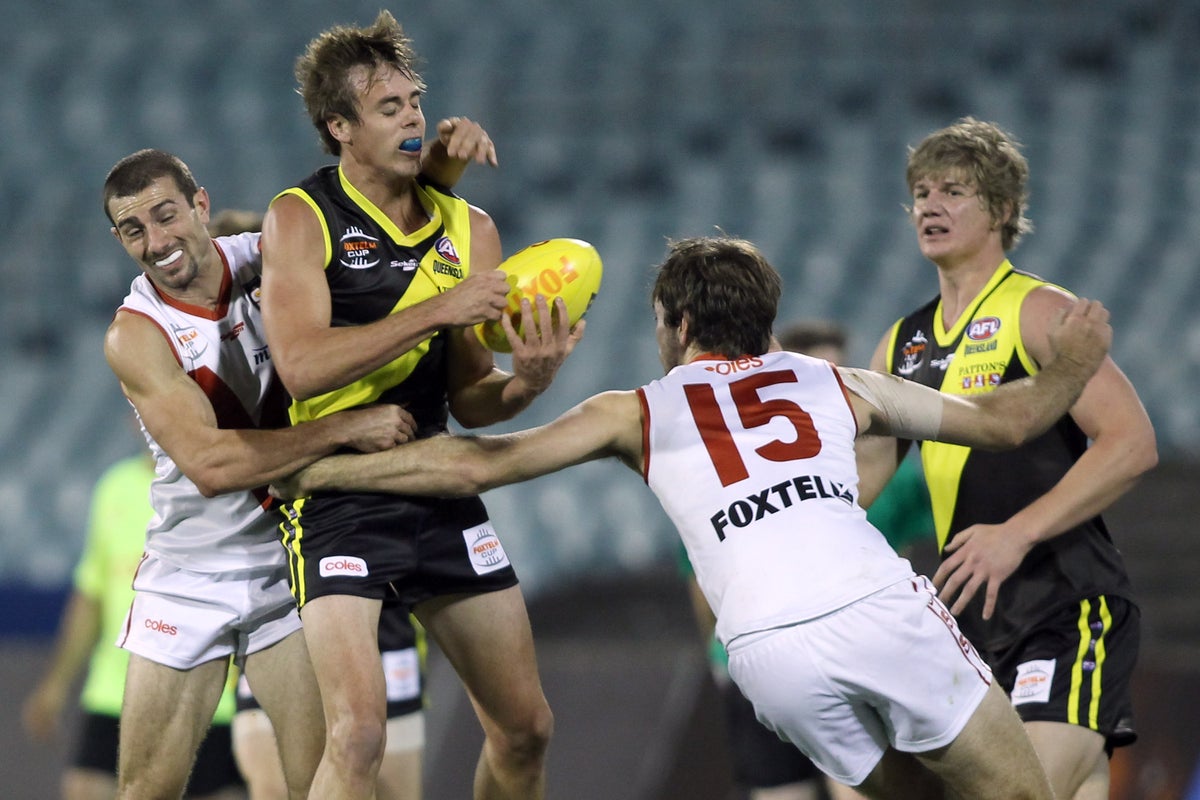
The emergence of Leigh Ryswyk as the first openly gay male footballer in the Australian Football League (AFL) ecosystem serves as a critical case study in the transition of high-performance sporting cultures from closed-loop social systems to modernized professional environments. This milestone is not merely a human interest narrative but a data point indicating a shift in the internal cost-benefit analysis of professional athletes regarding their personal identities. The core friction in this transition exists between the traditional "warrior archetype" of contact sports and the contemporary requirement for psychological safety to optimize athletic output.
The Psychological Safety Multiplier in Professional Athletics
Elite sport operates on the marginal gains principle. When an athlete allocates cognitive resources to self-censorship, concealment, or the management of a dual persona, they incur a measurable performance tax. In organizational psychology, this is defined as the "Cognitive Load of Concealment."
This load directly competes with the mental bandwidth required for split-second decision-making, spatial awareness, and strategic execution on the field. By eliminating the necessity of concealment, an athlete effectively reclaims these cognitive assets. Ryswyk’s public declaration is a strategic move to synchronize his personal and professional personas, thereby reducing internal friction. The result is a shift from a defensive psychological posture to an offensive, high-clarity state of performance.
Structural Barriers to Inclusion in Contact Sports
The delay in a male AFL player coming out, relative to society or even the AFLW (where LGBTQ+ representation is significantly higher), suggests a specific set of structural inhibitors unique to the men's professional game. These barriers are categorized into three primary vectors:
- The Cultural Homogeneity Trap: Professional football clubs often operate as "greedy institutions"—organizations that demand total commitment and conformity. Deviation from the perceived norm (the heteronormative warrior) is historically viewed as a threat to team cohesion, despite evidence suggesting that diverse teams often possess higher levels of adaptive intelligence.
- The External Stakeholder Feedback Loop: Players are not just athletes; they are commercial assets. The perceived risk of brand devaluation among traditionalist fanbases or conservative sponsors has created a "Silence Premium." Athletes calculate that the social and financial costs of coming out outweigh the benefits of authenticity.
- The On-Field Verbal Aggression Economy: In high-contact sports, verbal provocation is used as a tool to destabilize opponents. The fear that sexual orientation will be weaponized by opponents or spectators creates a perceived vulnerability that many athletes are unwilling to risk.
The Mechanism of the "First Mover" Advantage
Ryswyk’s position as the first mover in the AFL context creates a precedent that alters the risk profile for those who follow. In game theory, this is akin to breaking a coordination failure. When no one is out, the perceived risk is infinite. Once a successful precedent is established—provided it is met with organizational support rather than ostracization—the "risk-to-reward" ratio shifts for the rest of the cohort.
The AFL’s institutional response serves as the critical variable here. For inclusion to move from a gesture to a systemic reality, the league must transition from passive tolerance to active structural protection. This involves:
- Codified Conduct Standards: Moving beyond vague "respect" campaigns toward explicit, enforceable penalties for homophobic conduct from players, staff, and spectators.
- Mental Health Infrastructure: Providing specialized psychological support that understands the specific pressures of being a "first" or "only" in a high-pressure environment.
- Sponsor Alignment: Ensuring that commercial partners are vetted not just for their capital, but for their alignment with the league’s stated values, preventing "values-clash" when players come out.
The Bifurcation of Public and Private Safety
Ryswyk’s statement emphasizes the need to "feel safe anywhere we go." This highlights the distinction between Institutional Safety (within the club and league) and Public Safety (in the broader social sphere).
Institutional safety is a controllable variable. A club can dictate the culture within its four walls through leadership and policy. Public safety is an external variable influenced by media narratives and fan behavior. The challenge for the AFL is that the sport is a public-facing product; the two environments are inextricably linked. If a player feels safe at training but is subjected to vitriol in the stadium, the psychological safety multiplier is neutralized.
Measuring Success Beyond the Headline
The success of Ryswyk’s transition will not be measured by the initial wave of positive press, but by the following metrics over a 24-month horizon:
- Retention and Recruitment: Does the player’s career trajectory remain stable or improve? Do other LGBTQ+ athletes feel emboldened to enter or remain in the AFL pathway?
- Normalization of Discourse: Does the media focus shift from the player's sexuality back to their on-field performance metrics? The ultimate goal of inclusion is the "irrelevance" of the identity marker in a professional context.
- Incident Reports: Is there a measurable decrease in homophobic slurs or incidents at both the professional and grassroots levels?
The Strategic Path Forward for Sporting Organizations
The AFL and its constituent clubs must recognize that inclusion is not a social justice project; it is a human capital optimization strategy. To sustain the momentum generated by Ryswyk, the league should implement a "Systemic Inclusion Framework" that moves beyond the individual.
- Audit Team Dynamics: Conduct anonymous climate surveys to identify sub-pockets of resistance within playing groups and coaching staff.
- Leadership Training: Move away from top-down mandates. Instead, train influential "culture carriers" within the playing group (captains, senior players) to model inclusive behavior.
- Transparency in Adjudication: When breaches of conduct occur, the league must provide clear, transparent explanations of the penalties applied to reinforce the boundaries of the new cultural standard.
The transition initiated by Leigh Ryswyk is a signal that the AFL is finally confronting its lag in social modernization. The organizations that thrive in this new era will be those that treat psychological safety as a core performance metric rather than a peripheral HR concern. The focus must now shift from the courage of the individual to the competence of the institution.


