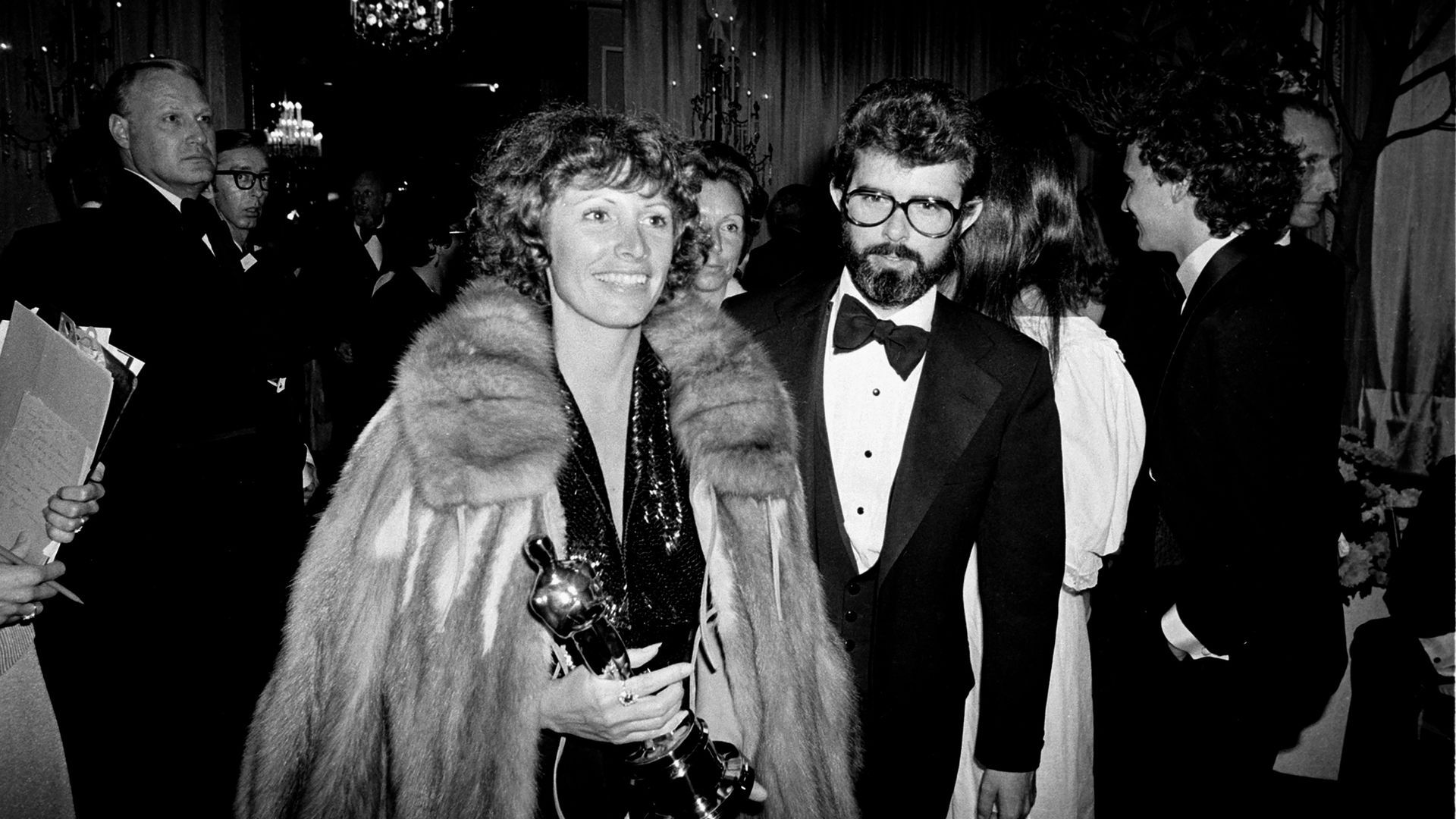
The foundational myth of contemporary Hollywood dictates that the modern blockbuster was conceived by solitary auteur visionaries. This narrative misinterprets the economic and technical realities of film manufacturing. The commercial survival and subsequent market dominance of the 1977 film Star Wars (later subtitled A New Hope) was not determined during principal photography, but within the editing suite. The recent passing of Oscar-winning film editor Marcia Lucas at age 80 provides a critical prompt to analyze the precise structural frameworks, structural interventions, and pacing metrics that saved a fundamentally broken production from commercial failure and established the baseline syntax for modern cinematic pacing.
The First Imperative: Structural Reconstruction of the Narrative Engine
A film script operates as a theoretical blueprint, but the assembly phase frequently reveals structural failure points where narrative velocity collapses. When George Lucas delivered the initial rough cut of Star Wars—assembled by British editor John Jympson—the production faced an existential commercial bottleneck. The pacing lacked urgency, the exposition was bloated, and test screenings yielded disastrous engagement metrics from studio executives.
The recovery strategy executed by Marcia Lucas, alongside co-editors Richard Chew and Paul Hirsch, can be understood through specific structural interventions that reorganized the narrative's cost-of-attention function.
1. Eliminating Ambient Narrative Debt
The original opening sequence contained extensive exposition tracking Luke Skywalker’s mundane life on Tatooine, including scenes with his peers at Tosche Station. While these sequences provided deep character context, they created a severe drag coefficient on the plot. By cutting these scenes entirely, the editorial team shifted the audience's point of engagement directly to the inciting incident: the structural pressure of a cosmic civil war. The elimination of this narrative debt compressed the first act, forcing the audience to catch up to the story rather than waiting for the story to begin.
2. The Mechanics of the "Spiritual Guide" Pivot
Narrative stakes require emotional anchors to function. In the original screenplay architecture, Obi-Wan Kenobi survived his confrontation with Darth Vader aboard the Death Star, escaping with the core protagonists. Marcia Lucas identified a critical structural flaw in this design: if Kenobi survived, his presence as an active, high-powered ally neutralized the stakes for the third act. He functioned as a narrative safety net, reducing the perceived risk to the protagonist.
[Original Plan]   Kenobi Escapes ──> Active Ally ──────> Lowers Stakes for Luke
[Marcia's Pivot]  Kenobi Dies ────> Spirit Guide ──────> Maximizes Isolation & Growth
Her intervention was structural: convince George Lucas to kill Obi-Wan Kenobi. This choice transformed the character from an active physical asset into a psychological catalyst. By removing the mentor figure, the narrative forced the protagonist into a position of absolute isolation, escalating the dramatic tension of the final assault.
The Cross-Cutting Matrix: Engineering Third-Act Velocity
The climax of Star Wars—the Battle of Yavin—is widely studied as a masterclass in cross-cutting mechanics. The sequence requires the audience to track four distinct, moving variables simultaneously:
- The physical progression of the Rebel X-Wing fighters down the Death Star trench.
- The closing proximity of Darth Vader’s pursuit squadron.
- The countdown timer of the Imperial space station as it clears a planet to target the Rebel base.
- The psychological state of the characters inside the Rebel command center.
The primary challenge in editing a multi-variable climax is managing cognitive load while maximizing tension. If an editor dwells too long on any single variable, the momentum of the parallel tracks dissolves.
         [Variable A: X-Wings]  ───┐
         [Variable B: Vader]    ───┼───> Unified Climax (Max Tension)
         [Variable C: Countdown]───┤
         [Variable D: Base]     ───┘
Marcia Lucas resolved this by executing a rhythmic pattern based on tightening time constraints. In the original assembly, the Death Star was not an immediate threat to the Rebel base; it simply arrived in system. The editorial team manufactured the countdown mechanism in post-production by inserting cutaways to tactical screens and recording new lines of dialogue. This introduced a hard mathematical constraint: a literal clock ticking down to zero.
By systematically reducing the duration of each cut as the clock neared zero—moving from twelve-second tracking shots down to two-second close-ups—the edit simulated an accelerating heart rate. This optimization of visual data density created the illusion of velocity, transforming a chaotic sequence of model miniatures into a cohesive, high-stakes military operation.
Humanization Variables and the Scepticism Factor
A significant risk in sci-fi and fantasy production is the alienation of the audience via aggressive world-building. When technical jargon and grand mythologies overwhelm human behavior, audience detachment occurs. Marcia Lucas operated as the structural counterweight to George Lucas’s inclination toward clinical, world-building detail.
Her editing philosophy prioritized emotional intelligence over visual continuity. If a performance take contained an imperfect technical background but captured a genuine micro-expression of warmth, humor, or frustration, that take was selected.
This methodology is clearly visible in her work outside of science fiction, notably on Martin Scorsese’s Taxi Driver (1976) and Alice Doesn't Live Here Anymore (1974). In Taxi Driver, her task was to construct a coherent psychological descent out of fragmented, highly erratic character study footage. The editorial logic required pacing that mirrored Travis Bickle’s destabilizing internal state—using jagged transitions and lingering, uncomfortable close-ups to induce anxiety in the viewer.
When applied to Star Wars, this same instinct for human fallibility tempered the coldness of the special effects. She preserved the banter, the eye-rolls, and the desperate improvisations of the characters. This created an intellectual friction: the technology was vast and alien, but the behavioral patterns were deeply familiar.
Institutional Bottlenecks and the Gendered Division of Post-Production
To understand the scope of Marcia Lucas’s impact, one must evaluate the institutional landscape of New Hollywood in the late 1960s through the 1970s. The senior ranks of studio executives, directors, and cinematographers were overwhelmingly male. However, the editing room historically represented a rare senior creative vector where women could secure structural leverage.
This phenomenon was not born of progressive corporate policy, but of a legacy systemic bias. In the early days of cinema, cutting film was viewed by studio management as a form of physical assembly akin to knitting or garment factory work—a tedious, manual task involving scissors and glue. This mischaracterization inadvertently allowed female practitioners to master the technical and narrative architecture of film before the industry fully realized that the editing room was where the final directorial vision was actually codified.
Marcia Lucas belonged to a distinct cohort of female editors—alongside peers like Dede Allen (Bonnie and Clyde) and Verna Fields (Jaws)—who fundamentally redefined the rhythm of American cinema. Their male contemporaries often focused on scale and composition during photography; these editors focused on behavior and momentum.
The institutional limitation of this era was the systemic erasure of these contributions from public-facing promotional campaigns. While the director was elevated to the status of a singular mythic creator to simplify marketing narratives, the post-production pipeline remained a highly collaborative, multi-layered operation where the editor regularly rewrote the story in the dark.
The Strategic Legacy of Pacing Architecture
The systems engineered by Marcia Lucas established the operational playbook for contemporary franchise entertainment. The modern blockbuster relies entirely on the structural principles refined in the edit suites of the mid-1970s:
- The aggressive compression of exposition to maximize runtime efficiency.
- The insertion of artificial temporal constraints (the "ticking clock") to force narrative velocity.
- The prioritization of character-driven emotional anchors to ground high-budget visual effects.
When analyzing the commercial viability of media properties, the primary metric of value is long-term audience retention. Visual effects age rapidly as technology evolves; performance pacing and structural tension do not. The enduring monetization of the Star Wars intellectual property across five decades rests securely on the editing choices made in 1977. By cutting away the bloat, inventing the tension, and anchoring the fantasy in human behavior, Marcia Lucas did not merely edit a film—she engineered the baseline architecture of the global entertainment franchise.