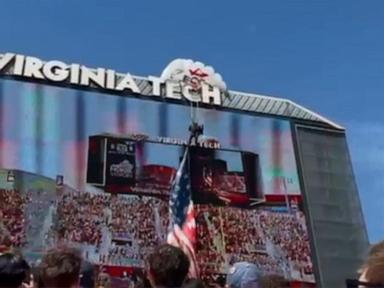
The collision of a professional skydiver with the North End Zone scoreboard at Lane Stadium during a Virginia Tech football pre-game ceremony represents a catastrophic breakdown in mission-critical safety parameters. While mainstream media focuses on the visual spectacle of a performer dangling from a Jumbotron, a rigorous analysis reveals a failure chain involving kinetic energy mismanagement, environmental navigation errors, and the rigid architectural constraints of modern athletic venues. This incident serves as a case study in the high-stakes intersection of precision aeronautics and urban infrastructure.
The Kinematics of Confined Space Landings
Aerial exhibitions in collegiate stadiums operate within a high-risk envelope defined by "The Box"—the physical volume of the stadium bowl. Unlike open-field landings, stadium environments introduce three specific variables that transform a standard descent into a high-precision maneuver. Learn more on a related issue: this related article.
- The Stadium Micro-Climate: The physical structure of a stadium bowl creates localized wind patterns, specifically rotors and "venturi effects." As wind hits the exterior walls of Lane Stadium, it is forced upward and over the rim, creating a pocket of turbulent, downward-moving air on the leeward side. A skydiver entering this zone experiences sudden loss of lift or unpredictable horizontal displacement.
- Kinetic Energy Dissipation: A high-performance ram-air parachute generates significant forward speed to maintain lift. In an open field, a skydiver uses a "flare" maneuver to convert that horizontal velocity into a momentary vertical lift, resulting in a zero-speed touchdown. Within a stadium, the available "runway" for this dissipation is constrained by seating charts, goalposts, and electronic displays.
- The Vertical Obstacle Density: Modern stadiums have increased their vertical footprint through massive video boards. These structures are not merely visual aids; they are fixed aeronautical hazards that shrink the safe landing corridor.
The Failure Chain Analysis
The Virginia Tech incident can be decomposed into a sequence of events where the margin for error was systematically eroded. Analyzing the footage and site layout suggests the operator was forced into a suboptimal flight path, likely due to an uncompensated wind gust or a late adjustment to avoid the crowd.
Phase 1: Navigation Error and Glide Path Deviation
The primary goal of a stadium jump is the "holding area," a designated point in space high above the field where the jumper assesses the final approach. If the jumper is pushed even ten feet off-axis during the final turn, the glide ratio—the distance traveled forward for every foot of descent—no longer aligns with the target center-field logo. In this instance, the jumper’s trajectory intersected with the scoreboard's vertical plane before the descent reached field level. Additional reporting by NPR delves into similar views on the subject.
Phase 2: The Impact Physics
The force of a skydiver hitting a stationary object is calculated by the formula $F = ma$, or more precisely in this context, the change in momentum:
$$\Delta p = m \Delta v$$
Given that a jumper and their gear weigh approximately 200 to 220 pounds and move at horizontal speeds of 20 to 30 miles per hour, the impact energy is substantial. The scoreboard at Lane Stadium is a rigid steel and LED structure with zero give. The jumper’s survival and lack of serious injury are attributed to the "canopy snag," where the parachute material absorbed the initial momentum by entangling with the scoreboard's framework, acting as a secondary deceleration system.
Phase 3: The Suspension Trap
Once the canopy entangled with the top of the scoreboard, the jumper became a pendulum. The tension on the suspension lines—made of high-strength materials like Spectra or Vectran—is designed to hold the weight of the jumper under several Gs of force. This strength, while necessary for flight, becomes a hazard during an entanglement, as it keeps the jumper suspended in a high-voltage, high-altitude environment, complicating extraction.
Infrastructure Vulnerabilities and Regulatory Gaps
Stadium displays are designed for visibility and wind resistance, not for impact attenuation. The North End Zone scoreboard at Virginia Tech is a massive vertical surface that acts as a sail. When a parachute—which is essentially another sail—comes into contact with it, the aerodynamics of the canopy are instantly neutralized.
The FAA and the United States Parachute Association (USPA) provide guidelines for "PRO" rated jumpers, who are the only individuals authorized to perform in these environments. However, these regulations often fail to account for the increasing complexity of stadium technology.
- RF Interference: Large LED displays and stadium-wide Wi-Fi networks emit electromagnetic signals that can, in rare cases, interfere with digital altimeters or GPS-guided navigation aids used by some advanced performers.
- Thermal Columns: The heat generated by thousands of spectators and massive electronics can create small localized thermals, rising air that can buoy a parachute and delay its descent, causing the jumper to overshoot the target.
The Logistics of Extraction
The rescue of a suspended jumper in a stadium setting presents a unique tactical challenge for local Fire and EMS teams. Standard ladder trucks are often unable to drive onto the reinforced turf of a football field due to weight constraints and the risk of damaging expensive drainage and heating systems located beneath the grass.
Extraction requires:
- High-Angle Rescue Teams: Specialists must climb the interior structure of the scoreboard to reach the jumper.
- Tension Management: Cutting the parachute lines prematurely would result in a freefall to the concrete or turf below. The jumper must be secured to the scoreboard structure before the parachute is detached.
- Medical Evaluation in Situ: The jumper must be assessed for "suspension trauma," a condition where blood pools in the legs due to hanging in a harness, which can lead to fainting or heart failure if not addressed immediately.
Structural Mitigation and Risk Management
To prevent a recurrence, organizations must move beyond "pilot error" as a catch-all explanation and look at the systems architecture of the event. Relying on the skill of the jumper is a single-point-of-failure strategy.
Dynamic Exclusion Zones
Event planners must establish "No-Fly" vertical cylinders around all stadium infrastructure. If a jumper’s telemetry indicates they have entered an exclusion zone, pre-planned abort maneuvers—such as an intentional "tree landing" style maneuver into empty seats—must be executed to avoid high-mass structures like scoreboards.
Environmental Monitoring Arrays
Relying on a single windsock at midfield is insufficient for a complex bowl environment. Deploying ultrasonic anemometers at the rim of the stadium provides the jumper with real-time data on the shear layers they will encounter during the final 200 feet of descent.
Material Interaction Studies
There is a lack of data regarding how modern parachute textiles interact with the composite materials used in stadium displays. Investigating "slick" coatings for scoreboards that might allow a canopy to slide off rather than snag could reduce the risk of suspension, though it increases the risk of a ground-impact injury.
Strategic Decision Framework for Aerial Exhibitions
The decision to include a stadium jump in a pre-game program should be governed by a weighted risk-reward matrix.
- Environmental Thresholds: Wind speeds exceeding 15 knots or gusts exceeding 5 knots over the mean should trigger an automatic scrub of the jump.
- Obstacle Clearance Ratios: A minimum 3:1 ratio of horizontal distance to vertical obstacle height must be maintained throughout the final approach.
- Emergency Egress Zones: At least 15% of the stadium seating must remain unoccupied to serve as "emergency runoff" areas for jumpers who lose the ability to reach the field.
The incident at Lane Stadium highlights that even with elite operators, the physics of a 200-pound object moving at 30 mph into a confined, high-obstacle environment is inherently volatile. Future exhibition planning must prioritize the engineering of the environment over the skill of the performer. The primary strategic move for athletic departments is to mandate a "hard-deck" altitude—if a jumper has not cleared the rim of the stadium with a stabilized glide path by a certain altitude, they must steer away from the bowl entirely, regardless of the crowd's expectations. Precision is not an option; it is the baseline for survival.