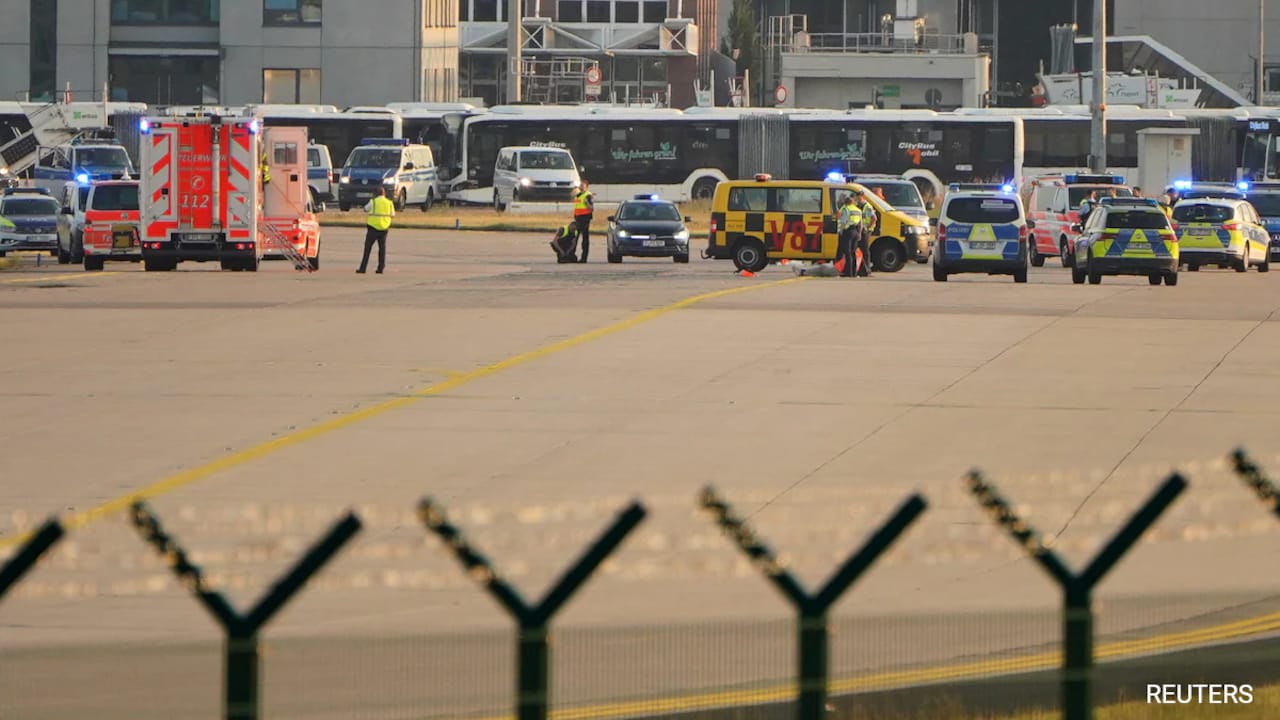
The recent incident involving a suspected drone attack attempt targeting German airport infrastructure attributed to Russian state actors highlights a fundamental vulnerability in modern transportation security architecture. Security analysts evaluating the event often isolate the tactical moment of detection, but this approach misdiagnoses the systemic failure. The primary security issue is not the presence of an unauthorized low-altitude aerial vehicle near a perimeter fence; it is the structural mismatch between legacy counter-unmanned aerial systems and the economic realities of asymmetric aerial incursions.
Evaluating this incident requires moving past political attribution and examining the mechanical, economic, and regulatory bottlenecks that prevent civil aviation authorities from neutralizing low-cost aerial threats. Civil airports operate under a commercial imperative that prioritizes passenger throughput, open spatial layouts, and continuous ground operations. Military-grade air defense assets, conversely, are optimized for high-velocity, high-altitude threats within restricted, controlled sectors. When a commercial airport attempts to map a defense strategy onto a civilian footprint, it encounters a multi-dimensional optimization problem where every defensive variable degrades operational efficiency.
The Economic Asymmetry of Aerial Incursions
The core challenge of defending civil aviation infrastructure against drone interference lies in cost disparity. A commercial-grade or modified consumer unmanned aerial vehicle can be procured and deployed for a fraction of the capital required to intercept it.
The Cost Function Discrepancy
- Offensive Deployment Cost: A standard long-range or programmable drone operates at an acquisition cost ranging from hundreds to a few thousand dollars, requiring minimal infrastructure and zero specialized personnel to launch near a perimeter.
- Defensive Interception Cost: Kinetic interception measures, electronic jamming suites, or high-powered microwave systems involve capital expenditures scaling into millions of dollars per installation, alongside recurring maintenance, calibration, and operational overhead.
- Economic Disruption Cost: Grounding operations at a major European hub like Frankfurt or Munich drains millions of dollars per hour in delayed flights, missed connections, diverted cargo, and cascading schedule resets.
This economic imbalance means an adversary does not need to achieve a kinetic impact to succeed. The mere threat of an incursion forces an immediate shutdown of airspace, achieving strategic disruption through economic attrition rather than physical destruction.
The Detection and Classification Bottleneck
Civil air traffic control radar systems are tuned to track large metal bodies moving at high velocities at significant altitudes. They utilize filtering algorithms designed to ignore ground clutter, birds, and small moving objects to prevent operator fatigue and false alarms.
Why Conventional Radar Fails
- Radar Cross Section Deficit: Consumer and commercial frames are frequently constructed from carbon fiber and plastic polymers, yielding a negligible radar cross-section that blends seamlessly into the ambient clutter of an urban or semi-urban transport hub.
- Altitude Masking: Low-altitude approaches exploit ground clutter interference, rendering standard airport surveillance radar blind to vehicles operating below a certain threshold altitude near perimeter fencing.
- Sensor Fusion Latency: Integrating acoustic sensors, radio frequency scanners, and optical cameras requires real-time data processing pipelines. In practice, the time required to detect, track, classify, and verify an unauthorized object often exceeds the time window available for defensive intervention.
When an unidentified signature appears on the periphery of an airport boundary, operators face a classification dilemma. Without high-fidelity telemetry, identifying whether an object is a localized hobbyist error, an authorized internal maintenance drone, or a hostile state-sponsored reconnaissance platform is nearly impossible within seconds.
The Regulatory and Jurisdictional Friction Matrix
Beyond technical limitations, the response to low-altitude aerial incursions is paralyzed by jurisdictional fragmentation. Civil airports operate under civil aviation laws, municipal police forces maintain local jurisdiction, and national intelligence or military bodies hold the mandate for foreign state-sponsored cyber-physical attacks.
[Incursion Detected] --> [Jurisdictional Hand-off Delay] --> [Delayed Authorization] --> [Operational Paralysis]
When a foreign actor initiates a probe against critical transport nodes, the bureaucratic latency of cross-agency communication routinely outpaces the speed of the tactical event. Local police lack the legal authorization and electronic warfare tools to jam military-grade or encrypted control frequencies. National military assets are restricted from operating inside civilian airspace due to constitutional prohibitions and safety protocols designed to prevent friendly-fire incidents involving passenger aircraft.
This friction creates a defensive vacuum. The entity responsible for facility security does not possess the tools to neutralize the threat, while the entity possessing the tools lacks the legal standing to engage within a civilian perimeter during peacetime or gray-zone conflict conditions.
The Countermeasure Trade-off Space
Deploying defensive architecture around civil aviation hubs forces a choice among three imperfect methodologies, each carrying severe operational externalities.
- Kinetic Neutralization: Utilizing physical projectiles or net-capture systems inside a civilian airport environment introduces catastrophic secondary risks. Uncontrolled debris falling onto active taxiways, aircraft engines, or crowded terminal areas presents a greater hazard than the original drone incursion.
- Electronic Countermeasures: Radio frequency jamming and GPS spoofing can sever the link between an operator and an autonomous or remote-piloted vehicle. However, these emissions frequently disrupt civilian navigation aids, instrument landing systems, and ground control communications, potentially blinding incoming commercial airliners.
- Directed Energy Systems: High-energy lasers or microwave emitters offer precise neutralization without falling debris, but their power requirements, thermal management systems, and line-of-sight limitations make continuous perimeter coverage financially and spatially prohibitive.
Strategic Realignment for Transport Infrastructure
Securing civil aviation against targeted state-backed disruptions requires abandoning the paradigm of absolute perimeter denial. Because the attack surface is vast and the economic cost of total fortification is unsustainable, security design must shift toward resilience and rapid absorption.
Airports must implement layered, passive architectural defenses that decouple ground operations from airside vulnerabilities. This includes deploying automated, sensor-agnostic classification grids that rely on edge-computed machine learning to eliminate human decision latency during the initial seconds of contact. Furthermore, legal frameworks must be updated to grant airport security operators pre-authorized defensive protocols, removing the multi-agency coordination delay that currently transforms minor security probes into systemic economic shocks.
The objective is not to prevent an adversary from flying an asset near a fence, but to minimize the operational downtime and eliminate the cascading economic leverage that transforms a low-cost drone into a high-value strategic weapon.


