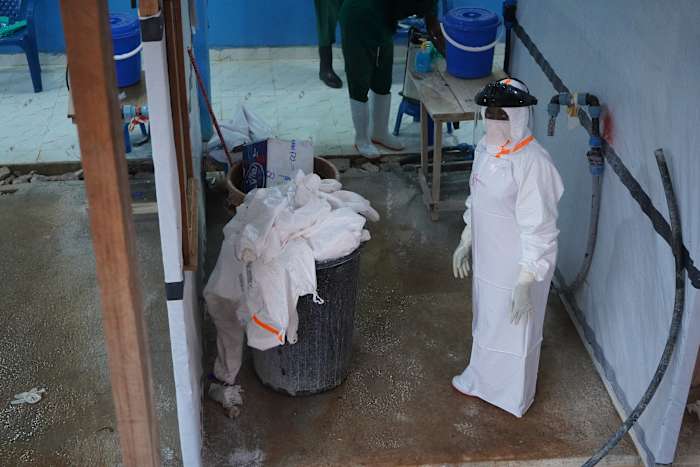
The rapid escalation of the Ebola outbreak in the eastern Democratic Republic of the Congo (DRC) to nearly 1,000 confirmed deaths highlights systemic vulnerabilities in regional epidemic response. Reaching over 2,400 confirmed cases in roughly two months, this surge represents the fastest documented expansion of the pathogen to date. Standard containment protocols, which rely heavily on early ring vaccination and centralized isolation, are failing to stop transmission across the affected provinces. Understanding why this outbreak outpaces previous events requires analyzing the biological profile of the specific strain, the structural mechanics of the local healthcare infrastructure, and the operational security constraints in eastern DRC.
The Three Determinants of Accelerating Spread
The rapid transmission velocity observed in the 2026 outbreak stems from three converging structural factors:
- Pathogen Lineage and Medical Countermeasure Deficits: The current outbreak is driven by the Bundibugyo virus strain. Unlike the Zaire ebolavirus strain—which can be counteracted using established vaccines like Ervebo and targeted monoclonal antibody therapies—the Bundibugyo strain lacks commercially available, regulatory-approved vaccines or specific therapeutic protocols. Medical intervention is currently restricted to supportive care, elevating the crude case fatality rate to approximately 39% and eliminating the containment advantage typically provided by targeted prophylactic rings.
- Population Displacement and Transit Corridors: Active conflict across Ituri and North Kivu has displaced large populations into high-density temporary camps. In these environments, basic sanitation infrastructure is scarce. High population mobility along informal mining and trade corridors continually introduces the virus into unmonitored communities, overwhelming traditional contact-tracing models.
- Institutional System Degradation: Public health delivery in eastern DRC suffers from severe resource exhaustion. Healthcare provider ratios sit at approximately 0.2 physicians per 1,000 residents. Frequent supply chain disruptions result in critical shortages of basic personal protective equipment (PPE), turning frontline medical facilities into vectors for nosocomial transmission rather than containment centers.
Structural Bottlenecks in the Surveillance Model
Traditional epidemiological containment assumes a static population, trusted local institutions, and clear physical access. Eastern DRC presents the inverse of all three conditions.
[Index Case Identified]
       │
       ├─► Security Barrier / Attack ──► Contact Tracing Suspended
       │
       ├─► Lack of Approved Vaccine ───► Ring Prophylaxis Ineffective
       │
       └─► High Population Mobility ───► Unmonitored Secondary Chains
In Ituri Province, which accounts for the vast majority of documented infections and fatalities, armed conflict directly interrupts surveillance cycles. When field teams experience security incidents or physical threats, contact tracing efforts halt. Unmonitored contact chains then spread undetected for multiple replication cycles before healthcare workers identify secondary clusters.
Community mistrust creates an additional operational bottleneck. Decades of instability have fostered skepticism toward centralized government initiatives and international aid organizations. Symptomatic individuals frequently avoid formal isolation facilities, choosing instead to remain within family units or seek care through informal networks. This behavior prolongs community exposure during the late, highly contagious stages of the disease, driving household transmission rates higher.
Epidemiological Dynamics: 2018 vs. 2026
Comparing the current crisis to the 2018–2020 North Kivu outbreak illustrates how pathogen variance and tool availability fundamentally alter transmission trajectories.
- 2018–2020 Outbreak (Zaire Ebolavirus): Reached 1,000 cases over approximately 235 days. The response deployed the rVSV-ZEBOV ring vaccination strategy alongside specialized monoclonal antibody therapeutics. Despite severe local conflict, healthcare workers managed to isolate transmission chains by immunizing over 300,000 contacts and potential exposed individuals.
- 2026 Outbreak (Bundibugyo Ebolavirus): Reached 1,000 cases within roughly 40 days. The absence of an approved vaccine or targeted therapeutic forces public health authorities to rely entirely on basic infection prevention, quarantine, and supportive fluid management. Deprived of biomedical shields, containment speed depends entirely on physical isolation efficiency—a metric consistently undermined by local security conditions.
Reallocating Capital and Field Operations
Containing high-velocity outbreaks driven by un-vaccinated strains requires shifting from reactive containment to localized structural fortification. Public health agencies and international donors must execute a threefold operational adjustment:
First, decentralize triage and treatment capabilities. Massive, centralized Ebola treatment centers present target vulnerabilities in active conflict zones and require patients to travel long distances through unsafe territory. Deploying smaller, modular isolation units directly into existing community health structures lowers the barrier to early self-reporting and reduces exposure duration within households.
Second, pivot contact tracing leadership to local community networks. External response teams often trigger institutional resistance. Training and compensating trusted neighborhood leaders, local faith figures, and resident community health workers to conduct symptom monitoring maintains surveillance continuity even when security conditions force international agencies to withdraw.
Third, fast-track emergency clinical trials for broad-spectrum antiviral compounds and candidate Bundibugyo vaccines. Relying indefinitely on non-pharmaceutical interventions in an active conflict zone guarantees recurrent, uncontrolled viral expansion. Establishing multi-site trial protocols directly within regional response frameworks provides the only sustainable path toward suppressing future outbreak cycles.