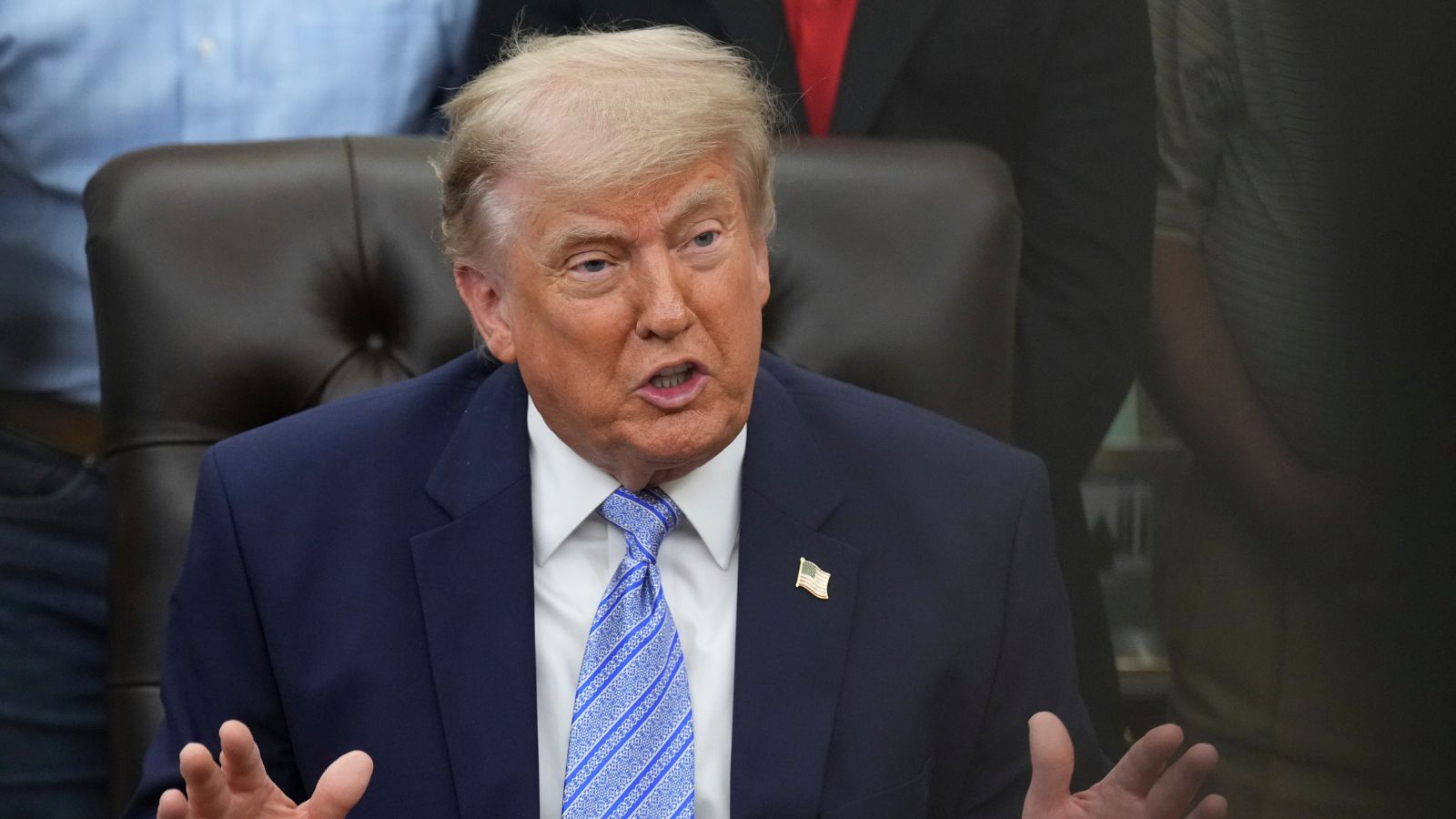
President Donald Trump’s recent declaration that birthright citizenship was intended strictly for the "babies of slaves" rather than the children of "Chinese billionaires" marks a significant shift in the administration's legal strategy. This rhetoric is not merely a political talking point. It serves as the ideological foundation for Executive Order 14160, a direct challenge to the Fourteenth Amendment currently awaiting a definitive ruling from the Supreme Court. By framing automatic citizenship as a Reconstruction-era remedy rather than a universal right, the administration is attempting to dismantle a century of established legal precedent.
The legal battle over jus soli—the right of the soil—has reached its absolute peak. While critics dismiss the president's historical narrative as an oversimplification, the administration’s legal team is using this specific interpretation to justify a fundamental narrowing of American citizenship.
The Historical Crucible of the Fourteenth Amendment
The administration’s argument relies heavily on the original intent of the Reconstruction Framers. When the Fourteenth Amendment was ratified in 1868, its primary, undeniable purpose was to overturn the infamous 1857 Dred Scott decision, which had declared that enslaved people and their descendants could never be citizens. By asserting that the amendment's text was meant exclusively to protect the children of formerly enslaved people, the administration seeks to isolate the law from modern immigration dynamics.
This argument intentionally overlooks the broader historical context of the late 19th century. The text of the amendment does not mention race, status, or historical servitude. Instead, it applies broadly to "all persons born or naturalized in the United States, and subject to the jurisdiction thereof."
The debate over who is "subject to the jurisdiction" of the United States is not new. In the decades following the Civil War, anti-immigrant factions used similar arguments to target Asian immigrants, claiming that children of Chinese nationals owed allegiance to a foreign emperor and were therefore excluded from the constitutional guarantee. That argument was tested, and it failed.
The Wong Kim Ark Precedent
In 1898, the Supreme Court delivered a landmark ruling in United States v. Wong Kim Ark.
   [14th Amendment Ratified: 1868]
                 │
                 ▼
   [Wong Kim Ark Ruling: 1898]
  (Affirmed citizenship for children
      of non-citizen residents)
                 │
                 ▼
   [Executive Order 14160: 2025]
  (Attempts to restrict citizenship
     based on parental legal status)
Wong Kim Ark was born in San Francisco to Chinese parents who were legally residing in the country but ineligible for naturalization under the Chinese Exclusion Act. When the federal government attempted to deny him re-entry to the United States after a trip abroad, arguing he was not a citizen, the Supreme Court ruled 6–2 in his favor.
The Court affirmed that the Fourteenth Amendment established a territorial standard for citizenship based on English common law. Unless a child was born to a foreign diplomat or an invading army, birth on American soil equated to automatic citizenship. For more than 125 years, this ruling has served as the bedrock of American immigration law.
The Operational Reality of Executive Order 14160
The administration’s current legal assault seeks to bypass the need for a constitutional amendment by reinterpreting the phrase "subject to the jurisdiction thereof." Under Executive Order 14160, the federal government would deny citizenship documentation to newborns if the mother is unlawfully present or holds a temporary visa, and the father is not a citizen or lawful permanent resident.
This policy would fundamentally alter the administrative mechanics of documenting American births.
| Current System | Proposed System Under EO 14160 |
|---|---|
| Birth Certificate acts as primary proof of citizenship. | Birth Certificate only proves place of birth, not legal status. |
| Automatic issuance of Social Security Numbers to newborns. | Parents must verify immigration status to secure a Social Security Number. |
| Minimal administrative burden on hospital networks. | Increased verification tracking for state and federal agencies. |
The operational friction would extend far beyond undocumented populations. Millions of high-skilled workers on temporary visas, such as H-1B holders, would find their children excluded from automatic citizenship. The burden of proof would shift entirely to parents, requiring them to present evidence of permanent residency or citizenship to federal agencies just to secure a Social Security card or passport for their child.
The Legal and Societal Fallout
The Supreme Court’s upcoming decision in Trump v. Barbara will determine the boundaries of executive authority over constitutional interpretation. During recent oral arguments, several justices expressed skepticism regarding the administration's narrow reading of the text. The core legal vulnerability lies in whether an executive order can override a century of judicial interpretation without a formal constitutional amendment, which requires a two-thirds vote in both houses of Congress and ratification by 38 states.
If the administration’s position is upheld, the societal consequences will be immediate.
Estimates suggest that ending birthright citizenship could deny status to over 250,000 infants annually. This would rapidly create a permanent, multi-generational underclass of individuals born on American soil who lack access to legal employment, voting rights, and basic social services. Rather than curbing immigration, the policy would systematically increase the undocumented population within the country's borders.
The administration’s focus on "birth tourism" and wealthy foreign nationals obscures the broader institutional impact. By tying citizenship directly to parental legal status, the United States would move away from its traditional territorial model of identity and adopt a system based on ancestry and lineage. The legal machinery required to enforce such a system would inevitably touch every family in the country, transforming birthright from an absolute guarantee into a bureaucratic determination.