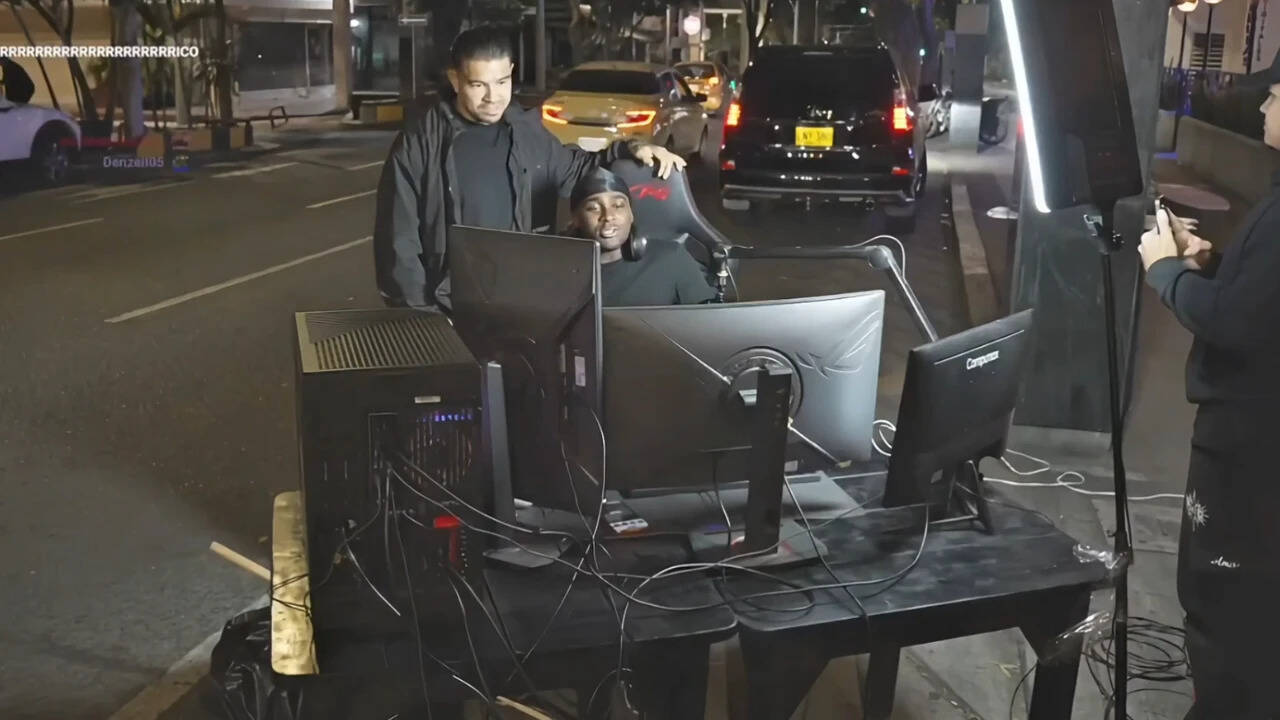
Broadcasting high-value computing hardware on a public street at night introduces an extreme operational vulnerability. When Kick streamer La Piquiña established an open-air desktop setup on a thoroughfare in Cali, Colombia, a helmeted motorcyclist rapidly closed the physical distance to the station. The subsequent intervention by private security personnel prevented a potential asset seizure or physical confrontation, yet public discourse fragmented into polarized debates regarding intent and environmental risk.
This incident exposes a fundamental design flaw in contemporary outdoor broadcasting: the collision between unvetted public exposure and high-value mobile capital. Analyzing this event requires stripping away subjective speculation about the rider's internal motives and instead examining the structural vectors that expose creators to predatory risk.
The Threat Architecture of Open-Air Broadcasts
Every public livestream operates within a hostile information environment defined by three distinct variables: broadcast latency, physical stationariness, and asset visibility. Traditional media production mitigates these variables through closed sets, controlled access points, and delayed feeds. The independent creator economy reverses these parameters by broadcasting real-time geographic data to a distributed audience while deploying portable high-net-worth assets directly into uncontrolled environments.
When a creator anchors a stationary desktop tower, monitors, and lighting rigs on a public sidewalk, they create a localized beacon of portable wealth. In urban environments globally, this configuration alters the local crime equation. The expected utility of theft spikes upward because the asset's location is broadcasted globally, its exact GPS coordinates are verifiable by anyone in proximity, and the target is structurally distracted by the performance demands of live audience interaction.
The presence of a motorcycle compounds this vulnerability through kinetic asymmetry. A motorcycle provides high-velocity ingress and immediate egress routes, bypassing standard urban foot-traffic bottlenecks. In traffic-dense or mixed-use corridors, a two-wheeled vehicle allows an actor to close a twenty-meter gap in under two seconds—a timeframe shorter than human neurological reaction loops paired with physical motor response.
Analyzing the Security Response Function
The efficacy of the intervention observed in the broadcast depends on proximity metrics and positioning discipline. Close protection in an unstructured public space fails if security details maintain a passive posture or suffer from visual occlusion. In this specific scenario, the security detail's survival and asset-protection success relied on immediate spatial compression.
The guard closed the distance because they maintained pre-established interior lines of drift around the workstation rather than remaining stationary behind the camera lens. This spatial management creates an outer warning perimeter and an inner hard defense zone.
However, relying on private kinetic security introduces secondary legal and operational liabilities:
- Escalation Hazard: Introducing armed personnel into a civilian crowd increases the statistical probability of lethal escalation over non-lethal property disputes.
- Jurisdictional Friction: Private security operators navigate complex local firearms regulations, creating potential criminal exposure for the creator and the guards if a weapon is discharged in a public municipal zone.
- Signaling Value: Visible security acts as a dual-purpose signal; it deters opportunistic actors while simultaneously advertising that the asset being protected holds high financial value, thereby attracting more sophisticated professional threats.
The Economics of Content Risk
Why do creators accept these survival odds? The answer lies in the algorithmic return on friction. Content platforms reward high-arousal, unpredictable scenarios. Controlled studio environments suppress the variance that drives audience retention and chat engagement. Danger functions as a synthetic multiplier for viewer numbers.
The economic model incentivizes creators to externalize safety costs onto physical reality. The marginal revenue generated by an outdoor night stream in an exotic or high-risk locale often outweighs the perceived short-term risk of confrontation. Creators calculate that the insurance of a private guard or the statistical rarity of a catastrophic event protects them. This calculation ignores tail-risk probability—the reality that low-frequency, high-severity events (such as armed robbery or physical trauma) completely wipe out cumulative earnings and operational viability.
Optimizing Broadcast Security Protocols
Mitigating the vulnerabilities exposed by street-level streaming requires replacing ad-hoc reactions with systematic hardening procedures. Creators operating in high-variance public spaces must transition from passive target configuration to active threat suppression architectures.
Deploy a mobile production rack housed in opaque, non-descript casing rather than glowing, high-end desktop configurations that telegraph asset value to passing vehicular traffic.
Enforce a strict two-minute geographic delay on all live transmissions when broadcasting from unvetted urban environments. Real-time data feeds allow local bad actors to use the stream itself as a surveillance viewfinder, matching digital video frames with physical street landmarks to intercept the creator.
Establish mandatory movement corridors with the security detail prior to going live, ensuring that ingress and egress routes for both personnel and equipment are cleared of blind spots and vehicular choke points. Eliminate stationary street-side setups entirely in municipalities lacking robust public infrastructure security, shifting instead to mobile, body-worn transmission units that eliminate the kinetic vulnerability of a fixed workstation.