The declassification of UAP (Unidentified Anomalous Phenomena) files by the Department of Defense represents a shift from reactive secrecy to a structured data-collection framework. This transition is not driven by a newfound commitment to public transparency, but by the operational necessity to resolve the persistent "domain awareness gap." When the Pentagon releases multi-decade imagery, it is executing a cold-start strategy for a comprehensive sensor-fusion network. The primary objective is to normalize the reporting of anomalies to distinguish between foreign adversarial surveillance—specifically low-observable drones and electronic warfare platforms—and truly unidentifiable aerodynamic signatures.
The Tripartite Framework of UAP Analysis
To understand the scope of the declassified materials, one must categorize the data into three distinct analytical pillars. These pillars define how the All-domain Anomaly Resolution Office (AARO) and its predecessors evaluate sensor data.
- Airborne Clutter and Sensor Artifacts: This category encompasses objects with low velocity and high reflectivity, such as weather balloons, research equipment, and commercial drones. It also includes "bokeh" effects and thermal glare in FLIR (Forward Looking Infrared) systems that create the illusion of anomalous movement.
- Adversarial Surveillance Platforms: High-priority data points that exhibit signatures of foreign intelligence gathering. These are characterized by sophisticated electronic signatures and flight paths that loiter over sensitive military installations or testing ranges.
- Trans-medium Anomalies: The smallest but most significant subset. These files contain data suggesting "propulsion without visible means" or "instantaneous acceleration" that exceeds the structural load limits of known materials science.
The Physics of Observation and the Data Bottleneck
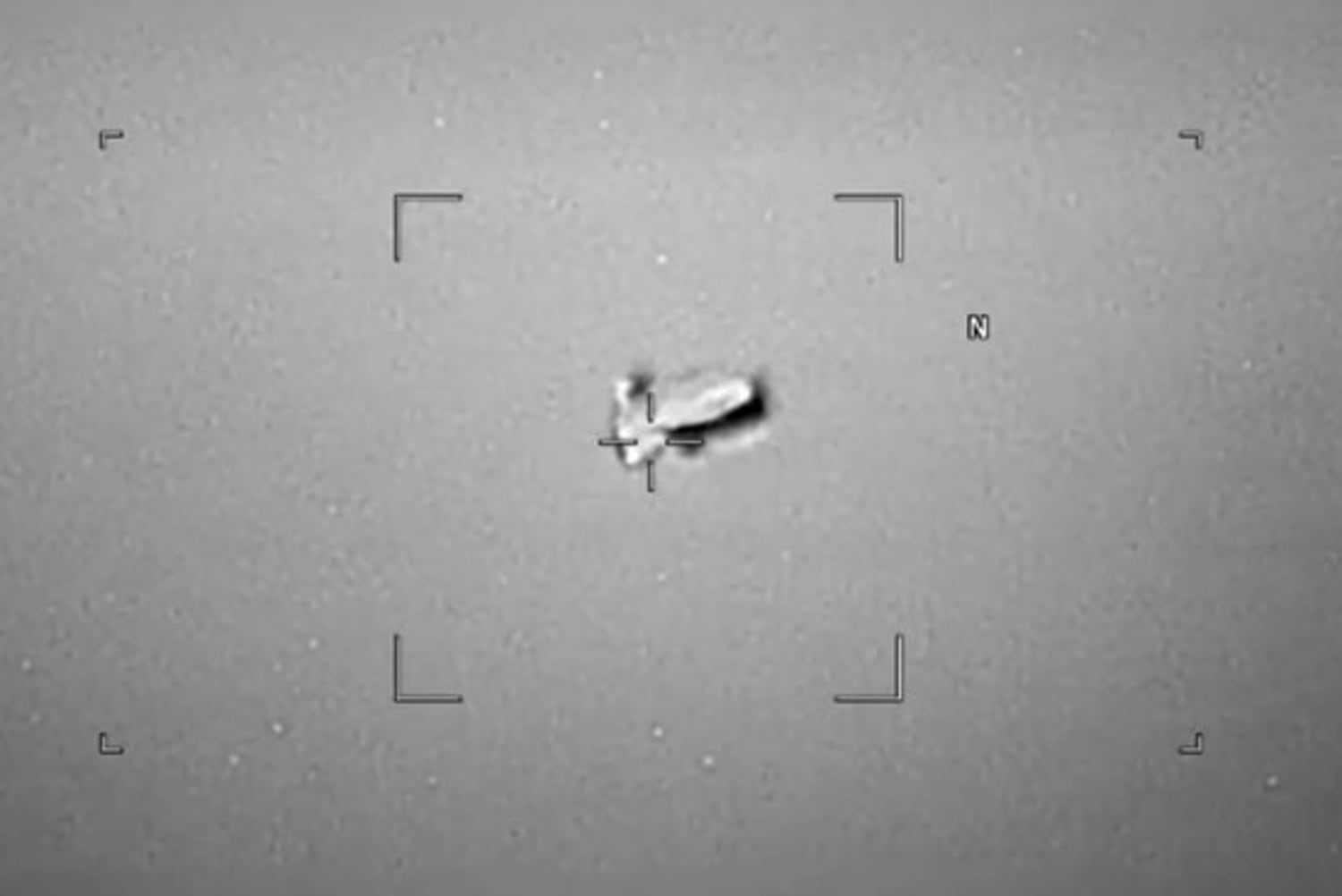
The declassified images often appear graining or low-resolution because they are captured at the edge of the sensor's effective range. The Pentagon’s reliance on the "kill chain" methodology means that most sensors are optimized for target acquisition and destruction, not scientific inquiry. This creates a fundamental bottleneck in UAP analysis: the instruments used to record these events are designed to track objects with known radar cross-sections (RCS) and infrared signatures.
When an object exhibits "low-observable" characteristics, the sensor's software often attempts to normalize the data, leading to the smearing or "pixel jitter" seen in the released footage. The challenge is not just the lack of high-definition video, but the lack of multi-modal corroboration. A single IR video without simultaneous phased-array radar data and SIGINT (Signals Intelligence) remains a low-confidence data point.
The declassification process serves to calibrate the public’s expectation of what "proof" looks like. By releasing legacy files, the Department of Defense is establishing a baseline of "known unknowns." This allows for the implementation of the UAP Reporting Standardization Act, which mandates that pilots and radar operators use a uniform taxonomy when describing anomalies. Without this taxonomy, the data is too noisy for machine learning algorithms to process at scale.
The Strategic Utility of Controlled Transparency
The timing and nature of these releases function as a signal-to-noise management tool. By declassifying older, less sensitive files, the government achieves several strategic outcomes:
- Destigmatization of Pilot Reporting: Historically, the career risk associated with reporting "UFOs" led to a massive underreporting of potential national security threats. By framing these events as "anomalous phenomena" rather than "extraterrestrial," the military encourages the reporting of high-altitude balloons and drones that might otherwise go unnoticed.
- Crowdsourcing Analytical Labor: Releasing raw data to the civilian scientific community offloads the preliminary filtering of non-anomalous events. Civil organizations can identify commercial flight paths or astronomical events that the military’s high-side analysts do not have the bandwidth to investigate.
- Adversarial Probing: If an adversary is using a new propulsion or cloaking technology, publicizing the military's inability to identify certain objects may lure the adversary into deploying the technology more frequently, providing more opportunities for high-fidelity data collection.
Mechanical Limitations of Current Detection Systems
The current U.S. sensor architecture is built upon a Cold War-era logic: identify large, fast-moving objects (ICBMs, fighter jets) or slow, predictable objects (ships). UAPs frequently fall into the "Goldilocks zone" of detection failure—objects moving too fast for traditional air traffic control radar but displaying a radar cross-section too small for ballistic missile early warning systems.
The declassified files highlight a specific technical failure: Clutter Rejection Logic. To prevent radar screens from being overwhelmed by birds or weather, systems are programmed to ignore objects that do not meet certain velocity or size thresholds. If a UAP moves at a high rate of speed but then stops abruptly and hovers, the radar software may "drop" the track, perceiving it as a glitch. The strategy moving forward involves updating the logic of the Integrated Battle Command System (IBCS) to retain these "low-confidence" tracks for later analysis.
The Economic Cost of Uncertainty
The lack of a centralized UAP database has resulted in significant "opportunity costs" for the defense budget. Millions of dollars are spent scrambling interceptors to identify objects that turn out to be harmless weather balloons. Conversely, the failure to identify a sophisticated adversarial drone represents a potential multi-billion dollar intelligence breach.
The declassification initiative is the first step in a Cost-Benefit Rebalancing. By creating a public-facing repository, the Pentagon reduces the administrative burden of Freedom of Information Act (FOIA) requests and redirects those resources toward active sensor integration.
Material Science Hypotheses and the Propulsion Gap
While the majority of declassified files can be attributed to conventional objects or sensor errors, the 2-5% that remain "unexplained" represent a radical departure from current aerospace engineering. Analysis of the flight trajectories in these files often suggests the bypass of inertia. In conventional physics, an object accelerating from 0 to Mach 5 in a fraction of a second would be obliterated by G-forces.
$$F = ma$$
To survive such acceleration, the object would either need to be unmanned and constructed of hypothetical high-tensile materials, or it would need to manipulate the local gravity field to ensure the interior of the craft remains in an inertial frame. The absence of heat signatures or sonic booms in several declassified videos suggests that these objects may be utilizing Magnetohydrodynamic (MHD) drive systems or other forms of field propulsion that do not rely on the expulsion of mass.
Institutional Resistance and the Silo Problem
The primary obstacle to a unified understanding of UAP data is the "Silo Effect" within the intelligence community. Data collected by the Navy (ONR) is often formatted differently than data from the Air Force (NASIC) or the Space Force. The declassification of these files is a forced synchronization event. It mandates that all branches of the military adopt the AARO-standardized metadata tags:
- Altitude (MSL/AGL)
- Velocity Vector (3D)
- Signature Type (RF, IR, Visual, Acoustic)
- Environmental Context (Proximity to nuclear assets, electromagnetic interference)
This standardization is the prerequisite for a functional Anomaly Detection Algorithm. Until the data is cleaned and unified, the declassified files serve primarily as a historical archive rather than a predictive tool.
Operational Recommendation for Future Analysis
The current trajectory of UAP declassification suggests that the government has moved from a "policy of denial" to a "policy of data collection." For analysts and researchers, the focus must shift from the provenance of these objects to their functional capabilities.
The strategic play is to integrate civilian "citizen science" sensor arrays with military-grade data to create a ubiquitous surveillance net. This requires the development of low-cost, high-frequency passive radar systems that can be deployed globally. By monitoring for the specific radio frequencies (RF) associated with the declassified events—often cited in the 1-3 GHz and 10-12 GHz ranges—researchers can trigger high-speed optical cameras to capture the high-resolution evidence that currently eludes military sensors.
The goal is no longer to ask "what are they," but to quantify the "performance envelope" of the phenomena. Once the physics are defined, the origin becomes a secondary, solvable variable. Institutional focus must remain on the development of real-time, multi-static sensor fusion to eliminate the domain awareness gap permanently.