The Strait of Hormuz functions as the singular most critical carotid artery of the global energy trade, where the intersection of geography and geopolitics creates a permanent state of high-stakes friction. When a coalition including the European Union, Japan, and Canada issues a joint statement regarding maritime security in this corridor, it is not merely a diplomatic gesture; it is a formal acknowledgment of a systemic vulnerability in the global supply chain. This vulnerability is defined by a binary state: the passage is either fluid, allowing for the transit of approximately 21 million barrels of oil per day, or it is contested, triggering an immediate and non-linear spike in global insurance premiums and energy spot prices.
The current security framework relies on a delicate equilibrium between regional sovereignty and international maritime law, specifically the United Nations Convention on the Law of the Sea (UNCLOS). The primary challenge lies in the "transit passage" regime, which allows vessels to move through the territorial waters of coastal states—in this case, Iran and Oman—provided the transit is continuous and expeditious. Any disruption to this regime constitutes a direct threat to the economic stability of net-energy-importing nations.
The Triad of Maritime Risk Metrics
To quantify the threat level within the Strait, analysts must move beyond headlines and examine the three specific variables that determine the operational safety of the waterway.
- Kinetic Interference Probability: This measures the likelihood of physical interdiction, including ship seizures, limpet mine attachments, or Unmanned Aerial Vehicle (UAV) strikes. The density of the traffic—with tankers often separated by only a few miles within the designated Shipping Separation Schemes (TSS)—makes them "fat targets" for asymmetric naval tactics.
- Insurance Risk Rating (The War Risk Surcharge): The London insurance market, specifically the Joint War Committee (JWC), maintains a list of areas where additional premiums are required. When the Strait is "listed," the cost of shipping a single VLCC (Very Large Crude Carrier) can increase by hundreds of thousands of dollars per voyage. This is a direct tax on the global consumer, internalized through the energy supply chain.
- The Shadow Fleet Factor: The proliferation of "dark" or "shadow" fleets—vessels operating with deactivated Automatic Identification Systems (AIS) and questionable P&I (Protection and Indemnity) insurance—creates a localized data blackout. This increases the risk of collisions and complicates the ability of international monitors to distinguish between legitimate commerce and sanctioned activity.
The Mechanistic Failure of Unilateral Security
The joint statement by European and G7 partners signals a shift away from reliance on any single hegemon to police the waters. Historically, the United States Fifth Fleet provided the "security umbrella," but the current strategic pivot toward the Indo-Pacific has created a perceived security vacuum. This vacuum is being filled by a modular, multilateral approach.
The European-led Maritime Awareness in the Strait of Hormuz (EMASoH) and its operational arm, Operation AGENOR, represent a de-escalatory model of presence. Unlike more aggressive carrier strike group deployments, these missions focus on "maritime domain awareness." The logic is that transparency acts as a deterrent; if every movement in the Strait is tracked and broadcasted in real-time, the political cost of interdiction rises for any actor seeking to disrupt traffic.
However, the limitation of this strategy is the "Escalation Ladder" problem. If a vessel is seized despite being monitored, a purely observational force has no mandate for kinetic intervention. This creates a strategic bottleneck where the coalition has the eyes to see a crisis but lacks the hands to stop it without triggering a wider regional conflict.
Economic Cascades of a 24-Hour Closure
A total blockage of the Strait of Hormuz is often discussed as a "black swan" event, but the mechanisms of its impact are entirely predictable. The global economy operates on just-in-time delivery for energy.
The first 12 hours of a closure would see the "Fear Premium" dominate the markets. Brent Crude futures would decouple from physical supply-demand fundamentals, driven by algorithmic trading responding to the news cycle. The second 24 hours would activate the Strategic Petroleum Reserves (SPR) of IEA member nations. While the SPR can mitigate physical shortages, it cannot suppress the psychological volatility of the market.
The long-term consequence of repeated instability in the Strait is the acceleration of the "Energy Bypass" infrastructure. Saudi Arabia’s East-West Pipeline and the Habshan–Fujairah pipeline in the UAE are the primary valves designed to circumvent the Strait. Yet, their combined capacity remains significantly lower than the total volume flowing through Hormuz. The math remains stubborn: there is currently no physical infrastructure capable of fully replacing the Strait’s throughput.
The Role of Asymmetric Technology in Maritime Denial
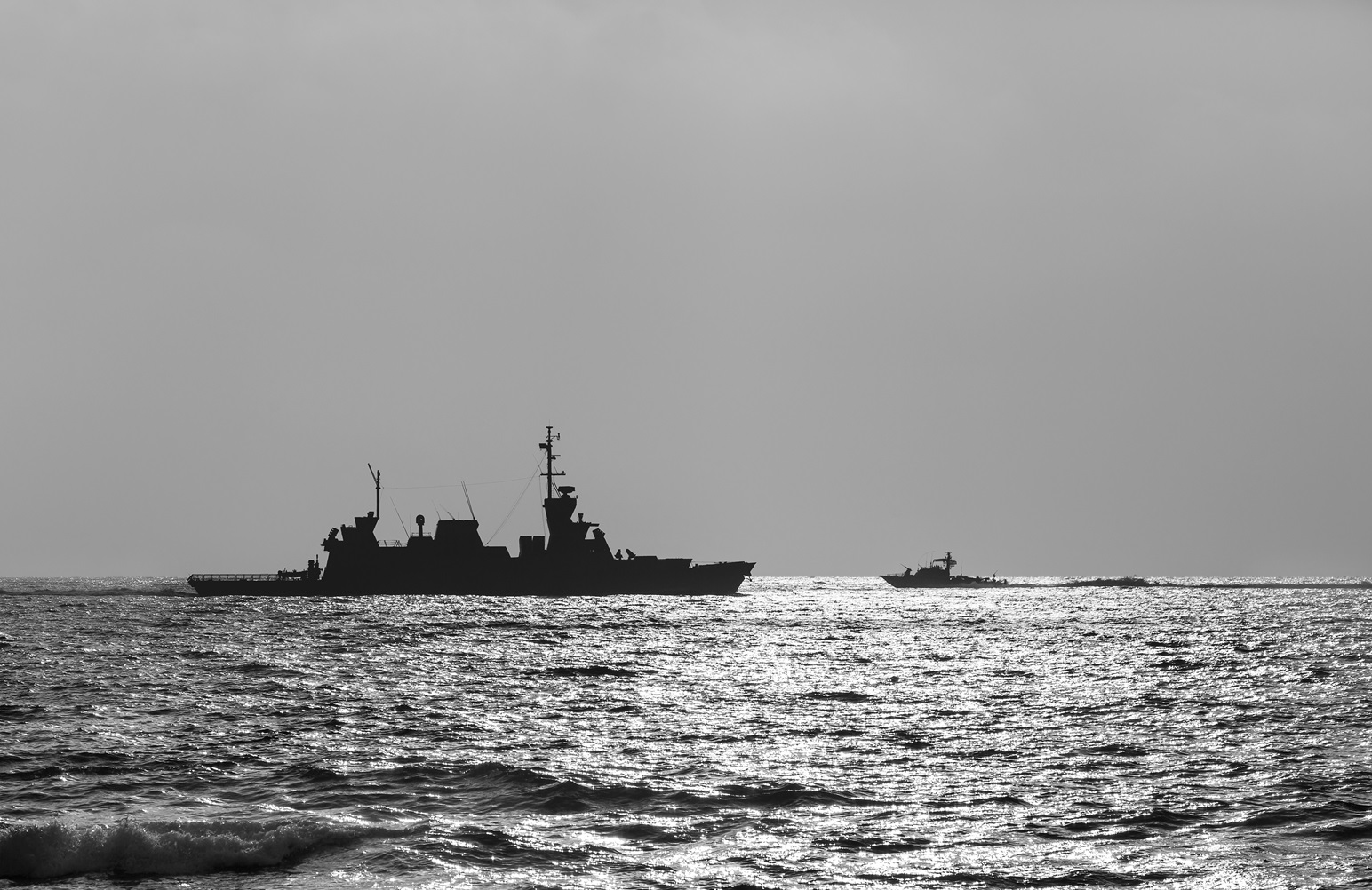
The shift in the Strait's security landscape is increasingly driven by low-cost, high-impact technology. The use of "swarm" tactics—small, fast-attack craft coordinated via encrypted mesh networks—presents a challenge to traditional blue-water navies. Large destroyers and frigates, designed for mid-ocean combat, are ill-equipped for the "littoral clutter" of the Strait.
Furthermore, the introduction of loitering munitions and anti-ship cruise missiles (ASCMs) positioned along the rugged coastline provides a "denial of access" capability that is difficult to neutralize without a full-scale land-and-air campaign. For nations like Japan and Canada, which rely on the predictability of these routes for their industrial bases, the technical sophistication of these threats necessitates a constant evolution in ship-borne electronic warfare and point-defense systems.
Strategic Divergence in Coalition Objectives
While the joint statement presents a unified front, the underlying strategic objectives of the participants often diverge.
- European Nations: Focus on regional stability and the preservation of the Joint Comprehensive Plan of Action (JCPOA) framework. Their presence is intended to be "neutral" and protective of the rule of law.
- Japan: Almost entirely dependent on Middle Eastern crude (over 90% of its imports). For Tokyo, the Strait is a matter of existential national security, leading to a unique "self-defense" naval presence that operates independently but in coordination with Western allies.
- Canada: While a net energy exporter, Canada’s interest lies in the stability of the global price of oil and the principle of "Freedom of Navigation," which governs its own Arctic and Atlantic interests.
These misaligned incentives mean that while the coalition can agree on the necessity of security, they often struggle to agree on the intensity of the response required when a provocation occurs.
The Fragility of the Shipping Separation Scheme
The physical reality of the Strait is a narrow corridor where the inbound and outbound lanes are each only two miles wide. These lanes are separated by a two-mile wide buffer zone. Navigational errors in this tight space, compounded by the presence of hundreds of small fishing vessels and regional dhows, create a "high-noise" environment.
In this environment, "Gray Zone" tactics thrive. A state actor can harass a commercial vessel or perform "unsafe maneuvers" while maintaining plausible deniability, attributing the incident to navigational confusion or the need to inspect a vessel for "environmental violations." This tactic forces the international community into a legalistic quagmire rather than a clear military confrontation.
Calculated Deterrence and Operational Resilience
The move toward joint statements and multi-national patrols is an attempt to create a "Global Commons" defense. By involving nations from North America, Europe, and Asia, the security of the Strait is rebranded from a "Western interest" to a "Global mandate." This raises the stakes for any disruptive actor, as an attack on a tanker is no longer a provocation against one nation, but an affront to a broad-based economic collective.
The future of Hormuz security lies in the deployment of persistent, autonomous surveillance. The integration of underwater UUVs (Unmanned Underwater Vehicles) to detect mines and high-altitude, long-endurance (HALE) drones to provide a 24/7 unblinking eye over the TSS will eventually replace the need for constant, high-cost destroyer patrols. This transition from "manned presence" to "autonomous persistence" will likely be the next phase of the maritime security strategy outlined by these nations.
To maintain operational continuity, maritime stakeholders must shift from a reactive posture to a predictive one. This requires the integration of real-time satellite telemetry, AI-driven anomaly detection in shipping patterns, and a solidified legal framework that defines exactly what constitutes "interference" in the modern age of hybrid warfare. The objective is to make the Strait of Hormuz so transparent that the shadows required for asymmetric disruption no longer exist.