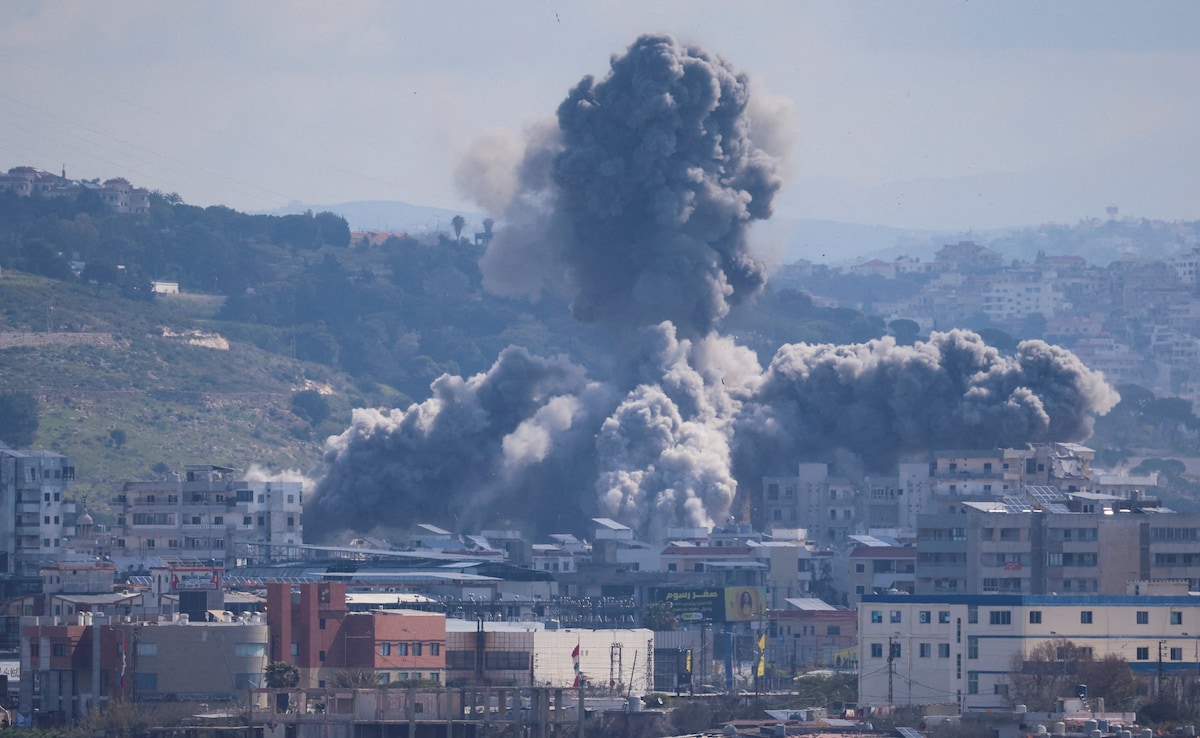
The announcement of renewed maritime and border negotiations between Lebanon and Israel in Washington serves as a critical stress test for the Mediterranean’s energy security architecture. While surface-level reporting focuses on the diplomatic scheduling, the underlying structural reality is a complex optimization problem involving gas extraction rights, sovereign debt pressures, and the physical demarcation of the Blue Line. The primary objective for both states is not merely the cessation of friction, but the mitigation of geological risk in the Levant Basin—a zone where delayed extraction represents a massive opportunity cost in the current global energy market.
The Geopolitical Cost Function
The resumption of talks is driven by a convergence of fiscal and kinetic pressures that make the status quo unsustainable for both parties. For Lebanon, the motivation is dictated by a collapsing currency and a desperate need for a sovereign credit signal. For Israel, the priority is the security of the Karish field and the expansion of its export capacity to European markets.
Three primary variables define the current negotiation matrix:
- The Hydrocarbon Extraction Timeline: The net present value of underwater gas reserves decreases every year that drilling is delayed by legal or military threats.
- Sovereign Credit Viability: Lebanon’s participation acts as a proxy for its willingness to engage with international financial institutions, a prerequisite for any future IMF-led recovery.
- Regional Deterrence Equilibrium: The negotiations exist in a delicate balance with the military capabilities of Hezbollah, which views the maritime border as a primary lever for domestic political influence.
Structural Constraints of the Line 23 vs. Line 29 Dispute
The technical core of the dispute rests on the interpretation of UNCLOS (United Nations Convention on the Law of the Sea) principles regarding the influence of uninhabited islands on maritime boundaries. The discrepancy between Lebanon’s official claim (Line 23) and the more aggressive maximalist claim (Line 29) creates a contested "triangle" of roughly 860 to 1,430 square kilometers.
The "Line 29" claim is based on the inclusion of the Karish field within Lebanese waters, a position that Israel rejects as a non-starter. The Washington talks will likely focus on a "Shared Resource Management" model or a "Profit-Sharing Mechanism" rather than a hard line that bisects potential reservoirs. Splitting a single gas field between two hostile states creates an engineering nightmare; pressurized reservoirs do not respect national borders. If one side pumps gas, it lowers the pressure—and thus the value—for the other. This physical reality forces a degree of cooperation that political rhetoric often masks.
The Washington Intermediary Mechanism
The transition of these talks to Washington signals a shift from technical military-to-military dialogue (previously held at the UNIFIL headquarters in Naqoura) to high-level strategic arbitration. The United States serves as the only actor capable of providing the necessary "Guarantor Premium"—a set of assurances that neither side will face domestic blowback for perceived concessions.
This mechanism operates through three distinct layers:
- The Technical Buffer: US energy envoys provide the geological mapping and seismic data interpretation that serves as the "neutral" truth for both delegations.
- The Sanction/Incentive Lever: For Lebanon, the incentive is the potential waiver of Caesar Act sanctions to allow for regional energy deals involving Egyptian gas and Jordanian electricity.
- Security Insulation: The US provides a backchannel to ensure that border skirmishes do not escalate during the diplomatic window, effectively de-linking maritime disputes from the broader Arab-Israeli conflict.
Economic Impediments and the Levant Basin Opportunity
The Levant Basin contains an estimated 122 trillion cubic feet of recoverable natural gas. However, the cost of extraction is heavily influenced by the "Risk Premium" assigned by international oil companies (IOCs). TotalEnergies, Eni, and Novatek (before its exit) have historically hesitated to commit massive capital expenditure to Block 9 while the legal status remains "contested."
The financial bottleneck is not the presence of gas, but the bankability of the projects. Without a signed border agreement, no major global bank will provide the project financing required for deep-water extraction. This creates a feedback loop where political intransigence leads to direct capital flight. The Washington talks are an attempt to break this loop by creating a "legal safe harbor" for IOCs to operate within.
Asymmetric Pressures: Lebanon’s Liquidity Crisis
Lebanon enters these negotiations from a position of profound economic asymmetry. The Lebanese Lira has lost over 95% of its value, and the central bank’s foreign exchange reserves are depleted. In this context, the maritime talks are less about the "sanctity of the border" and more about the "sanctity of the balance sheet."
The Lebanese government must navigate a "Two-Level Game" strategy:
- At the International Table: Securing enough of the Qana prospect to justify a long-term energy independence narrative.
- At the Domestic Table: Satisfying the various sectarian factions that view "sovereignty" as a non-negotiable asset, while simultaneously needing the influx of US dollars that an energy deal would eventually provide.
Failure to reach a consensus in Washington will result in a "Stranded Asset" scenario for Lebanon. While Israel has already begun extracting gas from fields like Leviathan and Tamar, Lebanon remains in the exploration phase. Every month of delay compounds the infrastructure gap between the two nations, further weakening Lebanon’s regional leverage.
The Security Dilemma and the Role of Non-State Actors
The presence of Hezbollah introduces a non-linear variable into the negotiation. While the Lebanese state delegates are in Washington, Hezbollah maintains a "Threat of Escalation" posture. This creates a paradox: Hezbollah’s threats may provide Lebanese negotiators with leverage (by signaling that they cannot concede too much), but they also increase the insurance costs and security risks that prevent the gas from ever being extracted.
The "Red Line" for this negotiation is the Karish field. If Israel begins production at Karish without a maritime agreement, the risk of a kinetic strike increases significantly. Conversely, if Lebanon attempts to block Karish legally or militarily without offering a viable alternative border, it risks further international isolation.
Strategic Play: The Path Toward De-escalation
The most probable outcome of the Washington session is not a final treaty, but a "Framework of Non-Interference." This would involve a tacit agreement where Israel proceeds with Karish while Lebanon is granted a clear, uncontested path to explore the Qana field, even if that field extends slightly into Israeli-claimed waters.
For the international community, the metric of success is not a perfect border line, but the establishment of a "Commercial Truce." This requires:
- Standardizing the seismic data used for demarcation.
- Establishing a third-party escrow or revenue-sharing model for cross-border reservoirs.
- Securing written guarantees from the US that energy infrastructure will be exempt from military targeting.
The window for this negotiation is narrow. As the global energy transition accelerates, the window for monetizing fossil fuels is closing. For Lebanon, the Washington talks represent the final opportunity to transform a geological hypothesis into a fiscal reality before the nation’s infrastructure and credit standing deteriorate beyond the point of recovery. The focus must remain on the physics of the reservoir and the mechanics of the market, rather than the symbolism of the map.
The strategic imperative for the Lebanese delegation is to decouple the maritime file from the broader regional geopolitics. By treating the border as a technical infrastructure problem rather than a nationalist zero-sum game, Lebanon can unlock the capital required to stabilize its internal collapse. Failure to do so will result in the total "sterilization" of its offshore assets, leaving billions of dollars of wealth permanently inaccessible beneath a contested seabed.



