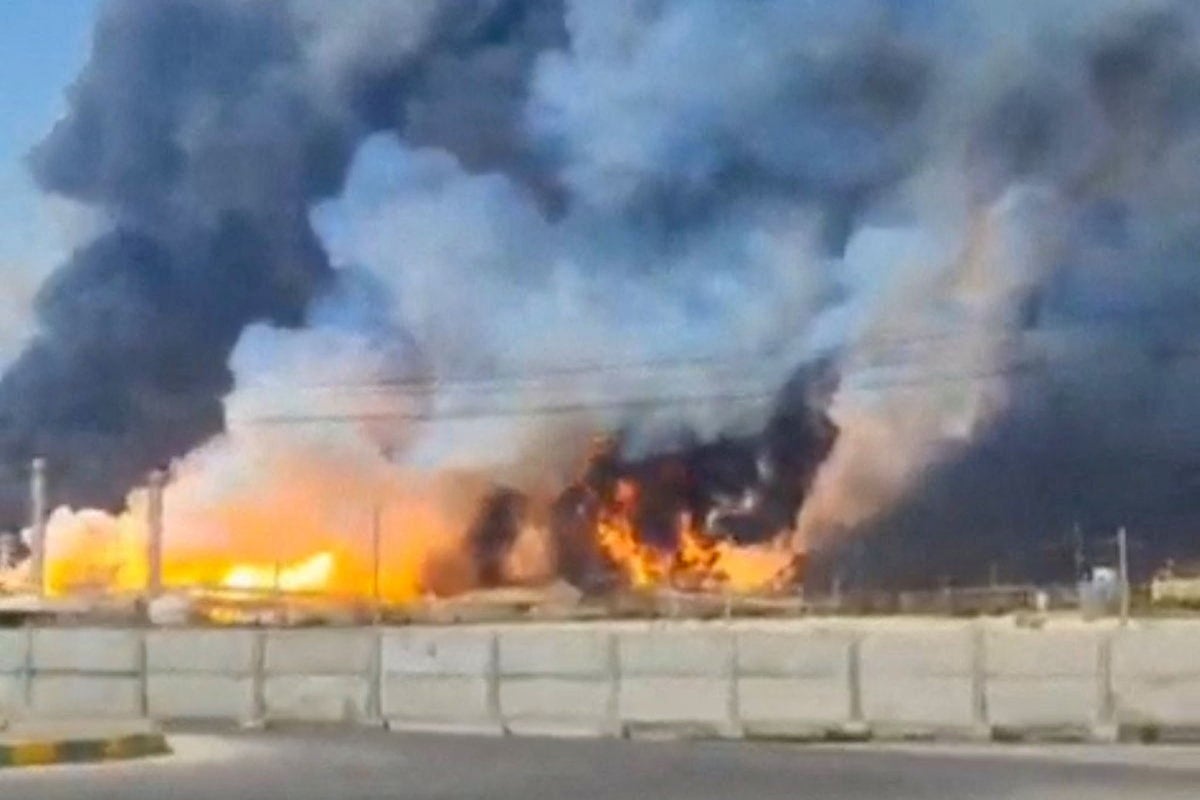
The assumption that degrading an adversary's energy infrastructure leads to immediate political concessions rests on a flawed understanding of authoritarian resilience and the physics of modern power grids. While the tactical execution of precision strikes on refineries or electrical distribution hubs is feasible with current IAF capabilities, the strategic outcome frequently mirrors the "Sievierodonetsk Effect"—where the aggressor achieves a localized technical victory at the cost of a long-term strategic deficit. In the context of a potential Israeli campaign against Iranian energy assets, the failure of the Russian "Special Military Operation" to collapse the Ukrainian will through power grid degradation provides a critical data set for understanding why this specific vector of warfare often yields diminishing returns.
The Triad of Infrastructure Vulnerability
To quantify the risk of an infrastructure-led campaign, we must first categorize the Iranian energy complex into three distinct operational layers. Each layer presents a different cost-to-benefit ratio and a different recovery timeline.
- The Generation Layer: This includes thermal power plants and hydroelectric dams. These are high-value, static targets. However, they are also the most resilient to permanent decommissioning due to redundant turbine systems and the ability to reroute load across a national synchronized grid.
- The Midstream Processing Layer: Refineries and petrochemical plants. These are the "chokepoints" of the Iranian economy. Unlike power plants, refineries involve highly volatile chemical processes; a single kinetic strike can trigger a chain reaction that destroys specialized catalytic cracking units which take years to replace due to sanctions.
- The Export Layer: Terminals like Kharg Island. This is the primary source of hard currency. While destroying these assets cripples the state's budget, it also removes the "Golden Bridge"—the incentive for the adversary to remain within the bounds of conventional escalation.
The Elasticity of Authoritarian Control
The logic of copying the Russian "Energy Terror" model ignores the fundamental difference in how domestic populations react to systemic deprivation. In a liberal democracy, infrastructure failure leads to intense political pressure on the leadership to negotiate. In an ideological autocracy, infrastructure failure is leveraged as a tool for total social mobilization.
When the lights go out in Tehran, the IRGC does not face a voter revolt; instead, it gains a pretext for implementing "War Economy" protocols. This involves the rationing of resources, the nationalization of remaining private assets, and the redirection of all available energy to the security apparatus. The civilian population bears the cost, but the kinetic capacity of the military—which operates on independent, hardened micro-grids and strategic fuel reserves—remains largely unaffected. The result is a paradox: the more the civilian economy is degraded, the more the state's grip on the remaining resources tightens.
The Physics of the Grid vs. The Logic of the Missile
Modern electrical grids are designed with N-1 or N-2 redundancy, meaning they can lose one or two major components without a total system collapse. To effectively "copy" a tactic of systemic degradation, the attacker must achieve a rate of destruction that exceeds the defender’s rate of repair.
- The Repair Variable: Iran possesses a robust domestic engineering sector capable of "cannibalizing" older plants to keep primary hubs online.
- The Distribution Variable: High-voltage transformers are the most vulnerable link. They are difficult to manufacture and heavy to transport. However, if the goal is to force a change in regime behavior, destroying transformers only creates a localized blackout, not a centralized state failure.
The mathematical reality of a "backfire" occurs when the cost of the munitions used exceeds the economic damage dealt, or when the damage dealt triggers a response in a different domain (asymmetric retaliation) that the attacker is unprepared to defend.
Strategic Displacement and the "Oil Weapon" Reborn
Targeting Iran’s energy system risks a phenomenon known as Strategic Displacement. If Iran can no longer export oil or generate domestic power, it has no further incentive to protect the global energy flow through the Strait of Hormuz.
The Iranian response function is likely to follow a three-stage escalation ladder:
- Stage 1: Proxy Symmetrization. Hezbollah and the Houthis are directed to target Israeli energy interests, specifically the Leviathan and Tamar gas rigs. This creates a "Mutual Assured Destruction" (MAD) scenario for energy.
- Stage 2: Regional Contagion. Sabotage operations against Saudi (Aramco) or Emirati infrastructure to force international pressure on Israel. By making the world feel the "heat" of the strike, Iran globalizes a local conflict.
- Stage 3: Total Denial. The mining of the Strait of Hormuz.
The "backfire" referenced in tactical circles is not just a military failure; it is an economic one. A strike that removes 2 million barrels of Iranian oil from the market, followed by a disruption in the Strait that removes another 20 million, would result in a global price shock. For a country like Israel, which relies on international diplomatic and financial support, triggering a global recession is a high-risk strategic move that could lead to immediate isolation.
The Cognitive Dissonance of Parallelism
The comparison between Netanyahu and Putin fails at the level of objective-setting. Putin’s strikes on Ukraine were intended to force a "freeze" in the conflict by making the territory uninhabitable during winter. Israel’s objective with Iran is the permanent degradation of a nuclear-threshold state’s ability to fund its proxies.
However, the "Energy Vector" is an inefficient tool for this specific objective.
- Funding is Fungible: Even with a 50% drop in energy revenue, a state will prioritize its shadow budget for proxy warfare over civilian welfare.
- Hardening of Resolve: Kinetic strikes on "National Pride" assets (like the oil industry) often unify fractured domestic populations against an external aggressor, delaying the internal political collapse that many analysts predict.
The Attrition Calculus
If the goal is to neutralize the Iranian threat, the data suggests that kinetic strikes on energy systems are a suboptimal use of precision-guided munitions (PGMs).
$$C_a > (D_t \cdot R_f)$$
Where:
- $C_a$ is the total cost of the attack (munitions, fuel, diplomatic capital, and retaliatory damage).
- $D_t$ is the technical damage to the grid.
- $R_f$ is the resilience factor of the regime.
When the resilience factor $R_f$ is high, the total cost of the attack will almost always outweigh the tactical gain. The Israeli defense establishment must account for the "Reconstitution Rate"—the speed at which an adversary can bypass a damaged node. In the 2024-2025 conflict cycles, we have seen that non-state and quasi-state actors have become experts in "Distributed Logistics," moving away from centralized dependencies that can be easily targeted.
Strategic Pivot: Moving Beyond Kinetic Infrastructure Destruction
The focus should shift from Total Destruction to Functional Paralysis. Instead of "bombing" the energy system—a move that invites environmental disaster and international condemnation—the more effective strategic play is the disruption of the "Control Plane."
Modern energy systems are managed via SCADA (Supervisory Control and Data Acquisition) systems. A kinetic strike is a permanent, loud, and escalatory act. A cyber-physical disruption of the SCADA systems that manage the balance of the grid achieves the same functional result—blackouts and industrial stoppage—without the "Backfire" of a massive environmental spill or the visual of "Terror Bombing" that Putin has become associated with.
The most effective strategy is not the replication of failed Russian tactics, but the exploitation of the "Complexity Gap." Iran’s energy grid is an aging, complex system held together by patchwork repairs. It is more vulnerable to a "Systemic Shock" (forcing a frequency imbalance that causes generators to trip automatically) than to a "Physical Attrition" campaign.
The final strategic move for a regional power is to ensure that any strike on an adversary’s energy infrastructure is accompanied by a secondary "De-escalation Off-ramp." If you destroy the enemy's ability to provide for its people, you must be prepared to occupy that space or face a "Permanently Failed State" on your doorstep, which is a far more dangerous neighbor than a functional, albeit hostile, one. The move is to target the refinery capacity—the economic engine—while leaving the civilian distribution grid intact. This isolates the regime’s wallet from the people’s light bulbs, maintaining a wedge between the state and the populace.