Long-range kinetic strikes targeting deep industrial nodes over seven hundred miles from international borders represent a fundamental shift in attrition warfare. The recent coordinated drone barrage hitting the Russian republic of Tatarstan—specifically the industrial manufacturing and refining hub of Nizhnekamsk—forces a structural re-evaluation of how asymmetric actors impose costs on centralized state economies. Rather than viewing these events through isolated tactical lenses, military and economic analysts must deconstruct the mechanics of strategic reach, supply chain vulnerabilities, and the geometric expansion of defense expenditure required to protect vast territorial zones.
The Three Pillars of Strategic Attrition
The campaign targeting Russian petroleum infrastructure operates on three distinct economic and operational vectors. Each vector compounds systemic stress within the adversary's resource allocation model.
Refining Capacity Compression
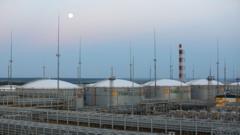
By systematically striking high-complexity distillation units, alkylation units, and petrochemical processing plants such as the Taneco facility in Nizhnekamsk, long-range drone operators bypass frontline tactical stalemates. Modern refineries are not easily replaceable modular units; they rely on specialized Western and proprietary catalytic technology, heavy engineering components, and unbroken supply chains. Removing fractional capacity forces domestic fuel redistribution, creates localized deficits, and spikes wholesale energy prices internally.
Territorial Defense Disproportion
Protecting a landmass spanning multiple time zones creates an impossible mathematical equation for air defense networks. Systems such as surface-to-air missile batteries and electronic warfare countermeasures are finite resources. Concentrating air defense around metropolitan centers or frontline combat zones leaves critical deep-interior infrastructure exposed. Conversely, distributing air defense assets across thousands of industrial facilities thwarts tactical concentration, depletes high-cost interceptor missiles against low-cost airframes, and creates systemic vulnerabilities elsewhere.
Psychological and Political Friction
When kinetic impacts register hundreds of miles inside recognized sovereign territory, the psychological buffer enjoyed by the domestic populace dissolves. The cost of conflict transitions from an abstract geopolitical projection on a distant front line to an immediate, local infrastructural hazard. This shifts public risk perception, complicates insurance and logistics underwriting for domestic commerce, and forces state leadership to expend political capital managing civilian panic and industrial downtime.
The Cost Function of Long-Range Interception
Evaluating the efficiency of deep strikes requires analyzing the raw cost asymmetry between offensive delivery systems and defensive countermeasures. A long-range, autonomous or semi-autonomous fixed-wing drone manufactured with commercial-off-the-shelf components represents a minor financial investment compared to the sophisticated, multi-million-dollar interceptor missiles required to neutralize it mid-flight.
When regional authorities in Tatarstan report hundreds of incoming vectors intercepted alongside successful structural impacts, the economic drain on the defender is staggering. Even a high interception percentage translates into structural attrition over time. The defender must maintain a 100% success rate to prevent cumulative infrastructural degradation, whereas the attacker requires only a fractional penetration rate to achieve strategic disruption. This dynamic creates an unsustainable fiscal burn rate for the defending state's military-industrial complex.
The Industrial Ripple Effect
The integration of remote industrial nodes into national supply chains means that localized kinetic impacts generate compounding systemic failures. When facilities like the petrochemical complexes in Nizhnekamsk experience forced shutdowns or severe operational scaling, downstream manufacturing sectors face immediate input bottlenecks.
Synthetic rubber, plastics, base chemical precursors, and refined diesel produced in these central Russian hubs feed thousands of secondary manufacturing and agricultural operations. Disrupting these hubs cascades through commercial lending markets, forcing central banks to intervene with emergency debt restructuring for dependent enterprises. The structural vulnerability lies in centralized hyper-specialization; modern industrial economies optimize for efficiency over redundancy, making them brittle when major nodes are systematically compromised.
Operational Constraints and Strategic Limitations
Deploying long-range unmanned systems across distances exceeding one thousand kilometers introduces severe technical frictions that limit operational efficacy. Navigation systems must operate reliably in heavily electronically jammed environments, relying on terrain-matching, inertial guidance, or machine-vision algorithms rather than standard satellite positioning.
Payload capacity remains constrained by fuel weight requirements. A smaller payload necessitates extreme precision; hitting the perimeter fence of an industrial zone yields negligible strategic value compared to penetrating a specific fluid catalytic cracking unit. Furthermore, collateral damage resulting from targeting errors or defensive interception debris over civilian areas introduces severe reputational and legal complexities, altering the domestic and international narrative surrounding the proportionality of the campaign.
Reallocate air defense interceptor manufacturing lines away from mass-production models toward localized, directed-energy and high-density electronic suppression networks specifically calibrated to neutralize low-signature, long-range autonomous airframes before they reach deep-interior industrial perimeters.
:max_bytes(150000):strip_icc()/ar-American-Cheese-taste-test-horizon-4x3-54cc339550cd44b9a818c17bdfd5428d.jpg)