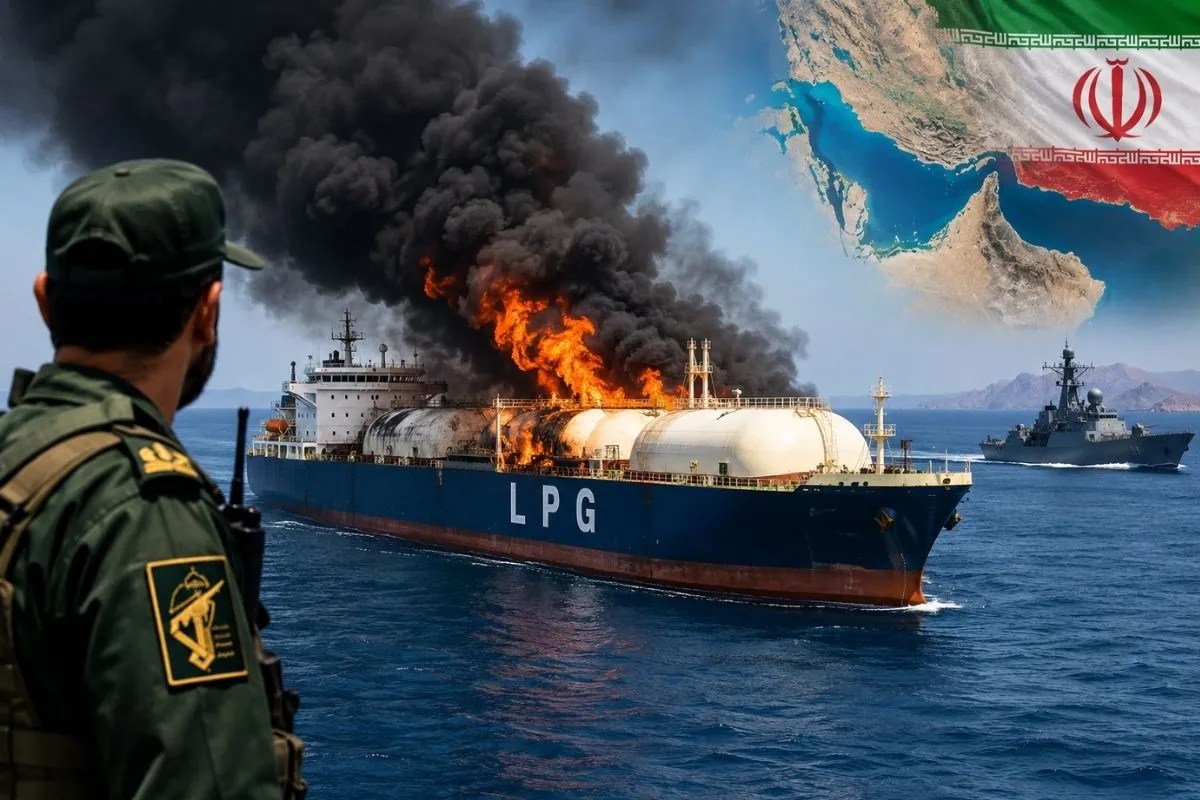
Every time a headline blares about an LPG tanker intercept or a warning shot in the Persian Gulf, the commentariat loses its collective mind. Tehran drops a fiery quote about obeying regional rules or facing severe consequences, and desk-bound analysts instantly dust off their doomsday templates. Energy traders panic-buy futures. Pundits scream about a global chokehold on liquefied petroleum gas.
It is all smoke, mirrors, and predictable geopolitical theater.
The lazy consensus claims that the Islamic Revolutionary Guard Corps controls a razor-thin dagger hovering over the global economy, capable of turning off the taps at whim. That narrative treats the Strait of Hormuz like a tollbooth operated by aggressive bouncers who can shut down international commerce whenever they feel aggrieved.
The reality on the water is far more mundane, highly regulated, and constrained by mutual self-interest than the screaming chyrons suggest.
The Economics Of Mutual Destruction
Let us look at the fundamental mechanics of energy transit. When an IRGC speed-boat approaches a commercial vessel, it is executing a ritual that has played out for decades. It is posturing designed for domestic consumption and strategic deterrence, not an invitation to World War III.
Why? Because Tehran relies on the very same maritime corridor to export its own hydrocarbons, primarily to Asian buyers who do not care about Western sanctions rhetoric as long as the discount is deep enough. If the regime actually closes the strait, it cuts its own financial throat within seventy-two hours. Foreign currency reserves dry up. Internal unrest spikes. The regime survives precisely because oil and gas keep moving, even if the margins are squeezed through shadow fleets and illicit ship-to-ship transfers.
I have spent years watching energy desks overreact to every localized skirmish in the Gulf. Traders blow millions chasing ghosts because they confuse tactical harassment with strategic disruption. The physical geography of the waterway dictates reality: maritime traffic is narrow, yes, but it is heavily monitored by naval assets from multiple global powers who maintain a quiet, grinding equilibrium. Nobody wants a shooting war in a bathtub filled with explosive cargo.
Dismantling The Chokepoint Myth
People ask how the world can survive if Hormuz is blocked for an extended period. The premise itself is flawed because it assumes a static global supply chain incapable of routing around bottlenecks.
It treats shipping lanes like fixed railway tracks rather than dynamic networks. When friction spikes in the Persian Gulf, insurance premiums jump, freight rates adjust, and alternative pipelines like the Habshan-Fujairah pipeline in the United Arab Emirates or Saudi Arabia’s East-West pipeline absorb the shock. These overland bypasses were built precisely to minimize the leverage that any single littoral state holds over export volumes.
Furthermore, let us define what an LPG tanker incident actually represents in maritime law. Under the United Nations Convention on the Law of the Sea, innocent passage grants vessels the right to navigate territorial waters subject to specific coastal state regulations. When regional forces board or query a vessel, they are usually enforcing customs queries, combating fuel smuggling, or pushing back against foreign naval presence. It is heavy-handed policing, not an existential maritime blockade.
Conflating routine maritime friction with an impending global energy collapse is lazy analysis. It sells clicks, but it blinds decision-makers to actual market dynamics.
The Real Vulnerability Nobody Talks About
While desk analysts obsess over physical tankers getting buzzed by fast attack craft, the real vulnerability in global energy infrastructure happens thousands of miles away from the Persian Gulf, deep inside cyber networks and financial clearing houses.
A physical interdiction of an LPG carrier is loud, visible, and easily managed by maritime insurance markets. A sophisticated cyber strike against port terminal logistics software or digital bunkering platforms causes exponentially more disruption than a dozen armed speedboats firing warning shots across a bow. Yet, the media circus remains fixated on men with machine guns on rubber dinghies because drama plays better on television than server downtime.
If you are running an energy portfolio or managing supply chain risk, stop reacting to the sound and fury coming out of state media outlets in Tehran. Look past the posturing. Look at the flow of physical molecules, the pricing of insurance risk pools, and the quiet expansion of overland pipeline capacities.
The next time an incident makes international front pages, remember that the actors involved have too much to lose by escalating past the threshold of noise. Stop trading the headlines and start trading the balance sheet.