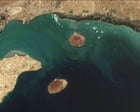
Geopolitical stability in maritime energy corridors depends entirely on the asymmetry between offensive cost functions and defensive protection expenses. When United States forces executed a precision strike against two Islamic Revolutionary Guard Corps rocket and mine-laying launchers on Larak Island, the action represented far more than a tactical exchange in the Persian Gulf. It exposed the structural vulnerability of global crude transit channels to localized, low-cost denial capabilities. Understanding why this specific strike occurred requires analyzing the economic friction of the Strait of Hormuz, the operational doctrine of asymmetrical naval denial, and the escalatory math governing modern maritime chokepoints.
The Geography of Maritime Denial
Larak Island occupies a dominant geographic vector within the Strait of Hormuz. Positioned just south of Qeshm Island and southeast of Bandar Abbas, Larak sits directly adjacent to the primary shipping lanes through which a significant percentage of globally traded petroleum flows daily. This geographic reality transforms small islands and coastal outposts into natural force multipliers for littoral states.
The operational utility of Larak Island stems from three distinct physical characteristics:
- Proximity to the Traffic Separation Scheme where inbound and outbound supertankers must navigate narrow, deep-water channels.
- Elevation profiles that provide line-of-sight tracking and radar advantages over commercial surface traffic.
- Dispersed terrain features that allow mobile missile launchers and sea-mine deployment units to blend into civilian or dual-use infrastructure before executing pop-up attacks.
When military planners evaluate maritime security in this theatre, they measure success through throughput capacity. The strategic objective of Iran's Islamic Revolutionary Guard Corps is not necessarily to sink an entire commercial fleet, but to raise insurance premiums, charter rates, and perceived operational risk to intolerable levels. By positioning launchers on Larak Island, operators create an immediate shadow of uncertainty that forces shipping companies to weigh the financial penalty of halted voyages against the catastrophic risk of hull penetration by anti-ship missiles or contact mines.
The Cost Function of Chokepoint Interdiction
To evaluate the strategic weight of the Larak Island strike, one must examine the cost asymmetry driving naval security in the Persian Gulf. Launching mobile surface-to-surface rockets or deploying maritime mines requires minimal capital expenditure compared to the replacement value of a single liquefied natural gas carrier or very large crude carrier.
The economic equation breaks down across three core variables:
- Marginal Attack Cost: The minor expense of propellant, guidance systems, and mobile launcher positioning used by littoral forces.
- Interception Expenditure: The high financial cost expended by naval defense forces firing sophisticated surface-to-air or point-defense interceptors to neutralize incoming projectiles.
- Systemic Economic Disruption: The exponential spikes in global energy futures triggered by even minor bottlenecks in maritime traffic flow.
When intelligence indicators show units preparing rockets and sea mines—as was detected prior to the Larak Island engagement—defending forces face a compressed decision window. Allowing the munitions to enter the water column forces a transition from proactive prevention to reactive hunt-and-clear operations. Clearing sea mines in a high-threat, narrow strait is notoriously slow and resource-intensive, multiplying the friction on global supply chains. Consequently, preemptive kinetic neutralization becomes the only mathematically viable strategy to preserve maritime freedom of navigation, despite the inherent risk of immediate political escalation.
The Escalation Feedback Loop
Every kinetic action within the Strait of Hormuz triggers immediate retaliatory calculus across regional networks. Following the American strike on Larak Island, secondary reactions materialized rapidly through proxy channels and regional missile exchanges, demonstrating how localized tactical events propagate across broader security architectures.
This dynamic forms a closed-loop feedback system:
- Intelligence surveillance detects pre-launch signatures or mine-staging activities on strategic islands.
- Command structures authorize preemptive kinetic strikes to protect commercial transit corridors.
- Adversarial forces enact retaliatory measures against regional military installations or allied infrastructure to reestablish deterrence.
- Insurance underwriters adjust risk premiums upward, altering global trade economics regardless of actual physical damage sustained by shipping vessels.
This cycle highlights the fundamental limit of tactical strikes. Bombing mobile launchers on Larak Island degrades immediate offensive capacity, but it does not alter the underlying geography or the strategic incentive structure of littoral denial. As long as asymmetric systems remain cheap to deploy and difficult to permanently eradicate across thousands of square kilometers of jagged coastline, maritime chokepoints will remain structurally volatile.
Deploy naval assets equipped with multi-layered electronic warfare and persistent overhead surveillance directly over the Traffic Separation Scheme to decouple tactical response times from regional escalation cycles.