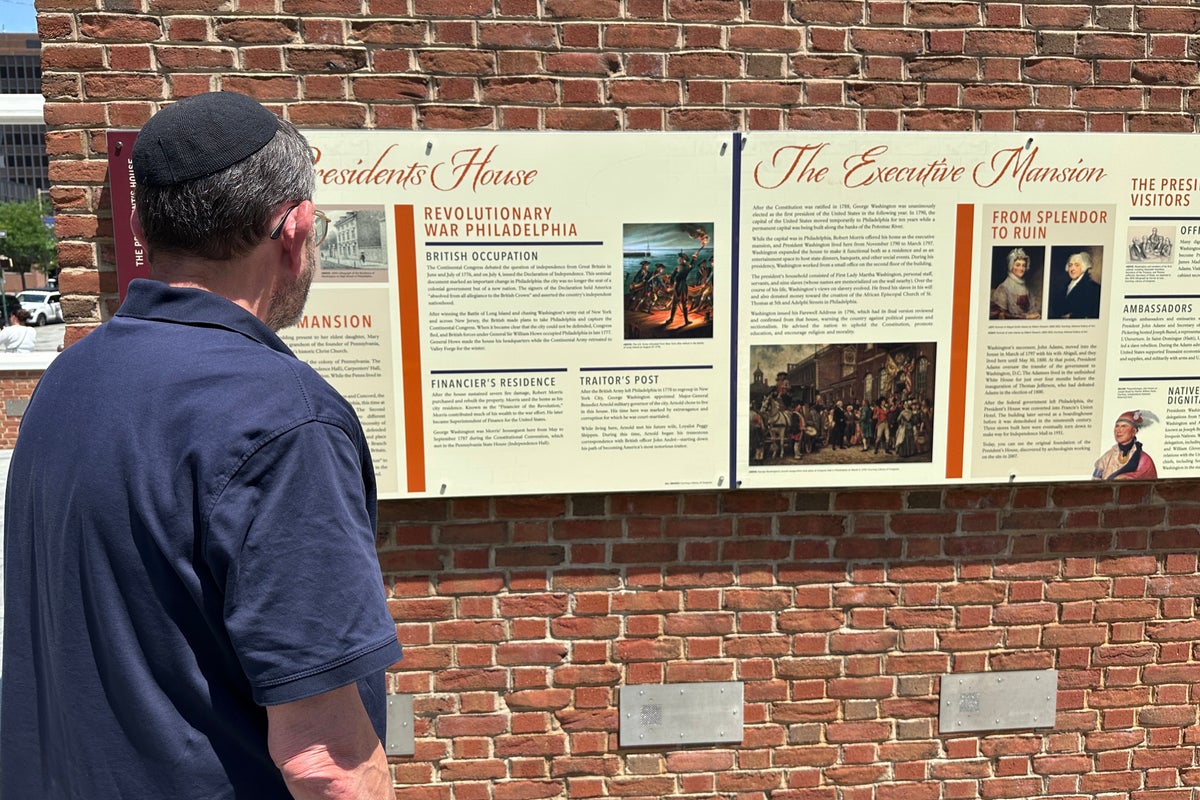
The outrage machine has a new monument, and it is a set of laminated outdoor panels in Philadelphia.
When the federal government swapped the interpretive displays at the President’s House site overnight, local politicians and activists reacted as if the National Park Service had dynamited Mount Rushmore. Philadelphia Mayor Cherelle Parker lamented the change occurring "under the cover of darkness". Activists declared it a catastrophic whitewashing of history. If you found value in this post, you should read: this related article.
This entire outrage cycle rests on a fundamental delusion.
The mainstream media and local politicians want you to believe that a public history exhibit is a sacred, immutable document of objective truth. It is not. It never has been. Public history is, and always has been, a reflection of the prevailing political winds of the era that funded it. For another look on this event, check out the latest update from Al Jazeera.
By demanding that a 2010 outdoor installation remain frozen in amber forever, critics are defending an absurd premise: that the state should hardcode its moral consensus onto public park plaques.
The battle over George Washington’s Philadelphia home is not a fight to save history. It is a performative turf war between two political factions who both believe that whoever controls the lawn signs controls the American soul.
The Illusion of Permanent Public History
I have watched organizations waste millions of dollars fighting over public statements, corporate mission statements, and museum plaques. They always make the same mistake. They mistake the medium for the message.
The original President’s House exhibit, opened in 2010, was the product of intense, years-long negotiations between local black activists, historians, and the federal government. It was a political compromise designed to balance the celebration of the early presidency with the brutal reality of the nine enslaved individuals who lived and labored on that footprint.
To treat that 2010 compromise as a permanent, unalterable historical truth is intellectually lazy.
History is a process of constant re-evaluation. It is not a fixed set of plaques. The moment we declare that a public park exhibit can never be updated, altered, or re-curated, we abandon the scientific method of historical inquiry. We replace history with dogma.
The Trump administration’s executive order to focus historic sites on "achievements and progress" is undoubtedly a political project. But the city of Philadelphia’s insistence that the federal government must obtain local approval before changing its own signs is equally political. Both sides are guilty of trying to weaponize the National Park Service to validate their own contemporary narratives.
The Legal and Operational Reality
Let’s look at the actual mechanics of how public lands work.
The city of Philadelphia sued the federal government, arguing that a decades-old cooperation agreement granted the city permanent veto power over what the National Park Service displays on its property. The U.S. 3rd Circuit Court of Appeals dismantled this argument in July 2026.
The court pointed out a basic truth: a "maintenance" clause in a property contract does not mean the tenant must keep the interior decoration identical to the day they moved in. The duty to maintain is a physical obligation, not a pledge of eternal ideological allegiance to a 2010 committee.
If Philadelphia's legal theory had won, it would have set a disastrous precedent. Imagine a scenario where every local municipality could sue the federal government to block updates to national parks, military bases, or federal museums because those updates did not align with local political sentiment. The Smithsonian would be paralyzed by endless litigation from local city councils.
The Department of Justice argued that the federal administration alone has the authority to decide what stories are told on National Park Service properties. This is legally correct and operationally necessary. If you do not like the narrative of the current administration, the solution is to vote them out, not to drag the court system into curatorial decisions.
The Content Myth and the Outrage Economy
To hear the critics tell it, the federal government completely erased the existence of slavery from the President's House site. This is a flat falsehood designed to generate clicks and donations.
The updated displays still contain approximately 200 references to slavery. They still detail the stories of the nine enslaved people who lived there. They still discuss Washington's economic dependence on slavery and his private expressions of discomfort. They even include information on the abolitionist movement and the end of slavery in Pennsylvania.
What actually changed? The new panels removed critical editorial headlines like "The Dirty Business of Slavery" and took down a map of slave trade routes. In other words, the federal government toned down the aggressive framing of the original exhibit and added broader historical context.
You can disagree with that editorial choice. You can argue that the original, more confrontational framing was more effective. But calling it "whitewashing" or "erasing history" is a gross exaggeration. It is curatorial editing. Every museum in the world edits, reframes, and alters its exhibits on a regular basis.
The real danger here is the standard we are setting. If we decide that any removal of a highly critical headline is an act of state censorship akin to Orwell's Ministry of Truth, we make it impossible for public institutions to ever update their material without sparking a federal lawsuit.
The High Cost of performative Battles
While politicians stand in front of television cameras on Independence Mall accusing each other of fascism, the actual study of history suffers.
No one learns history from a 150-word summary on an outdoor plaque while dodging tourists and traffic in downtown Philadelphia. Real historical engagement happens in classrooms, archives, books, and deep research. The fight over these panels is not about education; it is about territory. It is about who gets to claim moral ownership of the public square.
By treating these plaques as the primary battleground of our cultural memory, we are validating a shallow, consumerist approach to history. We are training the public to believe that history is something to be consumed in bite-sized, government-approved slogans pasted onto a metal post.
If we want an honest and accurate portrayal of history, we must stop expecting federal agencies to act as unbiased arbiters of moral truth. They are political entities controlled by political administrations. Expecting them to be anything else is naive.
Instead of wasting taxpayer dollars on legal battles to preserve 2010 lawn signs, local leaders and activists should focus on funding independent historical research, supporting local archives, and improving public education.
The federal government changed the signs because it has the legal right to do so. If you do not like the new signs, write a book, build a website, or host a lecture. But stop pretending that the removal of a laminated headline is the death of American history. It is just another day in the curatorial office.