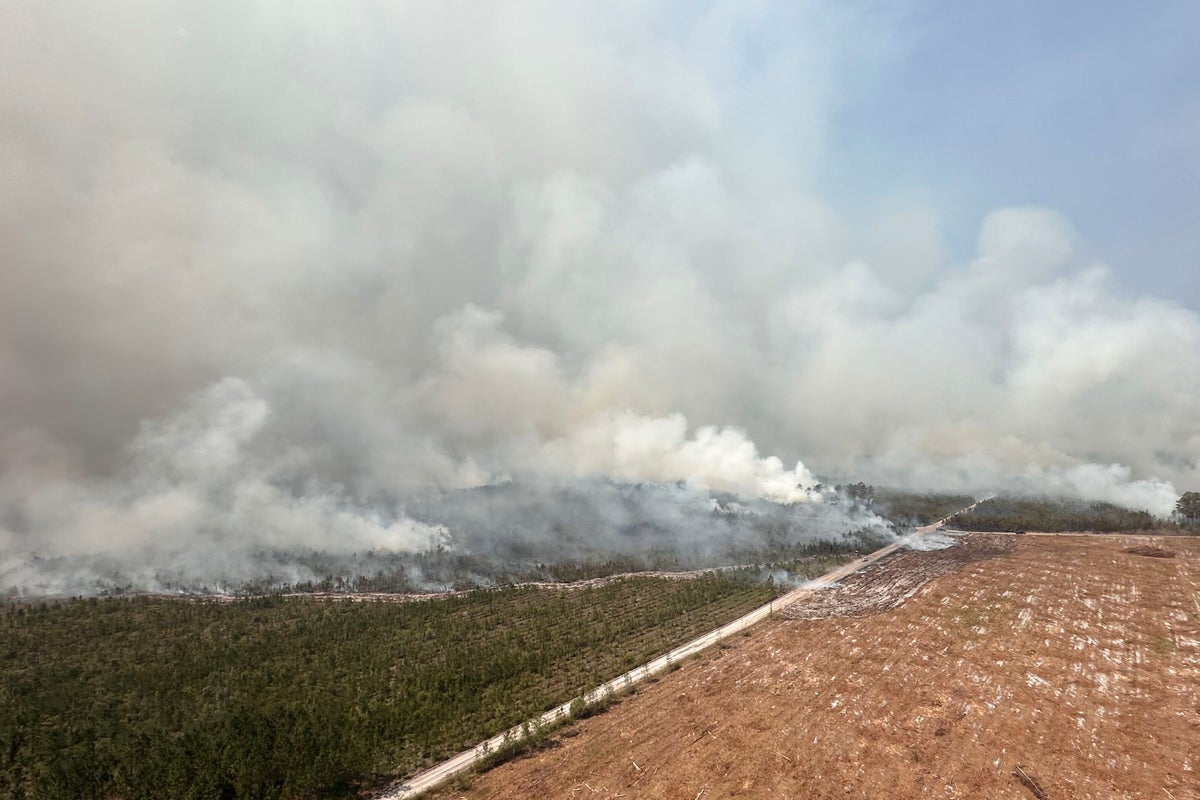
The headlines are bleeding red. They talk about "unprecedented threats" and "strong winds" as if the atmosphere just discovered physics this morning. The standard narrative is a tired script: residents are in danger, the winds are the enemy, and total suppression is the only victory.
It is a lie. Learn more on a related subject: this related article.
The real danger to Georgia residents isn't the fire currently moving through the brush. The danger is the century of cowardice that came before it. By treating every plume of smoke like a national emergency, we have engineered the very tinderbox that now threatens to erase entire neighborhoods. We are not "fighting" wildfires; we are subsidizing a future catastrophe by refusing to pay the ecological bill today.
The Suppression Paradox is Killing Us
Every time a news crew stands in front of a flickering ridgeline and praises the "heroic efforts" to achieve 100% containment, they are celebrating a long-term death sentence. Further journalism by TIME explores similar views on this issue.
Forests in the Southeast evolved with fire. The Longleaf Pine doesn't just tolerate heat; it demands it. When we suppress every small, low-intensity burn, we allow "ladder fuels" to accumulate. These are the shrubs and small trees that bridge the gap between the forest floor and the canopy.
In a natural cycle, a frequent, "cool" fire clears the floor. When we stop that cycle, we create a vertical highway for flames. This turns a manageable ground fire into a crown fire. A ground fire is a maintenance task. A crown fire is an extinction event.
The media focuses on the wind. Wind is just the messenger. The fuel is the message. If the fuel load weren't at historic, bloated levels, a 30-mph gust would just be a breezy day in a healthy forest. Instead, because we’ve hoarded fuel for decades, that wind is now a blowtorch.
The Myth of the Innocent Resident
We need to stop pretending that every person living in the Wildland-Urban Interface (WUI) is a passive victim of nature.
If you build a house in a floodplain, people call you a risk-taker. If you build a house in the middle of a fire-dependent ecosystem and demand that the state prevent every leaf from burning, you're called a "threatened resident."
I have seen homeowners associations in Georgia block prescribed burns because the smoke might ruin a Saturday brunch or leave a light dusting of ash on a luxury SUV. This is the height of hubris. You are living in a fireplace. You don't get to act surprised when someone lights a match.
Real safety isn't found in a fire truck. It's found in the "Home Ignition Zone."
- The Five-Foot Rule: If you have mulch or wooden fences touching your siding, you have built a fuse.
- The Ember Reality: Most houses don’t burn down because a wall of flame hits them. They burn because an ember landing in a gutter full of pine needles sits and smolders for forty minutes.
The "status quo" response is to demand more tankers and more boots on the ground. My contrarian take? We need fewer tankers and more chainsaws. We need to stop protecting every individual property at the expense of the landscape's health.
The Economics of Arson by Omission
We spend billions on suppression. We spend pennies on prevention.
From a budgetary standpoint, suppression is "emergency spending," which means the taps are always open. Prevention, such as mechanical thinning and prescribed fire, is "discretionary." It’s the first thing to get cut when the state legislature wants to look "fiscally responsible."
This is the equivalent of refusing to change the oil in your car to save $50, then acting shocked when the engine explodes and costs you $8,000.
The U.S. Forest Service and state agencies are caught in a political vice. If they let a fire burn for ecological benefits—a "managed fire"—and the wind shifts, they get crucified. If they spend $100 million "fighting" a fire that was inevitable, they get a bigger budget next year. We have incentivized the most expensive and least effective way to manage the land.
Why "Extreme Weather" is a Convenient Scapegoat
Blaming climate change or "extreme winds" is the ultimate get-out-of-jail-free card for land managers and developers. It shifts the blame from human decision-making to an atmospheric deity.
While the data shows that fire seasons are getting longer, the severity of these fires is a direct result of density. A forest with 40 trees per acre handles a drought much differently than a forest with 400 trees per acre. Georgia’s forests are overcrowded. They are stressed. They are thirsty.
When you have too many trees competing for the same limited water, they become weak. The bark beetles move in. They die standing up. Now you have a standing graveyard of bone-dry timber. When the wind picks up, you aren't dealing with a forest fire; you're dealing with a lumber yard fire.
The Brutal Truth About "Containment"
"Containment" is a PR term, not a scientific one. You can have 90% containment and still lose the whole game if the remaining 10% is upwind of a subdivision during a frontal passage.
We need to stop asking "How much of the fire is contained?" and start asking "Why was this forest allowed to become this dangerous in the first place?"
If you want to solve the Georgia wildfire crisis, you have to do the things that make people uncomfortable:
- Mandatory prescribed burns: Even if it makes the air hazy for two days in October.
- Defensible space enforcement: If your house is a fire hazard to the rest of the community, you shouldn't get an insurance payout.
- Managed retreat: Some areas are simply too dangerous to inhabit. Stop rebuilding in the same scorched canyons.
The Tech Won't Save You
Every year, some startup claims they will use "AI-powered thermal imaging" or "autonomous drone swarms" to end wildfires. This is tech-bro fantasy.
You cannot "disrupt" a chemical reaction that spans 50,000 acres. Fire is an elemental force. No amount of data visualization changes the fact that if you have 20 tons of fuel per acre and a low-pressure system moving in, things are going to burn.
The only "technology" that works is a drip torch and a plan. We have to be the ones to choose when and how the fire happens. If we don't choose, the wind will choose for us. And the wind doesn't care about your property values.
The current strategy is a failure of imagination and a failure of grit. We are treating the symptom and worshipping the disease. Stop looking at the smoke and start looking at the overgrown, neglected woods behind your house.
The fire isn't the tragedy. The tragedy is that we've spent a century making sure that when it finally happens, it's as destructive as possible.
Stop fighting the fire. Start fighting the forest.