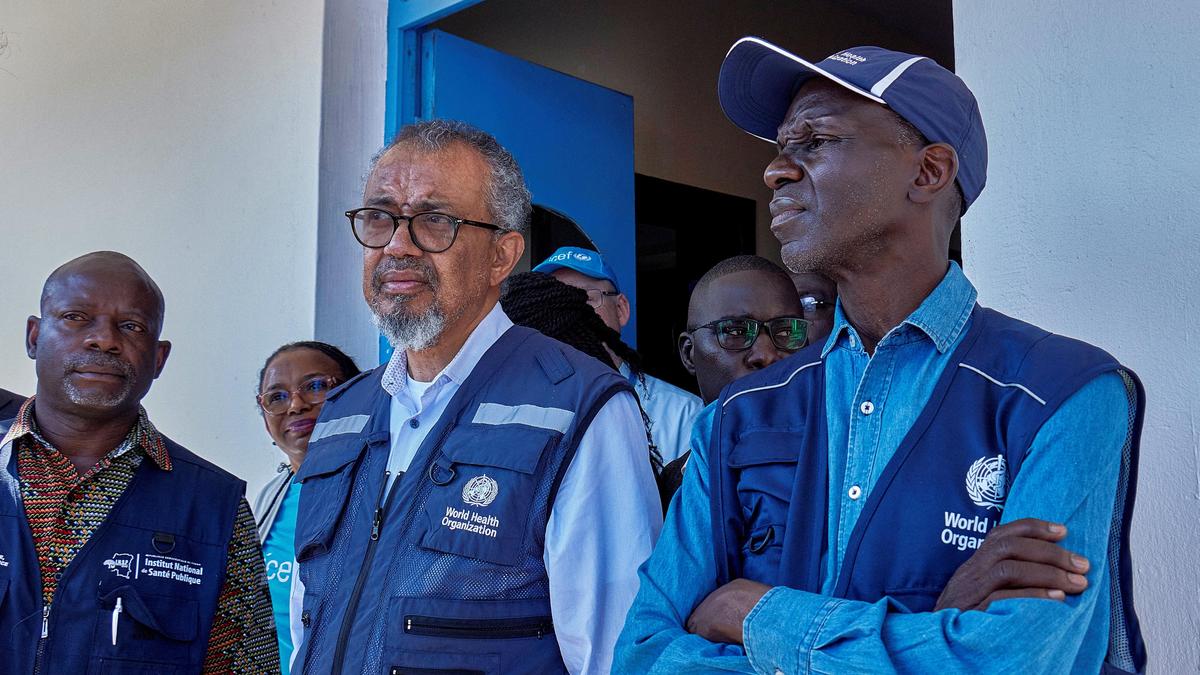
The global health bureaucracy is addicted to performative optimism. On Sunday, World Health Organization Director-General Tedros Adhanom Ghebreyesus stood in Bunia, a city in the eastern Democratic Republic of the Congo, to inaugurate a shiny new Ebola treatment center. He proudly paraded the news that five patients had recovered from the rare Bundibugyo strain of the virus. The press dutifully swallowed the narrative: international aid arrives, infrastructure goes up, and human resilience triumphs over a deadly pathogen.
It is a comforting story. It is also dangerously misleading.
Hailing five recoveries while a full-scale epidemic outpaces the international response is not a victory; it is a public relations smoke screen. I have spent years tracking how international agencies handle outbreaks in conflict zones. I have seen millions of dollars poured into field tents and high-level photo-ops while the actual mechanics of outbreak containment collapse on the ground. The reality in Ituri province is grim, and the institutional self-congratulation coming from the WHO actively obscures the systemic structural failures that are letting the Bundibugyo virus spin out of control.
The Myth of the Silver Bullet Facility
The international community loves building things. Treatment centers are visible, quantifiable, and make for excellent press photos. But concrete walls and imported medical cots do not stop a highly contagious virus that is already moving faster than the response.
The current outbreak involves the Bundibugyo strain. Unlike the more common Zaire ebolavirus, the Bundibugyo variant has exactly zero approved vaccines and zero validated therapeutic treatments. When a patient enters the new facility in Bunia, the medical intervention they receive is completely rudimentary. As Ezo Étienne, a nurse who contracted the virus, noted, his treatment consisted entirely of basic symptomatic management: anti-emetics to halt vomiting, intravenous fluids for dehydration, and standard pain relievers.
"That was all they could provide," Étienne said.
You do not need a multi-million-dollar international facility to administer basic IV fluids and paracetamol. What you need is an aggressive, functional, and hyper-localized diagnostic and contact-tracing network. Yet, Doctors Without Borders (MSF) explicitly warned that the virus is outpacing health measures. The bottleneck is not a lack of beds in Bunia; it is the catastrophic deficit in rapid testing, field-level epidemiological deployment, and sustained logistics for medical supplies outside the main provincial hubs. Building a centralized treatment center while the periphery lacks basic diagnostic reagents is like buying a state-of-the-art fire truck when you have no water pressure in the hydrants.
The Flawed Premise of Early Reporting
During his victory lap in Bunia, Tedros issued a classic piece of institutional advice:
"If you come to health facilities when you have symptoms, you can get the support and recover, so the key is to come forward as early as possible and to get the necessary support."
This statement is detached from the realities of eastern Congo. It operates on a flawed premise: that the local population trusts the health system and that the health system can deliver quick answers.
Let us look at the data. Nurse Étienne was tested seven times before his Ebola infection was finally confirmed. If a trained medical professional working within the system requires seven sequential diagnostic tests to get an accurate reading, how can the WHO honestly expect an impoverished civilian in a conflict zone to willingly present themselves at the first sign of a fever?
When the diagnostic loop takes days or weeks due to weak laboratory capacity, entering a treatment center is a massive gamble. Imagine a scenario where a patient with a standard, non-lethal bout of malaria or typhoid heeds the WHO’s advice and goes to an Ebola facility. Because diagnostics are slow, that patient is cohorted with suspected Ebola cases. By the time the negative test comes back, they may have actually contracted the virus from their environment. For the local population, avoiding these centers is not ignorant; it is a rational calculation based on self-preservation.
Bio-Colonialism and the Burial Ritual Failure
The global health apparatus constantly treats community resistance as an educational problem. They assume that if they just explain the science clearer, or bring in more foreign experts, the locals will comply with medical protocols. This paternalistic approach is why health centers in Ituri have already faced multiple direct attacks from angry residents.
The conflict stems from the imposition of stringent, sterile medical protocols for handling the bodies of the deceased. These protocols directly clash with traditional burial rites, which are deeply tied to community structure, spiritual duty, and grief processing. When international teams roll into a village in biohazard suits, seize a loved one's body, and bury them in a plastic bag without family involvement, they are destroying social fabric.
The institutional response? Double down on security and lecture the population on compliance.
Real epidemic control requires compromise, not coercion. If your medical protocol sparks armed resistance and health center burnings, your protocol is a failure, regardless of how epidemiologically sound it looks on a whiteboard in Geneva. True community engagement means co-designing safe, dignified burial alternatives with local elders and religious leaders, giving them the agency and ownership of the process. Instead, the current strategy treats local culture as an obstacle to be bypassed by international mandates.
The Geopolitical Blind Spot
The most glaring omission from the standard international narrative is the active war zone surrounding the outbreak. The Bundibugyo virus is not spreading in a vacuum; it is tearing through territories heavily destabilized by armed conflict.
The Allied Democratic Forces (ADF), an insurgent group allied with the Islamic State, and various ethnic militias are actively operating in Ituri. To the south, in North Kivu and South Kivu, the Rwanda-backed M23 rebel group controls critical cities like Goma and Bukavu. The rebels have already reported confirmed Ebola cases within their ranks.
You cannot execute textbook contact tracing when your epidemiologists require armed UN escorts just to move between villages. You cannot isolate a population when thousands of internally displaced persons are fleeing rebel advances every single week. The WHO acts as if building an isolation ward in Bunia solves the crisis, while completely ignoring the fact that geopolitical instability makes standard outbreak containment protocols functionally impossible to execute.
The global health machine wants to fight a pathogen. It does not want to fight the reality of structural collapse and active warfare.
The Brutal Math of the Outbreak
Let us look at the actual trajectory of the epidemic, stripped of the public relations spin. As of late May 2026, official figures indicate over 900 suspected cases and more than 220 suspected deaths, with cases crossing the border into neighboring Uganda. This is only the third time the rare Bundibugyo strain has ever been detected in human history, meaning natural immunity in the population is virtually non-existent.
To celebrate five individual recoveries against a backdrop of a climbing death toll and regional cross-border transmission is an insult to the scale of the crisis. It creates a false sense of security for international donors who want to believe their money has bought a solution.
Symptomatic management is a holding action, not a cure. The historical data on Bundibugyo outbreaks shows a case fatality rate hovering around 30% to 40%. The five people discharged in Bunia did not survive because of a breakthrough in international aid; they survived because their immune systems, supported by basic hydration, managed to fight off the infection.
The real metric of success for an outbreak response is the reproduction number of the virus—the number of secondary cases generated by a single infected individual. If that number remains above one, the epidemic is expanding, no matter how many ribbon-cutting ceremonies the WHO holds. Right now, by all independent accounts from field operators, the virus is moving faster than the bureaucracy.
Stop looking at the five empty beds of the recovered. Look at the expanding radius of the infection zone. Look at the unresolved conflict zones where tracking the virus is entirely impossible. The global health apparatus needs to drop the congratulatory rhetoric, admit that their centralized strategy is failing, and completely pivot resources away from prestige infrastructure projects and directly into decentralized, rapid-diagnostic field teams. Anything less is just public relations while the Congo burns.