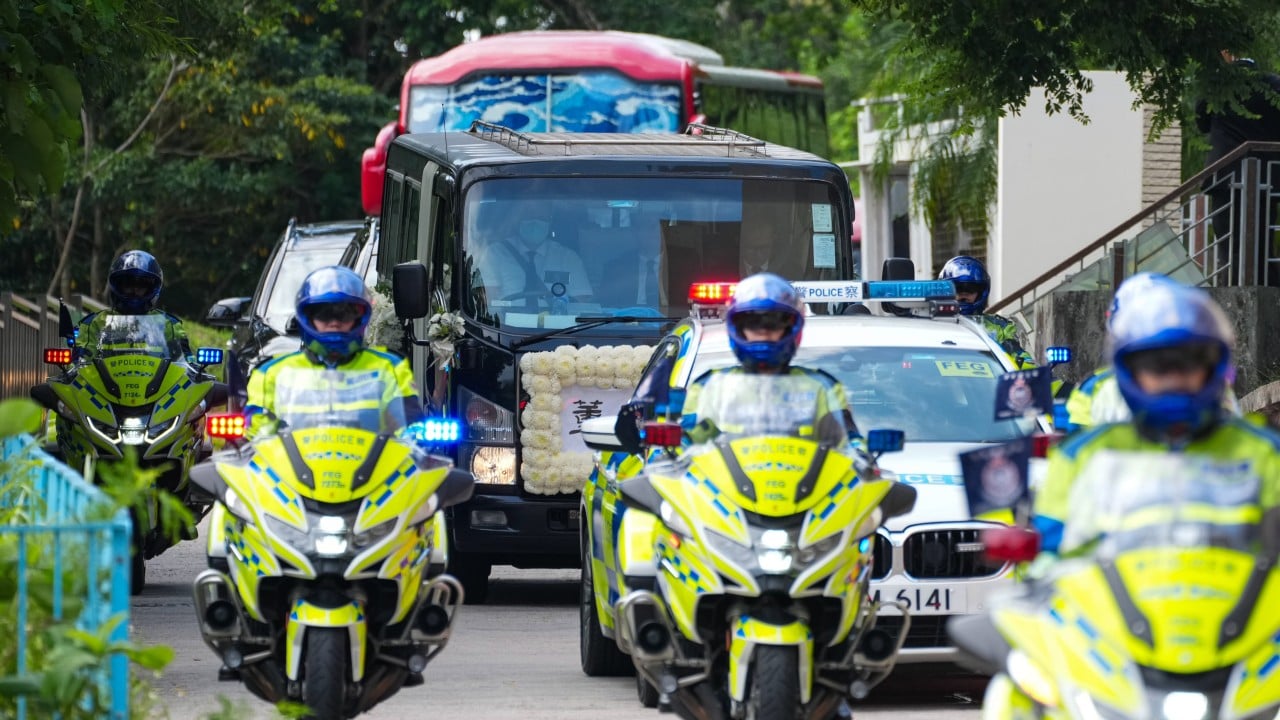
The mainstream press wants you to see a funeral. They want you to look at the wreaths, read the sterile wire-service summaries of Xi Jinping’s condolences, and nod along to a tidy narrative about Hong Kong’s first Chief Executive passing into the history books.
That reading is lazy. Worse, it is dangerously blind to how Beijing actually operates.
When a former leader of Hong Kong receives the full pomp of a state-level farewell, the ceremony is never just about the man in the casket. State funerals in the Chinese political system are precision-engineered signals. They are public audits of loyalty, retroactive edits to messy history, and rigid blueprints for whoever holds power next. If you are looking at Tung Chee-hwa’s memorial as a nostalgic tribute to the 1997 handover, you are asking the wrong question entirely. The real story is not how Tung governed. The real story is why Beijing needs to canonize him right now.
The Myth of the Reluctant Shipping Tycoon
For nearly three decades, Western commentators and local pundits have relied on a comfortable caricature of Tung Chee-hwa. In their telling, he was a well-meaning, slightly out-of-his-depth shipping magnate who inherited an impossible job in July 1997, got blindsided by the Asian Financial Crisis, fumbled the 2003 national security legislation, and quietly stepped down in 2005 with a bad leg and bruised ego.
I have spent twenty years watching boardrooms and policy shops in Central misread Beijing’s intent by clinging to this exact kind of biographical sentimentality. Executives routinely lose millions betting on the idea that Hong Kong’s political trajectory is driven by the personal quirks of its Chief Executives. It is not.
Tung was never meant to be a Western-style politician winning popularity contests in Victoria Park. Under the Basic Law—Hong Kong’s mini-constitution—the Chief Executive is structurally designed to sit at the intersection of two competing mandates: accountability to the Central People's Government and accountability to the Hong Kong Special Administrative Region. When those two mandates collide, Beijing’s reading of the Basic Law leaves zero ambiguity about which side wins.
Tung’s supposed "failures" look very different when you strip away Western democratic expectations and evaluate him against the metric that actually mattered to Zhongnanhai: sovereignty consolidation without systemic collapse.
Let us look at the cold facts of his tenure between 1997 and 2005:
- The 1998 Market Intervention: When hedge funds attacked the Hong Kong dollar peg during the Asian Financial Crisis, free-market purists screamed heresy as Tung’s administration deployed roughly HK$118 billion from the Exchange Fund to buy up blue-chip equities. Milton Friedman called it insane. Yet it broke the speculators, saved the currency board, and generated massive profits when the government later offloaded the shares through the Tracker Fund.
- The Housing Blueprint: His "85,000 flats a year" pledge was gutted by the property crash and fierce pushback from real estate cartels, but his diagnosis was dead right. Hong Kong’s land-supply bottleneck would eventually mutate into the primary fuel for generational rage two decades later.
- Article 23: He failed to pass the national security bill in 2003 after half a million people marched in the streets. At the time, observers called it the death knell of his authority. From Beijing’s vantage point today, Tung was simply the guy who tried to install the firewall seventeen years before the house caught fire.
By elevating Tung in death to the rank of a national statesman—complete with top-level condolences from Xi Jinping and burial honors reserved for vice-national leaders—Beijing is rewriting the verdict on the 1997–2005 era. The message is crystal clear. Tung was not a failed administrator. He was a misunderstood pioneer whose warnings about national security and structural economic reform were vindicated by the chaos of 2019.
What Everyone Gets Wrong About "One Country, Two Systems"
If you search online for what Tung Chee-hwa’s legacy means for Hong Kong today, you will find endless variations of the same tired question: Is "One Country, Two Systems" dead?
That question is broken at the foundation. You cannot declare something dead when its original architect never promised the version you are mourning.
Deng Xiaoping formulated "One Country, Two Systems" in the early 1980s not as an indefinite grant of Western liberal autonomy, but as a pragmatic mechanism for national reunification. Read Deng’s actual speeches from 1984 and 1987—specifically his warnings that Hong Kong’s administrative apparatus must be run by "patriots" and that Beijing would intervene if turmoil threatened national stability. The text has been sitting in plain sight for forty years.
The elite consensus in Hong Kong’s financial and legal circles spent twenty-two years pretending the "Two Systems" half of the equation was permanent and absolute, while treating "One Country" as a ceremonial formality. Tung Chee-hwa never made that mistake. Even when his administration stumbled, his compass pointed north. That singular alignment is what earned him the Vice Chairmanship of the Chinese People’s Political Consultative Conference (CPPCC) after he resigned as Chief Executive, and it is what secured his state funeral.
| Dimension | The Mainstream Media Narrative | The Beijing Strategic Reality |
|---|---|---|
| 1997–2005 Tenure | A period of policy missteps, economic stagnation, and declining public trust. | A foundational stress test that proved colonial-era administrative habits could not solve deep structural flaws. |
| 2003 Article 23 Retreat | A triumph of civil society over executive overreach. | A costly delay in closing a national security loophole that enabled foreign interference and street unrest. |
| Role of Business Tycoons | Natural partners who kept Hong Kong’s capitalist engine humming. | Entrenched monopolies whose resistance to land and housing reform undermined social stability. |
| Xi Jinping’s Condolences | Standard diplomatic protocol for a deceased former official. | High-level ideological validation of loyalty over popularity as the sole metric of leadership. |
Look at that third row. Most analysts miss the friction between Tung and Hong Kong’s traditional property tycoons. Beijing’s 1997 bargain relied heavily on co-opting the city’s billionaire class to ensure a smooth transition of capital. Tung came from that world—his family founded Orient Overseas Container Line—yet he tried to break the land-supply chokehold that enriched his peers. He lost that fight because the tycoons held too much institutional leverage in the early post-handover years.
Today, Beijing has systematically dismantled the political veto power of those same real estate dynasties. Honoring Tung now serves as a quiet rebuke to the old guard: the man you sidelined in 2005 had the right instincts all along.
The Mechanics of Political Canonization
To understand why Xi Jinping’s tribute carries such weight, you have to understand how the Chinese Communist Party uses funerary politics. In Beijing, there is no such thing as an unscripted eulogy. Every adjective in the official Xinhua obituary, every official who attends the memorial, and every flower wreath placed in the hall is calibrated to the millimeter.
When a figure like Tung Chee-hwa is honored as a "faithful patriot" who made "historic contributions" to the implementation of "One Country, Two Systems," three distinct operational gears turn at once.
1. Eliminating Ambiguity for Current Officials
Current Hong Kong officials—from John Lee down to mid-level permanent secretaries—watch these rituals with intense focus. For years, civil servants trained under the British colonial system prided themselves on "political neutrality." That doctrine is extinct. By canonizing Tung, Beijing reinforces the hierarchy of values required in modern Hong Kong governance. Political loyalty to the central government and proactive defense of national security sit at the absolute top. Technical competence and public approval ratings sit several rungs below. If you have to choose between pleasing international credit agencies and pleasing Beijing, you choose Beijing every single time.
2. Closing the Historical Loop on 2019
History is a battlefield in Chinese statecraft. If the 2003 protests against Article 23 are remembered as a heroic chapter, then the 2014 Occupy movement and the 2019 riots look like an organic continuation of local resistance. Beijing cannot allow that narrative to survive. By framing Tung’s early push for national security legislation as farsighted statesmanship, the official tribute retroactively delegitimizes twenty years of opposition politics. It turns Tung from a leader who retreated into a prophet whose warning went unheeded until 2020’s National Security Law finally finished his work.
3. Reassuring Global Capital on Beijing's Terms
There is an obvious downside to this hardline ideological framing, and pretending otherwise would be dishonest. International investors do not allocate capital based on patriotic loyalty; they allocate capital based on predictability, rule of law, and friction-free liquidity. Heavy-handed political symbolism makes Western fund managers nervous.
Yet Beijing calculates—correctly or not—that capital cares far more about street stability and regulatory certainty than about Western-style democratic rituals. Tung represents the ideal archetype for the "patriots administering Hong Kong" era: an internationally educated, English-speaking, capitalist shipping executive who understood global markets inside out, yet never wavered in his allegiance to the motherland. Putting him on a pedestal signals to global business that Hong Kong still wants dealmakers, provided those dealmakers leave politics at the door.
How to Read Hong Kong Without Getting Burned
If you run a business, manage regional risk, or allocate capital in Asia, consuming standard Western coverage of Hong Kong will actively distort your decision-making. Journalists love heroes, villains, and clean moral arcs. Geopolitics runs on incentives, institutional design, and power balances.
Stop treating Hong Kong’s political news like a local election cycle. Start reading it like an institutional balance sheet.
- Track the structural incentives, not the personalities. When Beijing praises a former leader, look at which policies from that leader's era are currently being revived or vindicated. In Tung’s case, it is state-directed industrial policy, aggressive public housing intervention, and zero-tolerance national security enforcement.
- Audit the Basic Law directly. Stop relying on secondary commentary about what Hong Kong’s autonomy means. Read Articles 12, 15, 18, and 23 of the Basic Law alongside the National People's Congress interpretations. The legal authority Beijing exercises today was embedded in the text from day one.
- Separate municipal economics from sovereign politics. Hong Kong remains a premier offshore renminbi hub, a deep-pocketed wealth management center, and a critical gateway for mainland firms going global. Its economic utility to China has evolved, not vanished. Businesses that fail there today usually fail because they misread regulatory red lines, not because the city lacks capital.
- Watch the subtle shifts in protocol. In Beijing’s system, rank is destiny. Whether a deceased Hong Kong figure receives a state-level farewell, who sends condolences, and how state media frames their biography tells you more about the next five years of policy than any press conference in Admiralty ever will.
The Verdict Written in Ink
Tung Chee-hwa spent the final chapter of his public life watching the city he once led undergo a total transformation. The polite consensus politics of the late 1990s vanished. The British-trained administrative elite was sidelined. The streets that forced his resignation in 2005 were brought under tight statutory control.
Now, in death, he has been given the vindication that eluded him in office.
Do not mistake the solemnity of his state funeral for a quiet closing of the book on Hong Kong’s post-handover experiment. Beijing is not mourning the end of an era. It is certifying the blueprint for the next one—and daring anyone in the room to misread the instructions again.