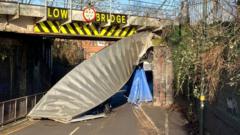
Every time a lorry wedges itself beneath a British railway bridge, the script writes itself. The media sighs about incompetent drivers. Network Rail launches another public awareness campaign. Pundits demand stiffer fines for haulage companies, and everyone goes home feeling intellectually superior.
It is a comfortable narrative. It is also completely wrong.
Blaming the driver who hits a bridge is like blaming the rain for a leaky roof. It targets the final, visible link in a chain of systemic failures while ignoring the structural rot that caused it. The lazy consensus insists that bridge strikes happen because truckers are distracted, poorly trained, or blindly following cheap consumer satnavs.
The reality? Bridge strikes are an inevitable tax we pay for forcing a 21st-century logistics network to run on Victorian infrastructure and fragmented data.
We do not have a driver problem. We have a systems problem. And until we stop treating truckers like scapegoats, the bridges will keep losing.
The Myth of the Careless Driver
Network Rail data consistently shows thousands of bridge strikes across the UK network every year. The immediate reaction from transport authorities is always the same: remind drivers to "know their height."
This approach completely misunderstands how modern logistics works.
I have spent years analyzing fleet operations and supply chain logistics. I have seen companies invest hundreds of thousands of pounds into driver training, only to watch their vehicles get peeled open like tin cans anyway. Drivers do not hit bridges because they forget how tall their trucks are. They hit bridges because the environment they operate in is actively hostile to accurate decision-making.
Consider the mental load of a commercial driver navigating an urban center. They are managing a 44-tonne vehicle, tracking vulnerable road users, fighting tight delivery windows, and scanning for confusing, often obscured road signage. To expect a human being to maintain perfect situational awareness across a ten-hour shift while filtering out a sea of visual noise is a statistical impossibility.
Human error is a constant. Design must account for it. When an aviation system fails, investigators do not just blame the pilot and call it a day; they look at the cockpit layout, the air traffic control interface, and the systemic pressures. Yet, in road haulage, we treat every incident as an isolated moral failure of the person behind the wheel.
The Satnav Scapegoat and the Data Mess
The most common refrain from the armchair critics is simple: "Why don't they just use a lorry satnav?"
It sounds like a silver bullet. It isn't.
Commercial vehicle satellite navigation systems are only as good as the underlying data layers they rely on. In the UK, that data is an absolute mess. There is no unified, real-time, open-access national database that maps every bridge height, weight restriction, and temporary road modification with absolute precision.
Instead, mapping providers rely on a patchwork of information sourced from local councils, Highways England, and Network Rail. Local authorities frequently change road layouts, resurface roads (which can raise the road level and decrease bridge clearance), or alter signage without instantly updating the central data repositories.
Imagine a scenario where a local council resurfaces a road under a low bridge, reducing the actual clearance by four inches. The physical sign on the bridge says 14 feet. The driver's specialized haulage satnav says 14 feet. But the physical reality is now 13 feet 8 inches. The truck is 13 feet 10 inches.
When that vehicle hits the bridge, who gets the blame? The driver. But the root cause is a failure of data synchronization.
Furthermore, the supply chain crunch means fleets increasingly rely on agency drivers or subcontractors who may be unfamiliar with specific regional blackspots. Expecting a transient workforce to possess tribal knowledge of every low bridge in the country is a fantasy.
Why Signs and Yellow Paint Fail
We have been conditioned to believe that bigger signs and brighter paint will solve the problem. Look at the famous bridge on Stuntney Tasker in Ely, or the perennially battered bridges in Leicestershire and Warwickshire. They are plastered with high-visibility jackets of paint, flashing lights, and warning signs.
They still get hit.
This happens because of a cognitive phenomenon known as change blindness and sign fatigue. When a driver is bombarded with hundreds of road signs every mile, the brain naturally filters out information it deems non-essential. A yellow sign warning of a low bridge ahead looks functionally identical to a yellow sign warning of a new housing development or a temporary diversion.
Worse, many bridge height signs are still displayed in imperial measurements, or use confusing dual metric-imperial formatting. While UK law requires commercial drivers to know their vehicle height in both systems, under stress, the human brain reverts to its primary language. For an international driver, a sign displaying feet and inches might as well be written in hieroglyphics.
The Real Cost of Inaction
The transport industry pays dearly for this systemic failure, but the proposed solutions are usually punitive. Authorities call for longer license suspensions and massive fines for hauliers.
This punitive approach backfires. When you increase the penalties for a systemic issue, you do not stop the incidents; you merely incentivize people to hide the near-misses. Drivers become terrified of reporting minor scrapes, meaning infrastructure owners miss out on critical data that could prevent a catastrophic collapse down the line.
The current strategy relies on the assumption that if we just scream "pay attention" loudly enough, physics will magically bend to our will. It won't.
The Unpopular Solution: Hard Infrastructure Overhaul
If we want to stop bridge strikes, we must stop trying to fix the human and start fixing the environment. This requires an aggressive shift away from passive warnings toward active, physical intervention and ironclad data standards.
1. Enforce Physical Deflectors
If a bridge is a known blackspot, stop relying on flashing signs. Install heavy-duty, sacrificial steel gantry beams several hundred yards ahead of the bridge at the exact clearance height. If a lorry is too tall, it hits the beam first. The beam makes a horrific noise, stops the vehicle, and takes the damage. The railway infrastructure remains untouched, trains keep running, and the public is spared a multi-million-pound disruption bill.
2. Mandate an Open-Source National Height Registry
The government must mandate a single, authoritative, real-time digital registry of every overhead restriction in the country. Any local authority that alters a road surface or changes a restriction must log it instantly. This API should be free and accessible to every single navigation app, from premium fleet software to basic Google Maps.
3. Laser-Detection Interventions
We need to deploy automated laser sensors ahead of high-risk bridges. Not to flash a generic "Overheight Vehicle" sign, but to trigger immediate, targeted interventions—such as changing the nearest traffic light to red to physically halt the vehicle before it reaches the structure.
The Trade-off We Refuse to Admit
The downside to this approach is obvious: it costs money. It requires capital expenditure from local councils and Network Rail. It requires taking accountability away from the easy target—the driver—and placing it squarely on the shoulders of bureaucrats and infrastructure planners.
It is far cheaper for authorities to print another leaflet or fine another transport company than it is to re-engineer a problematic junction. But let's be honest about what we are doing. We are choosing to tolerate thousands of hours of train delays and millions of pounds in economic friction just so we can keep blaming the guy in the cab.
Stop asking why lorry drivers keep hitting bridges. Start asking why we are still building roads that allow them to do it.