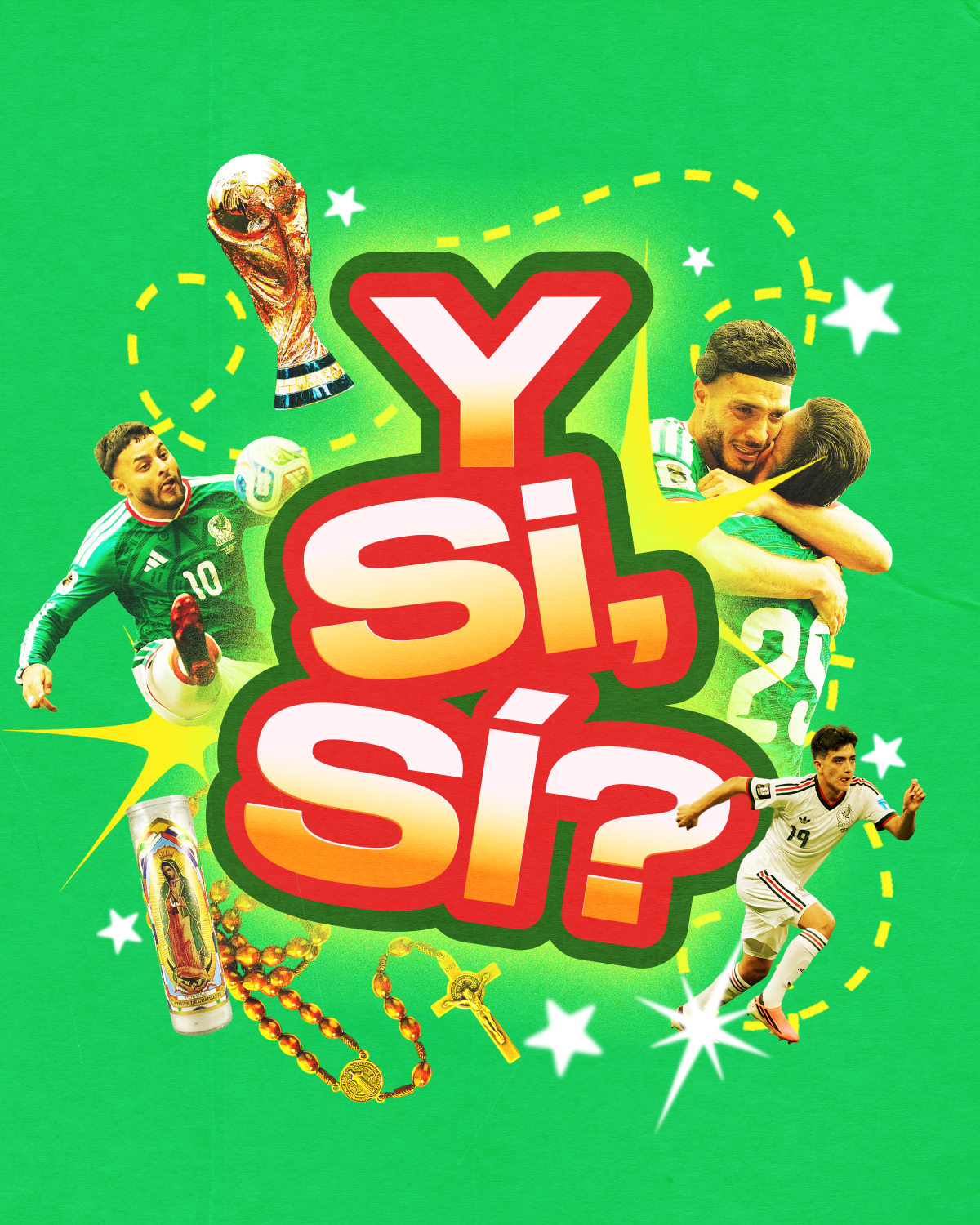
Every four years, a familiar cultural collective amnesia sweeps across millions of football fans. It crystallizes into a single, romanticized question: "¿Y si sí?" What if we actually do it? What if this is the tournament where everything clicks, the giants fall, and Mexico finally claims its place at the summit of global football?
The sports media industrial complex loves this narrative. It makes for beautiful television packages. It paints a picture of a passionate, resilient fan base clinging to unwavering faith against impossible odds.
It is also an absolute lie.
The phrase "¿Y si sí?" is not a testament to beautiful, romantic hope. It is structural Stockholm syndrome. It is a brilliant piece of accidental marketing that shields systemic incompetence, protects billionaire cartel owners, and guarantees that the Mexican national team remains exactly what it has been for decades: a highly profitable marketing product disguised as a football team.
By romanticizing blind faith, fans and media actively participate in the stagnation of the sport in Mexico. The blind hope of the consumer is the ultimate armor for an executive who cares about quarterly revenue statements rather than sporting merit.
The Economics of Exploited Nostalgia
To understand why this blind optimism is actively destructive, you have to follow the money. I have spent years tracking how sports federations monetize cultural identity. Most national teams exist to win trophies; the Federación Mexicana de Fútbol (FMF) exists to capture the disposable income of millions of nostalgic fans living in the United States.
Through its long-standing partnership with Soccer United Marketing (SUM), El Tri has turned international windows into a touring circus. They play endless friendly matches—derisively but accurately called "partidos moleros" (garbage games)—in American NFL stadiums. The stadiums are always full. The tickets are overpriced. The opponents are often second-string squads or confederation minnows chosen specifically to ensure a comfortable victory that keeps the consumer happy.
Consider the cold data of this business model:
- Mexico plays more games on foreign soil than almost any other major footballing nation.
- The revenue generated from US tours completely dwarfs the domestic income from matches played in Mexico.
- The fans filling these stadiums are buying an emotional connection to their homeland, not a high-level sporting spectacle.
This is where "¿Y si sí?" becomes insidious. The suits in the high-rise offices of Toluca do not look at a tactical disaster against a top-tier European side and think about changing their development models. They look at the gate receipts from AT&T Stadium or Rose Bowl and conclude that the strategy is working perfectly.
When your business model relies on selling hope rather than performance, you have zero financial incentive to improve the actual product. The blind faith of the fan base ensures that failure is always profitable.
The Systematic Destruction of Domestic Competition
While the media focuses on the psychological grit of the players and the magical thinking of the supporters, the actual infrastructure of Mexican football has been systematically dismantled to protect corporate interests.
Imagine running a business where there is absolutely no penalty for being the worst performer in your industry. That is the current reality of Liga MX. The abolition of promotion and relegation in 2020 removed the single most critical sporting mechanic that drives excellence in football: fear.
Without the threat of relegation, a significant portion of Liga MX clubs function as zombie franchises. Owners have no reason to invest heavily in youth academies or risk playing young domestic talents when they can coast by with cheap foreign imports and suffer zero consequences for finishing last. They simply pay a nominal financial fine that is easily covered by their share of the league’s centralized television money.
Furthermore, the league's playoff format—the Liguilla—actively rewards mediocrity. In a system where more than half the teams can qualify for the postseason, a club can lose more games than it wins over a short tournament, get hot for three weeks, and be crowned champion. It is an entertaining television product, but it is an atrocious way to develop elite, consistent football players.
Add to this the toxic reality of multi-ownership. In any serious footballing nation, one corporate entity owning multiple teams in the top division is strictly forbidden due to glaring conflicts of interest. In Mexico, it is a accepted business practice. Cartels of owners swap players back and forth, manipulate transfer values, and control the voting blocks within the FMF to ensure rules always favor ownership over the sporting health of the nation.
The Gold-Plated Cage of the Mexican Player
A common question asked by international observers is why more Mexican talent does not migrate to Europe's elite leagues. The lazy consensus answer is that Mexican players lack ambition or the adaptability to survive abroad.
The truth is an economic trap created by Liga MX owners.
Because the domestic league generates enormous amounts of commercial revenue, Mexican clubs can afford to pay wages that compete with mid-tier European teams. More importantly, they place absurd, inflated price tags on domestic players. When a European club inquires about a promising 21-year-old Mexican winger, they are quoted a transfer fee of 12 to 15 million dollars. For that same price, a European scouting department can buy three highly polished prospects from Argentina, Uruguay, or Colombia.
This creates a gold-plated cage. The young Mexican player stays at home, earning an excellent salary in a comfortable environment with low sporting stakes, playing in a league with no relegation. They do not get tested weekly against world-class opposition in the Champions League or the Premier League.
When they eventually put on the national team jersey to face a team like France, Argentina, or Germany, the gap in intensity, tactical awareness, and physical preparation is violently exposed. It is not a mental block; it is a structural deficit. You cannot expect players trained in a comfortable, non-competitive environment to suddenly match the intensity of athletes who fight for their sporting survival every single week.
Dismantling the Myth of the Fifth Game
For decades, the entire footballing discourse in Mexico has been obsessed with "el quinto partido"—the elusive fifth game, or the quarterfinal stage of the World Cup. The media treats this milestone as if it were a mystical curse, an invisible psychological barrier that requires spiritual intervention or a better sports psychologist to cross.
This framing is a brilliant distraction. It shifts the blame from the institutional failures of the federation to the fragile minds of the players.
Let's look at the cold reality of why Mexico repeatedly fails to progress past elite opposition when it matters most:
| Structural Factor | Impact on Elite Performance |
|---|---|
| No Promotion/Relegation | Eliminates high-pressure environments for young domestic players. |
| Excessive Foreign Player Roster Spots | Suffocates playing time for academy graduates in critical positions. |
| Commercial Prioritization | Schedules high-revenue friendly matches over tactically challenging fixtures. |
| Inflated Internal Market | Blocks players from moving to high-intensity European leagues. |
Crossing into the elite tier of global football requires a relentless, uncompromising commitment to sporting excellence. It requires cutting out the fat, sacrificing short-term commercial gains for long-term development, and forcing players out of their comfort zones.
Mexico does the exact opposite. Every single structural decision made by the FMF over the last fifteen years has prioritized short-term financial optimization over sporting development. Expecting a fifth game—or any meaningful international success—out of this architecture is not hope; it is delusion.
Starve the Beast
If you truly love Mexican football and want to see the national team compete on the global stage, you must stop asking "¿Y si sí?"
You must accept that your passion is being weaponized against you. Every time you buy the newly redesigned jersey, every time you pay hundreds of dollars to watch a meaningless friendly against a Caribbean nation's B-team in Texas, and every time you tune into a bloated playoff system, you are voting for the continuation of mediocrity.
The only way to force real, structural change in Mexican football is to make failure unprofitable.
Stop buying the tickets.
Stop filling the stadiums.
Turn off the television.
Demand the return of promotion and relegation. Demand the reduction of foreign player quotas. Demand an end to multi-ownership. Treat the federation not as a symbol of your national identity, but as a predatory monopoly that is burning your sport to the ground for spare change.
Until the stadiums in the United States sit empty and the television ratings plummet, the suits will keep laughing all the way to the bank, and the national team will remain a highly profitable tragedy. Stop dreaming. Wake up and starve the beast.