The dirt in New Orleans is different. It is heavy, damp, and prone to swallowing things whole. People who live there know that the ground is never truly solid; it is a shifting silt that remembers the river and the swamp. So, when a homeowner in the Jefferson Parish suburbs began a routine landscaping project, they expected to find the usual debris of a century—rusted nails, perhaps a glass bottle from a defunct apothecary, or the stubborn, thick roots of a live oak.
They did not expect to find a woman named Lucretia.
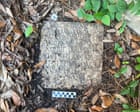
She was carved into a slab of marble, a silent figure from the first century CE, resting beneath the hydrangeas and the humidity of a Louisiana backyard. For decades, she had been a literal foundation of a private garden, her face pressed against the dark earth while lawnmowers whirred overhead and children played tag. This was not a replica. It was an authentic Roman funeral stele, a piece of history that had survived the collapse of empires only to end up as a decorative border in the American South.
How does a two-thousand-year-old ghost cross the Atlantic to haunt a New Orleans zip code?
The answer is rarely romantic. It usually involves a receipt, a suitcase, and a profound lack of questions.
In this case, the stone had been purchased in the late 19th century by a previous owner of the property. At the time, the "Grand Tour" was the ultimate status symbol for the wealthy. They traveled through Europe, scooping up pieces of antiquity as if they were seashells on a beach. It was an era of casual plunder. A marble head for the library. A fragment of a frieze for the mantle. The stele was brought back to New Orleans, displayed for a time, and then, as fashions changed and memories faded, it was moved. Then it was forgotten. Then it was buried.
The Weight of a Name
We often treat ancient artifacts as "objects," but a gravestone is an intensely personal document. It is a desperate shout against the silence of time. When the FBI’s Art Crime Team and Italian authorities finally examined the slab, they weren't just looking at a rock. They were looking at a memorial for a young girl.
The inscription was clear, or at least clear enough for those who know how to read the Latin of the dead. It honored a girl who had died far too young. In the Roman world, a stele was a way to ensure that as long as a passerby read the name aloud, the person lived on. For a hundred years in New Orleans, no one read the name. The connection was severed.
Consider the logistical absurdity of this journey. This marble was quarried from the hills of Italy during the reign of the Julio-Claudians. It was carved by a craftsman who likely smelled of sweat and stone dust, commissioned by grieving parents who paid in sesterces. It stood in a necropolis outside Rome, weathered by the Mediterranean sun, for nearly two thousand years.
Then, it was crated, hauled onto a steamship, navigated across the Atlantic, moved through the mouth of the Mississippi, and eventually tucked into a garden bed where the neighborhood dogs could bark at it.
The discovery triggered a quiet, high-stakes dance of diplomacy. The FBI doesn't just knock on a door and take a gravestone because it looks old. They have to prove it was taken in violation of cultural heritage laws. But the current homeowner wasn't a criminal; they were an accidental custodian. They were someone who had looked down at the mud and realized they were standing on a masterpiece.
The Long Walk Home
There is a specific kind of vertigo that comes from touching something that old. It makes your own life feel like a flicker. The homeowner contacted the authorities, beginning a multi-year process of authentication and repatriation.
This isn't just about "returning property." There is a deep, psychological gravity to cultural heritage. When a country like Italy asks for a stone back, they aren't looking to fill a hole in a museum wall. They are reclaiming a piece of their collective DNA. Every artifact stolen or exported without a paper trail is a lobotomy of the historical record. When you take a stone out of its context, you kill its story. You don't know who it was near, what road it faced, or what temple stood behind it.
The New Orleans stele had become a "cold case" of archaeology.
The FBI’s Art Crime Team operates in a world of shadows, chasing down looted statues and forged paintings. But cases like this are the most poignant because they involve people who didn't know they were part of a tragedy. The family in New Orleans had lived alongside this stone for years. It was part of the "vibe" of their home. Giving it up meant acknowledging that some things are too big to be owned.
The process of moving a one-ton slab of marble is an exercise in nerves. One slip of a crane, one unsecured strap, and two millennia of history become gravel. It was crated with the kind of reverence usually reserved for religious relics. It traveled back across the ocean—this time in the cargo hold of a plane rather than the damp bowels of a ship—and landed in Rome.
The Restoration of Order
When the stone arrived in Italy, it was greeted not as a trophy, but as a returned citizen.
The Italian Carabinieri Command for the Protection of Cultural Heritage is perhaps the most sophisticated "art police" force in the world. They treat these returns with the solemnity of a homecoming. For them, the New Orleans stone was a missing line in a poem they have been trying to finish for centuries.
We live in an age where we think everything is available to us. We believe that if we have the money, we can own a piece of the past. We buy "ancient" coins on eBay and limestone fragments in boutique shops. But there is a hidden cost to this obsession with possession. When we treat the past as a commodity, we strip it of its dignity.
The girl whose name was carved on that stone didn't belong in a suburban backyard in Louisiana. She didn't belong under a layer of mulch and Bermuda grass. She belonged to the soil that produced the marble, to the culture that mourned her, and to the history that recorded her existence.
The return of the New Orleans stele is a rare win in a world where the black market for antiquities is a multi-billion dollar industry. It serves as a reminder that the ground is always watching. We are temporary tenants on this earth, and the things we build—our houses, our fences, our gardens—are built on top of the lives of those who came before us.
Sometimes, the earth decides to give something back.
The New Orleans homeowner could have kept quiet. They could have left the stone face-down in the dirt, a secret buried beneath the flowers. But they chose to listen to the stone. They chose to recognize that some debts can only be paid by letting go.
Now, the sun that hits the marble is the same sun that watched the carver work two thousand years ago. The air is dry, the language is familiar, and the name is finally being read again. The woman in the stone is no longer a foundation for a garden. She is a memory restored to its proper place, a long-lost traveler who finally found the way back to the Appian Way.
History isn't just something that happened. It is something that is still happening, waiting for someone to pick up a shovel and start digging.