Concrete and Diesel Fuel
Stand on the riverbank in Sandwich, an old neighborhood on the west side of Windsor, Ontario, and you can smell two things at once: the damp, heavy sediment of the Detroit River and the constant, bitter reek of idling diesel engines.
For nearly a century, those fumes belonged to a single landmark. The Ambassador Bridge, privately owned and stubbornly ancient, opened in 1929. Since then, it has carried more than a quarter of all merchandise trade between Canada and the United States. Day after day, thousands of eighteen-wheelers form a creeping, metallic snake down Huron Church Road, grinding through city stoplights just to reach the customs plazas.
If a single trailer carrying brake rotors breaks down on that span, auto assembly plants in Michigan and Ontario begin to twitch like nervous nervous systems within four hours.
Now look up.
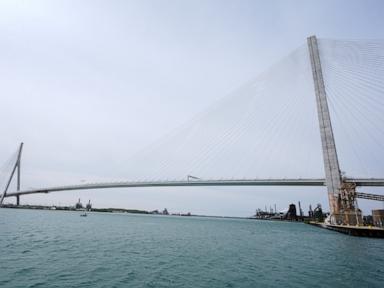
Rising over two hundred meters into the gray Midwestern sky stand two majestic concrete towers. They hold up six lanes of deck suspended by massive steel cables that sweep across the water in clean, dramatic diagonals. This is the Gordie Howe International Bridge. It is a public monument to shared economic destiny, constructed out of twenty thousand short-tons of structural steel and hundreds of thousands of tons of reinforced concrete.
It is almost ready. The Canadian government, which funded the overwhelming majority of the multi-billion-dollar project, is preparing to celebrate its opening.
Yet, as the physical structure settles onto its piers, the political ground beneath it is shaking.
A Border Built on Parts
Consider a simple automotive crankshaft.
To understand why a piece of civil engineering matters so deeply, you have to follow that chunk of forged steel as it makes a hypothetical, yet standard journey across the river. It starts as raw Canadian iron, poured and cast in an Ontario foundry. A driver hauls it across the river into Michigan, where a specialized plant machines the journals and drills the oil passages.
Then it crosses back into Canada for nitriding and heat treatment.
Finally, it returns to the United States to be dropped into an engine block on an assembly line near Detroit.
That crankshaft crosses the Detroit River four times before the vehicle it powers ever turns a wheel on a public road. That is not an accident of geography; it is the integrated reality of modern North American manufacturing.
When politicians in Washington speak about tariffs, trade wars, and economic nationalism, they speak in clean, sweeping abstractions. They draw neat lines on maps. But on the ground, the border is not a line. It is a circulatory system.
[Raw Iron] ---> Cast in Ontario
               ---> Machine In Michigan
               ---> Heat Treatment in Ontario
               ---> Assembly in Detroit
If you slap a twenty-five percent tax on a physical good every time it crosses a river, you do not protect a domestic industry. You strangle the very creature you built over decades of cooperative investment.
The Quiet Panic on the Line
Imagine a long-haul truck driver sitting in the cab of an International LT sleeper. Let us call him Mark.
Mark has been driving the Detroit-Windsor corridor for thirty-two years. He remembers when border crossings were settled with a nod, a brief glance at a paper manifest, and a quick question about fruit or fireworks. Today, his dashboard displays a bank of monitors, tracking electronic customs filings and automated weigh-in sensors.
For drivers like Mark, time is not just money; it is safety, sleep, and compliance with strict hours-of-service laws.
"Sitting on Huron Church Road for three hours with thirty tons of auto stampings behind you isn't just frustrating," Mark might tell you while waiting at the scale. "It burns fuel, it burns your legal clock, and if the line stops completely, the factory down the road shuts down its second shift before midnight."
When news breaks that tariff threats are resurfacing from Washington, the anxiety inside cabs like Mark’s is instant. If tariffs disrupt supply chains, shipping volumes drop. If shipping volumes drop, freight rates collapse.
The bridge was supposed to fix the physical nightmare: no more city stoplights, direct highway-to-highway connections from Ontario’s Highway 401 straight to Michigan’s Interstate 75. A smooth, uninterrupted artery for trade.
Instead, workers on both sides find themselves asking a troubling question: What happens when you build the most efficient trade conduit on the continent, just as the political appetite for trade begins to rot?
The Cost of Uncertainty
The math behind the new crossing is stark.
Canada took on the massive financial burden of building the bridge—originally budgeted around six billion Canadian dollars—after years of political paralysis in Michigan and bitter legal challenges from the private owner of the old Ambassador Bridge. Canada agreed to pay for the bridge design, the Canadian inspection plaza, the American inspection plaza, and the direct connection to Interstate 75. The money would be recouped through toll collection over decades.
It was a bet on the future. It was a statement of faith that the two nations were permanently tied together by geographic and economic logic.
Then came the policy shifts.
Threats of broad, sweeping tariffs on Canadian goods—including steel, aluminum, and automobiles—threaten to throw sand into the gears of the entire region. The danger is not merely the immediate cost of a tax at the border. The deeper danger is the chill of uncertainty.
When an executive in Toronto or Detroit considers building a new three-hundred-million-dollar manufacturing facility, they require predictability. They need to know that the rulebook five years from now will resemble the rulebook today.
If every election cycle carries the risk of sudden, punitive trade levies, capital sits on the sidelines. Factories do not expand. Machinery is not upgraded. The new bridge, designed to carry thousands of trucks an hour, risks watching a fraction of that capacity materialize if trade policy becomes a weapon of domestic political theater.
Two Nations, One River
There is a quiet irony in the naming of the bridge.
Gordie Howe was born in Saskatchewan, Canada. He became a hockey legend playing for the Detroit Red Wings. For millions of people living in the borderlands, he belonged to both places equally. He embodied a truth that regional residents know in their bones: the border between Michigan and Ontario has always been permeable, friendly, and deeply human.
Families live on one side and work on the other. Nurses cross every morning from Windsor to staff hospitals in downtown Detroit. Engineers commute daily to refine powertrain software on opposite sides of the river.
The workers who built the bridge towers understand this intuitively. Ironworkers from local unions in Ontario and Michigan labored side by side hundreds of feet in the air, tying rebar and torqueing structural bolts in sub-zero winter winds. They did not ask each other about political parties or national trade disputes. They built the connection because the river needed bridging.
Windsor, ON (Canada)  <========== Gordie Howe Bridge ==========>  Detroit, MI (USA)
      |                                                                 |
   Hospitals                                                        Commuters
   Factories                                                        Assembly
Now, as ribbon-cutting ceremonies are planned, officials in Ottawa and Toronto are balancing two completely different emotions.
On one hand, there is legitimate pride. The completion of a mega-project of this scale—on time and through the disruptions of global supply chain collapses—is a remarkable engineering triumph. On the other hand, there is a cold, creeping dread.
Celebrating a new trade route while the nation on the other end threatens to erect trade walls is an exercise in diplomatic tightrope walking.
The Weight of What Remains
Nations can sign treaties with the stroke of a pen, and they can tear them up just as quickly. A tariff can be announced on a social media post at two in the morning and take effect by Friday.
A bridge cannot be built or torn down on a whim.
It stands as a testament to long-term thinking in an age dominated by short-term political cycles. Thousands of tons of concrete sunk deep into the bedrock beneath the Detroit River do not care about election years, cable news outrage, or sudden policy shifts.
The cables are pulled tight. The deck is set. The lanes are painted.
When the first commercial truck rolls up the ramp onto the Gordie Howe International Bridge, its driver will look out over the river toward the skyline of Detroit. Below, the water will flow steady and indifferent toward Lake Erie, carrying the runoff of an entire continent.
The infrastructure is ready. The physical connection is complete. All that remains to be seen is whether the human will to trade, cooperate, and neighbor remains as solid as the steel holding it all up.