Silence.
That is the sound of history slipping through the cracks while everyone is looking at their phones, waiting for a push notification to tell them what mattered today.
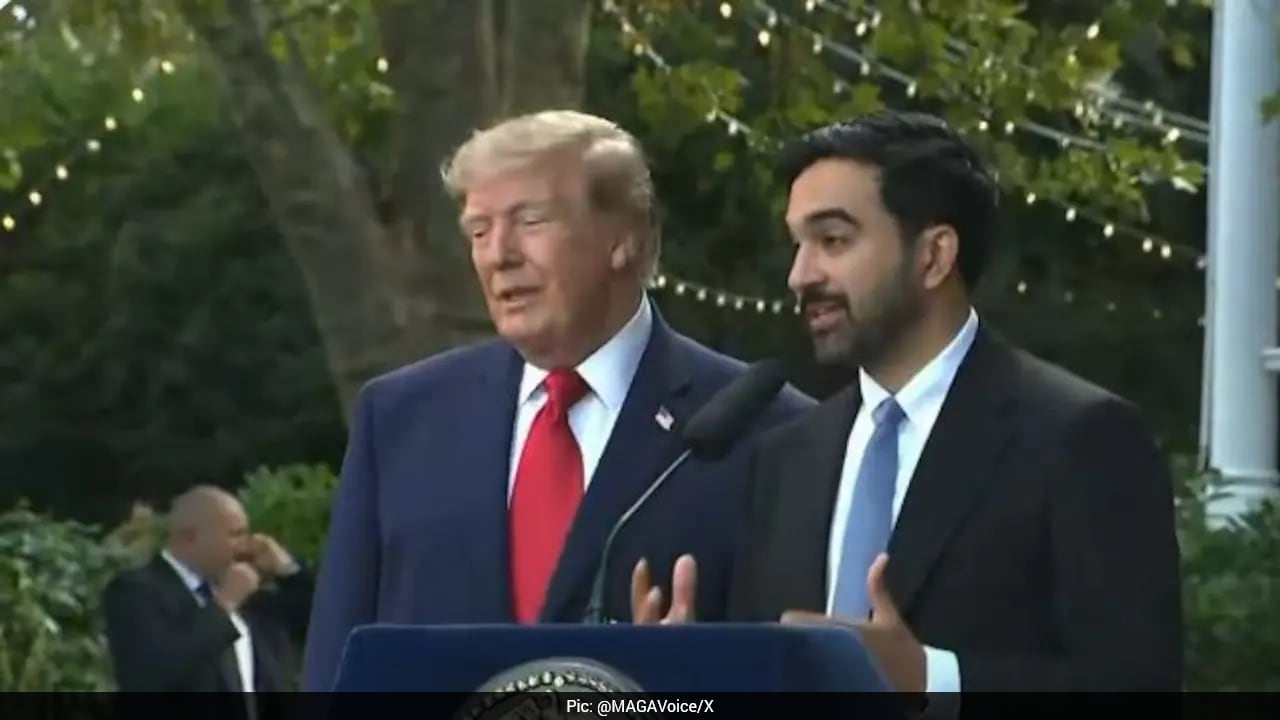
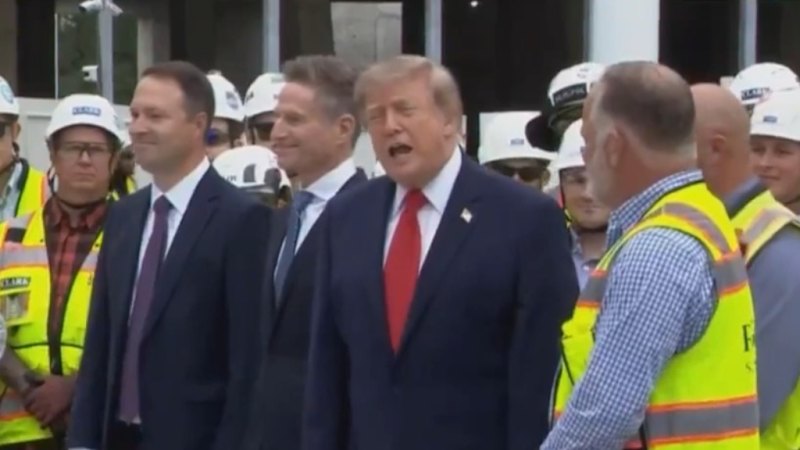
Picture a local gymnasium or a newly poured concrete loading dock in a mid-sized American county—let’s call this hypothetical town Millbrook, though it could be any of a hundred places across Pennsylvania, Ohio, or Michigan. The folding chairs are set out in neat rows. A heavy red ribbon stretches across two brass stanchions, catching the flat afternoon glare of October. A local high school band plays a slightly out-of-tune march, the brass section working hard against a brisk autumn wind. And at the podium stands Donald Trump, former president, current political juggernaut, a man whose every syllable usually triggers a thousand cable news chyrons before he even finishes his sentence.
He speaks for forty minutes. He talks about steel tariffs, about the local highway interchange, about a factory owner he met backstage, about the state of the union as he sees it from behind a plexiglass shield. People in the third row nod. A woman in a faded union jacket records a shaky thirty-second clip on an iPhone 11, her thumb partially covering the microphone.
Then the ribbon is cut. The crowd disperses. And by six o'clock that evening, for all practical purposes, the speech has ceased to exist.
No full transcript appears on the major wire services. No gavel-to-gavel video feed sits archived on the YouTube channels of the legacy networks. Because the major broadcast and cable networks opted not to send a pool camera—or decided the event was routine campaign or ceremonial filler not worth the satellite truck—the public record simply develops a blind spot.
We have reached a strange, disorienting moment in American public life. We live inside an ocean of noise, drowning in hot takes, podcasts, and algorithmic rage, yet the foundational bedrock of democracy—the literal record of what powerful people say in public—is quietly eroding.
The Vanishing Pool Camera
To understand how a major political figure can stand at a microphone in broad daylight and leave almost no official trace, you have to understand the invisible machinery of the press pool.
For decades, the arrangement worked like an insurance policy for the public. Even when an event seemed mundane—a bridge dedication, a chamber of commerce luncheon, a ribbon-cutting at a regional manufacturing plant—the major television networks and wire services maintained a rotating system. Someone was always there. A camera was always rolling. A tape was always running. Journalists called it "deathwatch" coverage: you didn't stand in the rain for four hours because you expected fireworks; you stood there because if something unexpected happened, or if the speaker made a promise to the people of Millbrook that contradicted what he told Wall Street the week before, the receipts would exist.
I spent years working in local and regional newsrooms before the great contraction hollowed them out, and I still remember the physical weight of those tapes and the fierce, almost stubborn pride of the people who logged them. There was a rule drilled into every cub reporter: Get the whole thing. Not the soundbite. Not the applause line. The whole, messy, rambling, unedited thing, because the truth rarely lives in the ten seconds a producer selects for the evening broadcast. It lives in the qualifiers, the tangents, and the off-the-cuff remarks delivered when a politician thinks nobody in New York or Washington is watching.
Today, that insurance policy is being canceled, one budget cut at a time.
Major news organizations are bleeding revenue. Newsrooms that once employed hundreds of field producers, audio engineers, and bureau reporters have shrunk to skeleton crews huddled in Manhattan and D.C. Sending a crew to a ribbon-cutting ceremony costs thousands of dollars in travel, overtime, and transmission fees. Meanwhile, an editorial desk can generate ten times the web traffic by clipping a thirty-second argument from a cable panel or aggregating a social media post from the comfort of an office chair.
The math is brutal, and the logic feels seductive to executives staring at quarterly spreadsheets. Why pay to record a routine speech when you can just cover the reaction to it?
What Happens When the Record Goes Dark
Consider what happens next: a vacuum opens up, and nature abhors a vacuum.
When the major networks decide a speech isn't worth recording in full, they don't just save money. They surrender the baseline of reality.
Imagine two people arguing at a dinner table a week after that ribbon-cutting. One says, "He promised he wouldn't touch Social Security, and he said it right there in front of the whole town." The other says, "No, he didn't—he said everything was on the table, I saw a clip on X."
Without a complete, verifiable, unedited recording from an independent source, how do you settle that argument? You can't. Both sides retreat to their chosen corners of the internet, armed with selective, out-of-context fragments shot from cellphones or released by the campaign's own media team.
This is where the stakes stop being abstract and start turning personal.
Think of a retired machinist—let’s call him Arthur—who drove forty miles in a pickup truck with a failing alternator just to hear what a national leader had to say about the pension fund that keeps his heat on in January. Arthur isn't looking for entertainment. He is trying to make a calculation about his own survival. When the major outlets skip the event, the implicit message sent to Arthur and everyone standing beside him in that gymnasium is unmistakable: Your town isn't big enough. Your concerns aren't cinematic enough. What happens here doesn't count.
And there is an even sharper edge to this problem. Political figures are acutely aware of when the red light on the network camera is off.
When a speaker knows that only friendly local outlets or campaign videographers are rolling tape, the guardrails come down. Rhetoric sharpens. Promises grow bolder, looser, and harder to verify later. Conversely, if a speaker says something genuinely significant—a subtle shift in foreign policy, a new stance on industrial subsidies, a candid admission about economic pain—it disappears into the ether because nobody with national reach was there to catch it.
We often talk about misinformation as if it is purely a digital virus, something cooked up by bot farms and bad actors in dark rooms. But half the time, misinformation is simply a symptom of under-coverage. Rumors thrive in the dark. Selective edits only work when there is no full-length original to compare them against.
The Economics of Attention
It is tempting to blame individual reporters for this, to picture lazy journalists sipping lattes while history happens out in the heartland. That picture is false, and it misses the real villain.
The reporters I know are exhausted. They are doing the work of three people, filing for web, radio, television, and social platforms simultaneously while watching colleagues get laid off every spring. The real culprit is an attention economy that rewards heat over light and outrage over documentation.
Think of journalism like a city's water system. The flashy cable shows, the viral columns, the investigative bombshells—those are the fountains in the town square. Everyone admires them. Everyone gathers around them. But the unglamorous work of recording speeches, attending zoning board meetings, and transcribing public hearings is the underground plumbing. Nobody takes selfies next to a water main. Nobody wins a Pulitzer for archiving a forty-minute speech at a ribbon-cutting ceremony.
Yet when you stop maintaining the pipes, the fountains eventually dry up, and whatever comes out of the tap turns brown.
According to data tracked by Northwestern University's Medill School of Journalism, the United States has lost more than a third of its newspapers since 2005, leaving over two hundred counties as complete news deserts with no local outlet at all. When local papers vanish, national networks are supposed to be the safety net. Instead, national networks have increasingly adopted the same triage mentality, covering politics like a sporting event—focusing exclusively on the stadium lights, the scoreboard, and the post-game press conference, while ignoring the actual play on the field.
I'll admit something that still bothers me when I think about my own years in the business: we used to joke about the boring assignments. Nobody wanted to draw the short straw and cover the ribbon-cutting or the afternoon proclamation. We wanted the scandal, the storm, the breaking news alert. We took the safety net for granted because we assumed someone else was always holding the other end of it.
Now we are looking down, and the net has holes wide enough to drive a motorcade through.
A Fragmented Memory
There is a deeper, quieter cost to letting speeches go unrecorded, and it has nothing to do with immediate partisan point-scoring. It has to do with memory.
Every generation relies on historians, biographers, and everyday citizens to look back and trace the arc of how a country changed its mind. We understand the 1930s because Franklin Roosevelt's fireside chats and whistle-stop remarks were preserved in full. We understand the civil rights movement not just through its famous crescendos in Washington, but through the grainy, complete recordings of speeches delivered in church basements across Alabama and Mississippi.
What happens when historians fifty years from now try to reconstruct the political reality of the 2020s?
They will find terabytes of commentary. They will find millions of hours of pundits arguing about what politicians meant. They will find endless threads of outrage, memes, and AI-generated summaries of summaries. And right in the middle of that digital mountain, they will find baffling gaps—days when major figures spoke to thousands of citizens, and the primary source material simply vanished because it didn't fit the content strategy of a media conglomerate on a Tuesday afternoon.
You cannot build a shared national memory out of thirty-second clips. A clip is an artifact of someone else's agenda; it tells you what the editor wanted you to feel, not what the speaker actually argued. Only the full record lets you think for yourself.
Reclaiming the Record
So where does that leave us—not as media executives, not as political operatives, but as ordinary people trying to stay informed without losing our minds?
First, we have to recognize the difference between coverage and documentation. Coverage is noisy, fast, and heavily filtered. Documentation is slow, complete, and raw. Whenever a major news event happens—a speech, a court hearing, a legislative debate—the single healthiest habit a citizen can build is to seek out the primary source before reading the commentary. Organizations like C-SPAN, local public broadcasting stations, and independent local reporters still do the unglamorous work of pointing a camera at the podium and letting it run without commercial interruption. They survive only when people actually use them.
Second, we need to value local journalism not as a nostalgic charity case, but as basic civic infrastructure. When a regional paper or local TV station sends a reporter to cover a ribbon-cutting in a town like Millbrook, that reporter isn't just writing for the town. They are acting as the eyes and ears for the entire country. Supporting local outlets—subscribing to the paper in your county, sharing their original reporting rather than national aggregators that rewrite their work—keeps boots on the ground where the network vans no longer park.
Finally, we have to demand better from the major institutions that still claim the mantle of the public record. Covering a major political figure isn't an all-you-can-eat buffet where networks get to pick only the flashy dishes that boost ratings and leave the vegetables on the tray. If you claim to cover American democracy, you have to show up even when the script looks predictable. Especially when the script looks predictable.
Back in that hypothetical gymnasium in Millbrook, the folding chairs are stacked against the cinderblock wall now. The high school band has packed its instruments into battered black cases and boarded the yellow bus home. Somewhere in the parking lot, the woman in the union jacket climbs into her sedan, unlocks her phone, and watches the thirty-second clip she recorded—the one where the wind caught the microphone and drowned out half a sentence.
She uploads it anyway, because it is all she has, and the rest of the speech is already gone.