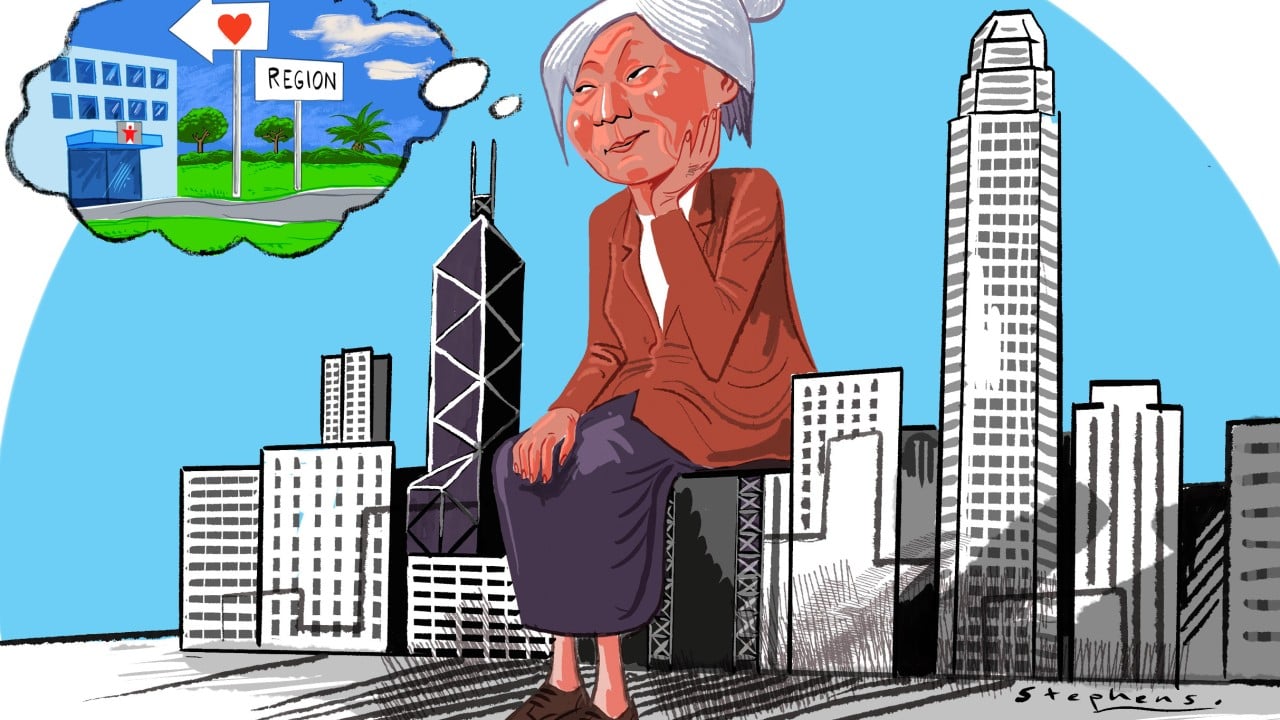
Hong Kong faces a demographic compression that is less about the total number of elderly citizens and more about the geographic misalignment between where people live and where care infrastructure exists. The city’s silver tsunami is a logistical bottleneck. By 2046, one in three residents will be aged 65 or older. However, the current urban planning model treats aging as a stationary problem when it is, in fact, a problem of spatial distribution and residential mobility. The failure to synchronize housing policy with healthcare accessibility has created a systemic deficit that cannot be solved by simply increasing the number of hospital beds.
The Tri-Node Model of Elder Care Dependency
To understand the strain on the city, we must deconstruct the aging process into three distinct spatial nodes. Each node represents a different level of dependency and requires a different set of infrastructure interventions.
- Node 1: Independent Aging in Place. This involves high-functioning seniors living in private or public housing. The primary requirement here is universal design—structural modifications like walk-in showers and barrier-free access.
- Node 2: Assisted Community Living. Seniors require daily support but not 24-hour clinical supervision. This relies on the proximity of Day Care Centres for the Elderly (DEs).
- Node 3: Institutionalized Residential Care. High-dependency individuals requiring Residential Care Homes for the Elderly (RCHEs).
The crisis emerges when individuals in Node 1 or 2 are forced into Node 3 prematurely because their physical environment—specifically the "walkability" and "elevator-to-unit ratio" of older districts—becomes a barrier to basic survival.
The District Mismatch Function
The intensity of the aging crisis is not uniform across Hong Kong’s 18 districts. There is an inverse relationship between district wealth and the availability of care facilities. Older, lower-income districts such as Kwun Tong, Wong Tai Sin, and Sham Shui Po possess the highest concentrations of elderly residents but suffer from "vertical isolation."
Vertical isolation occurs when elderly residents live in "tong lau" (walk-up buildings) or aging public housing estates where elevator wait times or maintenance failures effectively imprison them in their apartments. This physical confinement accelerates cognitive decline and muscle atrophy, shifting the burden from community-based care to the emergency medical system.
The "Old-age Dependency Ratio" is a common metric, but it is flawed because it assumes every person over 65 has the same impact on the system. A more accurate metric is the Geographic Care Access Score (GCAS), which factors in:
- The ratio of RCHE beds to the local population over 80.
- The median walking distance from public housing to the nearest primary clinic.
- The topographical gradient (slope) of the district, which dictates the energy expenditure required for a senior to access essential services.
The Structural Failure of the RCHE Market
Hong Kong’s residential care market is split between subvented (government-subsidized) and private homes. The wait time for a subvented bed currently averages several years, leading to a "deadlock" in the transition from hospital to home.
The economic reality of Hong Kong real estate dictates that private RCHEs often occupy the upper floors of old commercial buildings or podiums of residential blocks. This creates a safety bottleneck. Fire safety regulations and minimum floor space requirements per resident ($6.5$ square meters, though recently increased to $8$ and $9.5$ square meters for different home types) limit the scalability of these facilities.
The cost function of private care is unsustainable for the median household. When the cost of a private RCHE bed exceeds the median household income, families are forced into "informal caregiving." This removes productive adults from the workforce, creating a secondary economic contraction. The dependency isn't just about the elderly; it's about the erosion of the labor force participation rate among the 45–60 age bracket who must pivot to full-time care.
Technological Deficits in Aging Infrastructure
The narrative often suggests that "Silver Tech" will bridge the gap. However, the implementation of technology in Hong Kong's aging sector is fragmented. Gerontechnology—ranging from smart sensors to companion robots—requires a high-speed data backbone that many older residential facilities lack.
The bottleneck for technology adoption is not the software, but the physical environment. Installing a ceiling hoist for patient transfer or a smart monitoring system requires electrical retrofitting that many private care homes cannot afford without significant capital expenditure. Furthermore, the "digital divide" among the elderly is not merely a lack of skill; it is a lack of inclusive design in the government's digital service interfaces.
The Cross-Border Arbitrage Hypothesis
A significant strategic pivot currently under discussion is the "Northern Metropolis" and the integration of the Greater Bay Area (GBA). The hypothesis is that Hong Kong can export its aging problem by subsidizing seniors to retire in mainland cities like Shenzhen, Zhongshan, or Zhaoqing, where land costs are lower and space is more abundant.
While this solves the "space-per-resident" problem, it introduces a "Clinical Continuity Gap."
- Medical Record Portability: Despite the Electronic Health Record Sharing System (eHealth), the seamless transfer of data between Hong Kong’s Hospital Authority and mainland Chinese hospitals remains administratively complex.
- Healthcare Reimbursement: The Elderly Health Care Voucher scheme has been extended to some mainland facilities, but the scope of coverage for chronic disease management and emergency surgeries remains limited.
- Social Isolation: Removing a senior from their established social network in Hong Kong to a "retirement village" in a different jurisdiction can lead to psychological deterioration, which manifests as physical illness, eventually increasing the long-term cost of care.
The Decoupling of Land Use and Social Need
The primary cause of the current crisis is the historical decoupling of land auctions from social infrastructure requirements. For decades, land was sold to the highest bidder with minimal mandates for "social space." Consequently, we have high-density residential towers with luxury clubhouses but zero provision for communal elder care.
A structural shift is required in the Land Use Zoning (OZP) process. Future land sales must include "Elder Care Covenants" that mandate a specific percentage of GFA (Gross Floor Area) be dedicated to Node 2 facilities (Day Care). This should not be an optional "bonus" but a prerequisite for development.
The Labor Constraint and Migration Logic
Even if the spatial and physical infrastructure issues are solved, the labor constraint remains the most significant risk factor. The ratio of care workers to residents in Hong Kong is significantly lower than in jurisdictions like Japan or Singapore.
The resistance to importing labor in the care sector has created a wage-push inflation within the industry that does not translate into better care quality. The logic is simple: if the job of a care worker is physically demanding, low-status, and pays only marginally more than retail, the local talent pool will remain empty. The only logical path forward is a regulated, sector-specific migration channel for care professionals, combined with a mandatory "Dignity in Labor" framework that improves working conditions through automation.
Strategic Transition to a High-Density Aging Model
The solution to Hong Kong’s aging crisis is not to build more hospitals, but to redesign the city to be "orthopedic-friendly." This requires a shift from a clinical mindset to an architectural and logistical one.
The immediate priority is the Retrofitting of the 1970s–80s Public Housing Stock. This generation of housing was built for young families and is fundamentally ill-equipped for a population using mobility aids. The second priority is the Mandatory Integration of Medical and Social Records. We cannot manage a population we cannot track; the disconnect between the Social Welfare Department and the Hospital Authority results in "frequent flyers" in the A&E rooms who actually need social intervention, not medical procedures.
The final strategic move is the De-institutionalization of Care. By incentivizing the "hospice-at-home" and "care-at-home" models through tax credits and subsidized professional home-care visits, the state can offload the capital expenditure of building new RCHEs onto the existing housing stock. This only works if the housing stock is physically capable of supporting that care. If Hong Kong fails to integrate care capacity into its urban fabric, the result will be a permanent state of emergency in the public healthcare system, driven not by disease, but by the friction of an aging body in an unforgiving city.