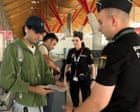
European unity sounds great in conference rooms, but it cracks fast when thousands of migrants cross a fence. Right now, a bitter diplomatic brawl between Madrid and Rome has turned internal European travel into a bureaucratic nightmare. Spain started carrying out spot checks on visitors arriving from Italy at midnight on Saturday. This tit-for-tat move came straight after Rome infuriated Spanish officials by launching its own targeted checks on travellers coming from Spain.
Honestly, you've got to ask yourself how two founding members of the European project ended up treating each other like hostile states. The roots of this feud trace directly back to the Spanish North African enclave of Ceuta, where roughly 72,000 people crossed the border from Morocco. That massive influx spooked neighboring Mediterranean nations, and Rome decided it needed to take matters into its own hands.
The Anatomy of a Diplomatic Fallout
When Rome launched checks on August 1 for travellers arriving from Spain, Italian officials pointed to the chaos in Ceuta as a direct security threat. Italian Foreign Minister Antonio Tajani defended the choice in local press interviews, arguing that some order had to be restored. He expressed fears that individuals holding jihadist views could slip through the cracks and make their way into Italy, which he views as a primary destination for secondary migration movements.
Madrid reacted with fury. Spanish Foreign Minister José Manuel Albares didn't hold back when addressing reporters, labeling the Italian checks an intolerable scene at airports, an attack on the dignity of the Spanish people, and a torpedo fired straight at the hull of European unity.
Spain's argument relies on a basic geographic and legal reality that Rome seems to be ignoring. Ceuta isn't actually part of the Schengen free-movement zone. Spanish authorities had the border back under control quickly, and the vast majority of those who crossed were returned to Morocco. Madrid argues there's virtually zero chance of unvetted individuals making their way into continental Europe from the enclave unless they already hold EU citizenship or legal residency.
Catching Real People in Political Crossfire
Politics at this level always sounds abstract until you look at the human cost. More than eight million people travel between Spain and Italy every year. Suddenly, ordinary tourists, business commuters, and dual citizens found themselves stuck in unnecessary bottlenecks.
Elisa Fabbri, a 41-year-old traveller leaving Madrid-Barajas airport, called the situation ridiculous. Israel Pérez, a Cuban-born Spanish citizen, described it as an absurd spiral that risks pulling everyone down. He noted that if European countries keep imposing checks on each other, everyone loses in the end.
You can't blame travellers for feeling frustrated. They are paying the price for a deeper political game being played by leaders trying to project strength ahead of upcoming elections.
The Hypocrisy Over Migration Policy
Underneath the immediate border checks lies a much older, uglier argument about how Europe handles immigration papers. Rome has spent years criticizing Madrid for its regularisation programs, claiming that giving working migrants legal papers sends a negative message that threatens everyone's safety.
Yet, the hypocrisy is staggering. While Italian Prime Minister Giorgia Meloni positions herself as a hardline migration hawk, the Italian government is quietly working on plans to grant nearly 1.1 million work permits to foreign workers by 2028. Researchers have accurately dubbed Rome's strategy a disguised amnesty. Both countries desperately need foreign labor to prop up their aging domestic workforces and grow their economies, but neither politician wants to admit it publicly. Pedro Sánchez defends foreign workers to sustain Spain's economic growth, while Meloni plays to her right-wing base by slamming those exact same policies.
Where Europe Goes From Here
EU Migration Commissioner Magnus Brunner has scrambled to contain the damage, stating that both governments assured him the internal border controls are strictly temporary. Signals suggest Italy might lift its restrictions soon as diplomatic pressure mounts.
Still, the damage to the Schengen ideal is already done. When a localized crisis at an external border triggers immediate retaliatory checkpoints between major EU partners, the illusion of a seamless borderless Europe shatters completely. If you are planning a trip between Italy and Spain over the coming weeks, keep a close eye on airport transit guidelines and expect sudden administrative delays. Keep your documentation ready, allow extra time for security queues, and don't assume your European transit rights will protect you from political theater.