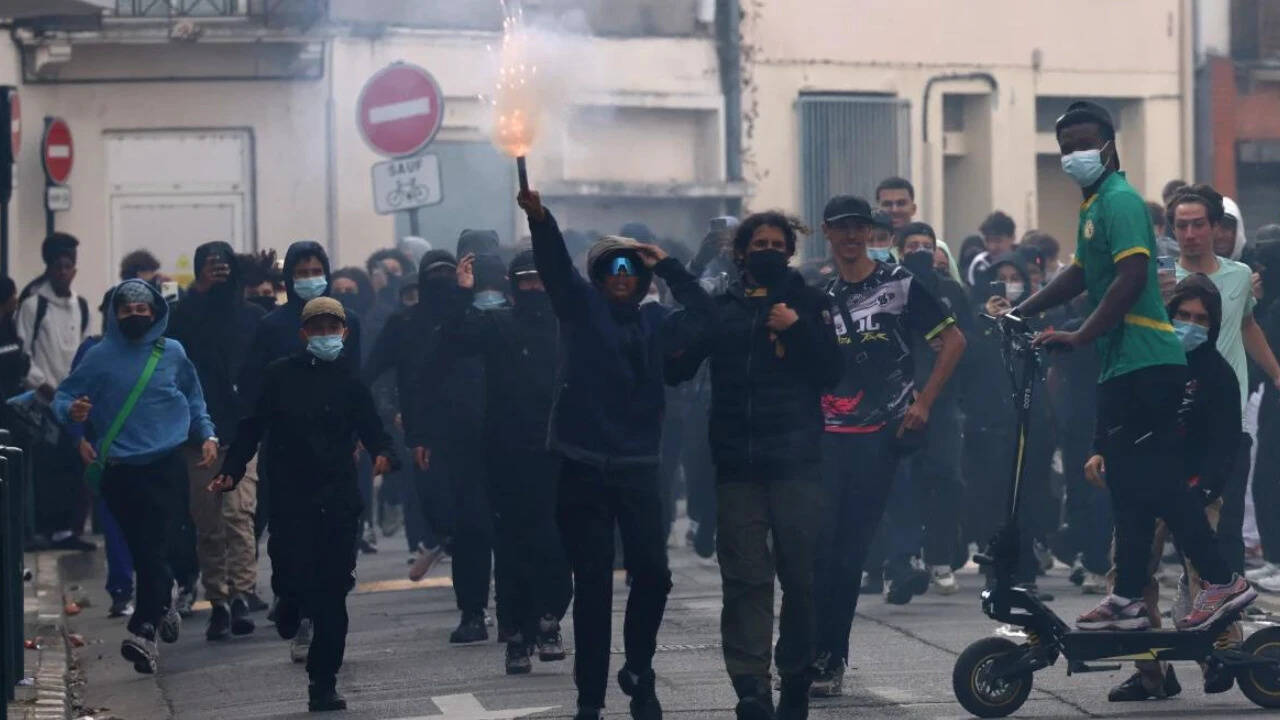
The air outside the high school gates in central France tasted like autumn rain and burnt gasoline. It was a crisp morning, the kind that usually smelled of damp leaves and cheap bakery croissants. Students milled about in loose circles, their breath pluming white against the grey dawn. They were cold, restless, and angry.
They were teenagers. They were protesting educational reforms.
Then came the sound. It was not a loud sound, not initially. It was a sharp, flat crack that severed the morning chatter cleanly in half. A split second later, smoke bloomed across the asphalt, thick and acrid.
For a fifteen-year-old boy standing near the front of the blockade, the world narrowed down to a single, impossible fraction of a second. A GLI-F4 stun grenade—a defensive weapon designed by the state to disperse unruly crowds—landed among the teenagers. It did not merely make noise. It detonated with the concussive fury of a military explosive, releasing an instantaneous shockwave and a blinding flash.
When the white smoke cleared, the screaming started. The boy looked down at his right hand. Or rather, where his hand had been moments before.
Smoke still curled from his ruined shirtsleeve. The concrete was stained crimson.
We live in an era that treats civil unrest as a logistics problem. When crowds gather, when teenagers chant slogans they half-borrowed from their older siblings, when high school gates are barricaded with overturned plastic bins and burning tires, the state panics. The machinery of public order grinds into motion. Batons are issued. Shields are hoisted. And increasingly, specialized munitions are handed to officers whose primary training is confrontation, not crowd psychology.
Consider what happens when a government meets youthful defiance with the vocabulary of war.
The French student protests of that autumn were not born in a vacuum. They were fueled by a deep, simmering anxiety over sweeping educational reforms, changes to university entrance exams, and the gradual erosion of the social safety net that working families relied upon. To the adults in parliament, these were line items on a bureaucratic spreadsheet. To the kids standing outside the school gates in the freezing dawn, they felt like an existential theft of their futures.
So they did what generations of French youth have done before them. They took to the streets.
They expected police presence. They expected scuffles, pushed shoulders, perhaps even the sting of tear gas—an unpleasant, stinging rite of passage for young activists. What none of them expected, and what no democratic society should ever normalize, is that a morning protest could result in a child losing a limb.
The device that changed that boy’s life forever was not a rubber bullet or a tear gas canister. It was an explosive charge containing high-grade chemical compounds designed to disorient through sheer sensory overload. In the hands of riot police facing volatile crowds, these weapons are defended as non-lethal deterrents. But ask the surgeon who operated on the fifteen-year-old boy whether the word non-lethal applies to an object capable of vaporizing bone and tissue.
Language matters. When we call an explosive grenade non-lethal, we sanitize its violence. We create a linguistic cushion that allows authorities to deploy military-grade hardware on civilian streets against minors.
Picture a typical French classroom the morning after the incident.
The desks are arranged in neat rows. The radiator clanks softly against the wall. The teacher stands at the front, chalk in hand, attempting to guide thirty exhausted minds through a lesson on nineteenth-century literature. But the air in the room is heavy. Empty chairs loom large.
The students are quiet. They are not listening to the lecture. They are staring at their own hands.
They are wondering how a Tuesday morning chant outside the school gates turned into a surgical amputation. They are learning a lesson far more potent than anything printed in their history textbooks: the state possesses an overwhelming monopoly on violence, and it is entirely willing to use it against its own children if they stand in the wrong place at the wrong time.
This is the invisible cost of heavy-handed policing. It does not restore order. It breeds a generational trauma that festers beneath the surface of society.
When a fifteen-year-old loses his hand over a dispute about high school curriculum, the social contract is fractured beyond repair. Trust is fragile. Once broken by the deafening roar of a state-issued explosive, it cannot be mended with press releases from the Ministry of the Interior or promises of internal investigations.
We are repeatedly told that public safety requires force. We are told that order is a fragile thing, easily shattered by the chaotic energy of the young.
Look at it from the other side.
Order maintained at the barrel of an explosive device is not order at all. It is occupation. It is an admission that the social fabric has worn so thin that the state can no longer converse with its citizens, only coerce them.
The boy whose hand was blown away will grow up. He will learn to write with his left hand. He will learn to button his shirts, tie his shoes, and navigate a world built for two-handed people. He will carry the physical evidence of a morning protest for the rest of his days.
And somewhere in a sterile government office, a committee will draft a new protocol, review a safety manual, and adjust a policy guideline. They will use neutral words. They will speak of operational parameters and tactical adjustments.
They will never hear the crack of that grenade. They will never smell the burnt powder on the asphalt. They will never look down at an empty shirtsleeve and realize that the future they were trying to protect has just been permanently mutilated.
The smoke cleared from the high school gates long ago. The debris was swept away. The traffic resumed its normal flow.
Yet in quiet moments, if you listen closely to the streets of Paris, or Marseille, or any city where young people still dare to raise their voices against a world they believe is failing them, you can still hear the echo of that morning. It is a sharp, flat sound. And it reminds us of the terrible price paid when those who govern us forget that the hands of the young are meant to build the future, not catch the shrapnel of our failures.