The air over the marshlands doesn't smell like salt anymore. It smells like a garage floor.
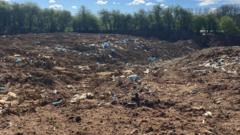
Walk deep enough into the protected reaches of the coast—past the signs that promise sanctuary for migratory birds and rare orchids—and you’ll find it. It isn't a mountain. It’s a scab. A jagged, gray-black crust of construction debris, twisted rebar, and chemical drums, hemorrhaging a thick, oily tea into the pristine silt. This isn't just a "waste dump." It is a crime scene where the victim is the ground itself.
Ten years ago, a local fisherman might have stood here and watched the tide pull life back into the sea. Today, he stands there and watches the sheen. He watches the way the water refuses to ripple. He watches the silence.
The Invisible Trespass
We tend to think of pollution as a dramatic event. We think of exploding tankers or smoke billowing from towering chimneys. But the most "sickening" destruction is often quiet. It happens one truck at a time, usually under the cover of a Tuesday night when the moon is thin and the local rangers are home in bed.
The inquiry into this specific site reveals a systematic betrayal of trust. It wasn't a one-time accident. It was a business model. By bypassing legal disposal sites—which charge high fees to safely process hazardous materials—unscrupulous contractors saved millions. They traded the health of a protected ecosystem for a healthier bottom line.
They thought the marsh would swallow the evidence.
Imagine a young family, the Millers, who moved to the edge of this protected zone for the "clean air" and the "unspoiled views." They are hypothetical, but their plight is mirrored in every resident currently living downstream from this toxicity. Mr. Miller notices his dog's paws are cracked and bleeding after a walk. Mrs. Miller realizes the garden she spent three summers tending is suddenly turning yellow from the roots up. They don't know about the lead. They don't know about the asbestos or the polychlorinated biphenyls (PCBs) leaching into the groundwater.
They just know that the place they call home feels wrong.
The Anatomy of an Environmental Heist
When investigators finally forced their way onto the property, they didn't just find trash. They found a graveyard of industrial negligence.
- The Concrete Layer: Thousands of tons of demolition waste, packed so tightly it has effectively paved over the natural drainage of the land.
- The Chemical Pocket: Rusted barrels containing industrial solvents, many of which are known carcinogens.
- The Bio-Hazard: Unauthorized medical waste mixed with household refuse, attracting vermin and creating a breeding ground for bacteria that hasn't been seen in this region for decades.
This isn't a "landfill." A landfill has liners. A landfill has methane vents. A landfill has oversight. This is an open wound.
The complexity of the cleanup is staggering. You cannot simply bring in a bulldozer and scoop it up. To move the waste is to risk puncturing the remaining barrels. To leave it is to ensure the permanent poisoning of the aquifer. It is a stalemate where the only loser is the earth.
Why We Look Away
It is easy to blame the shadowy figures driving the trucks. It is harder to look at the system that makes their crime so profitable.
In most developed nations, the cost of "doing things right" has spiked. Environmental regulations are strict—as they should be—but the enforcement of those regulations is often underfunded and toothless. We have created a world where it is cheaper to pay a fine than to follow the law. If you get caught, the legal fees are just a line item in your quarterly budget. If you don't get caught, you win.
This creates a perverse incentive. It turns our protected lands into the path of least resistance.
Consider the "hidden stakes." When a site like this is compromised, the damage isn't localized. The birds that feed here fly thousands of miles, carrying toxins in their fat stores. The fish that spawn in these reeds end up on dinner plates fifty miles away. The water that filters through this filth eventually finds its way into the taps of schools and hospitals.
We are all downstream from someone’s greed.
The Human Cost of Cold Hard Facts
Statistics are a great way to hide the truth. To say that "15% of the local wetlands are degraded" sounds manageable. It sounds like a problem for a committee.
But talk to the people who have lived here for generations. Talk to the grandmother who can no longer take her grandkids to the creek because the water causes a rash. Talk to the birdwatchers who have seen the diversity of species plummet by half in a single decade.
The "sickening" part isn't just the smell or the sight of the trash. It’s the realization that something we were told was "protected" was actually abandoned. The word protected implies a shield. It implies a promise.
When we break that promise, we lose more than just a few acres of grass. We lose our connection to the world that sustains us. We become strangers in our own landscape.
The inquiry currently underway will likely result in a few arrests. There will be headlines. There will be a flurry of activity as a few of the more visible piles of trash are moved. But the deeper problem—the systemic failure to value the land over the dollar—remains unaddressed.
The Long Road to Healing
Can the land ever truly recover?
Nature is resilient, but she is not a magician. Scientists estimate that even with a full-scale, multi-million-dollar remediation effort, the soil chemistry won't return to its baseline for at least a century. The heavy metals have already bound themselves to the clay. They are part of the geology now.
We are looking at a generational scar.
The real solution isn't just better fences or more cameras. It’s a fundamental shift in how we view "waste." As long as we treat the discarded remnants of our lives as something that simply needs to "disappear," we will continue to find it in the places we love most.
Waste doesn't disappear. It just moves.
The next time you drive past a wooded lot or a quiet marsh, look closer. Don't just see the green. Look for the glint of plastic. Look for the way the water moves. We have to stop being passive observers of our own environment. We have to become its fiercest protectors, because the people driving those trucks aren't going to stop until the last square inch of "free" space is filled with their filth.
The birds have stopped singing in the marsh, but the silence they left behind is the loudest warning we will ever receive.
The ground is full. The water is waiting. And the clock is ticking on the next Tuesday night when the moon is thin.