The olive tree does not care about borders. Its roots drink from the same limestone aquifer whether the flag above its canopy carries a crescent, a star, or nothing at all. For three hundred years, a single tree in the northern Gaza Strip might have shaded five generations of farmers, survived droughts, weathered empires, and held the topsoil together against the winter winds blowing off the Mediterranean.
Then came the blast wave. In less than a second, three centuries of carbon sequestration, microbial life, and root architecture turned into splinters and ash.
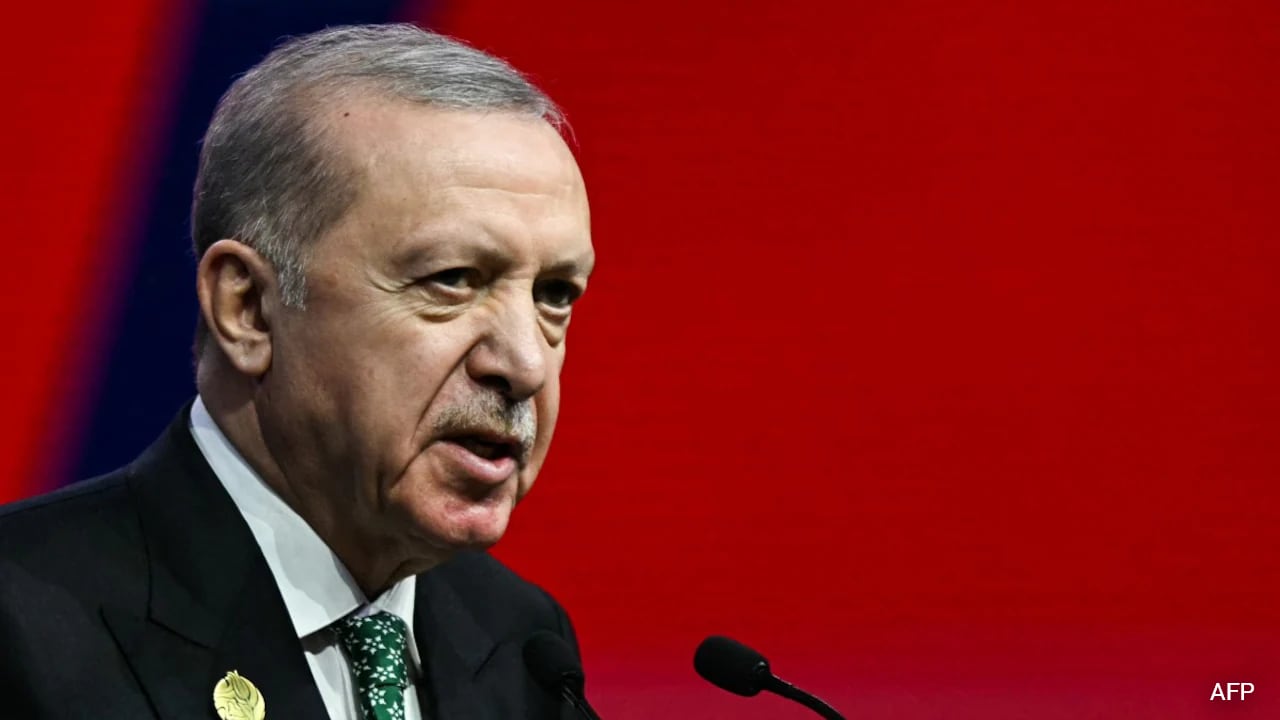
Thousands of kilometers away, under the sterile, climate-controlled fluorescent lights of a plenary hall at COP31, the air smelled of recycled oxygen, expensive espresso, and diplomatic tension. Outside the security perimeter, climate activists chanted for carbon neutrality. Inside, Turkish President Recep Tayyip Erdogan stepped up to the podium, adjusted his microphone, and dropped a single, explosive word into the global climate lexicon: ecocide.
Silence.
For a beat, the bureaucratic hum of the UN climate summit stopped. Delegations paused their quiet side-conversations. Headphones were pressed tighter against ears as simultaneous translators rendered the Turkish word ekokırım into English, French, Arabic, and Hebrew. Erdogan did not merely accuse Israel of collateral environmental damage during the Gaza war; he accused it of the deliberate, systematic destruction of a living ecosystem—turning fertile farmland into a wasteland, poisoning groundwater, and shattering the agricultural foundation of an entire people.
Within hours, the Israeli delegation fired back. Their response was sharp, immediate, and unapologetic: Turkey was weaponizing a global environmental forum for political theater, ignoring Hamas’s subterranean tunnel networks dug directly beneath orchards and greenhouses, and deflecting from Ankara’s own domestic environmental record and regional military operations.
To a casual observer scrolling past a news alert, this looked like just another predictable diplomatic skirmish—a Middle Eastern proxy fight hijacking a climate conference meant for solar panels and carbon credits.
That reading misses the terrifying truth. What happened on the stage at COP31 was not a distraction from the climate crisis. It was a preview of the twenty-first century’s most bitter battlefield, where ecological survival, military strategy, and international law collide in the dirt.
The Invisible Casualty of Modern Warfare
To understand why the word ecocide carries so much voltage in a room full of climate diplomats, you have to step out of the convention center and walk the ground.
Consider a hypothetical farmer—let us call him Tariq—whose family tended four dunams of citrus and olive groves near Beit Hanoun before the war. Tariq is a composite, drawn from the documented realities of agricultural workers across the coastal enclave, yet his daily ledger is written in hard, verified data. Before October 2023, nearly forty percent of Gaza’s land was agricultural. Those fields did not just feed local families; they cooled the microclimate, absorbed seasonal floodwaters, and anchored sandy soil that otherwise erodes straight into the sea.
Now, picture Tariq returning to that same plot.
He does not need a satellite spectral analysis from the United Nations Environment Programme to know the land is sick. He can smell it. The air carries the acrid, metallic tang of pulverized concrete, heavy metals, and burned plastics. Where lush rows of lemon trees once stood, the earth has been churned by heavy armored treads into a hardpan crust—compacted so tightly that rainwater can no longer penetrate to the aquifer below. Instead, winter storms wash toxic runoff straight into the Mediterranean.
Satellite assessments conducted during the conflict revealed that well over half of Gaza’s tree crops and agricultural fields suffered severe degradation or outright destruction. Greenhouses—the delicate glass and plastic lungs that produced tomatoes, cucumbers, and strawberries year-round—were flattened by the thousands.
War has always scarred the earth. The Romans famously salted the fields of Carthage; the United States sprayed twenty million gallons of Agent Orange across the canopies of Vietnam; retreating Iraqi forces ignited hundreds of Kuwaiti oil wells in 1991, turning midday into midnight across the Persian Gulf.
Yet for decades, international law treated the environment as mere scenery—an unfortunate bystander to human tragedy. If a bomb destroyed a hospital, the Geneva Conventions had clear, sharp teeth. If a bomb destroyed an ancient aquifer, poisoned a watershed with white phosphorus and unexploded ordnance, and collapsed sewage treatment plants so that tens of thousands of cubic meters of raw waste poured daily into the sea, the legal framework grew foggy, hesitant, and slow.
A Legal Weapon Forged in Mud
This legal vacuum is precisely what made Erdogan’s speech at COP31 so incendiary.
When a head of state uses the term ecocide at a United Nations summit, he is reaching for a legal hammer that activists and jurists have been trying to forge for half a century. In 2021, an independent panel of international lawyers drafted a formal definition of ecocide, proposing it as a fifth international crime alongside genocide, crimes against humanity, war crimes, and the crime of aggression at the International Criminal Court. Their definition was stark: unlawful or wanton acts committed with knowledge that there is a substantial likelihood of severe and either widespread or long-term damage to the environment.
Think of the ecosystem like a human body’s immune system. A single cut heals; a localized infection can be fought off. Ecocide is the equivalent of systemic organ failure—destroying the soil’s microbiome, salinizing the freshwater lens, and coating the land in heavy metals so thoroughly that the earth loses its capacity to regenerate on a human timescale.
By invoking that specific word, Erdogan was attempting to reframe the Gaza conflict not merely as a territorial or security struggle, but as a crime against the planetary commons. His argument rested on a visceral premise: you cannot preach about saving the planet’s biodiversity inside a conference hall while turning a blind eye to the flattening of an entire coastal ecosystem just across the sea.
Israel’s counterargument, however, exposed the jagged fault lines beneath that moral framing.
From the Israeli perspective, the accusation was a masterclass in selective amnesia. Israeli officials pointed out a brutal tactical reality on the ground: Hamas had spent nearly two decades weaving hundreds of miles of reinforced concrete tunnels directly beneath agricultural fields, orchards, and civilian infrastructure, using dense tree cover to conceal rocket launchers and tunnel shafts. In urban and semi-rural asymmetric warfare, where the battlefield is deliberately embedded inside the civilian and ecological fabric, distinguishing between military necessity and environmental destruction becomes agonizingly complex.
Furthermore, Israeli diplomats pushed back hard on the messenger. Turkey, they argued, was positioning itself as a champion of environmental justice while pursuing aggressive fossil-fuel exploration in the Eastern Mediterranean, damming rivers in ways that choked water supplies to downstream neighbors in Syria and Iraq, and conducting military operations in northern Syria that damaged local infrastructure and forests.
Both sides were speaking to entirely different realities, yet both were trapped in the same paradox.
The Carbon Footprint Nobody Counts
Have you ever wondered why your airline ticket or your local utility bill comes with endless pledges about net-zero targets, while the massive, roaring machinery of global warfare gets a quiet pass?
Here is a secret that climate negotiators rarely highlight during opening ceremonies: military emissions are largely exempt from mandatory reporting under international climate agreements. For decades, major powers lobbied to keep defense-related carbon footprints voluntary, shrouded behind the impenetrable curtain of national security.
Yet war is an ecological furnace.
Every fighter jet sortie burns thousands of gallons of aviation fuel. Every heavy tank moving across rough terrain consumes fuel at a rate measured in gallons per mile, not miles per gallon. Every ton of concrete manufactured to rebuild shattered cities releases roughly a ton of carbon dioxide into the atmosphere. Researchers analyzing the first few months of the Gaza war estimated that the carbon emissions generated by military operations, munitions manufacturing, and supply flights exceeded the annual carbon footprint of dozens of climate-vulnerable nations combined—and that figure did not even account for the colossal carbon cost of eventual reconstruction.
When you sit in a climate summit and watch leaders debate whether global temperatures will rise by 1.5 degrees or 2.0 degrees Celsius, that invisible ledger hangs over the room like smoke.
I remember standing near the press risers at a previous climate conference, watching a delegate from a low-lying Pacific island nation listen to a heated geopolitical row between two larger powers. His country was literally losing centimeters of coastline every year to rising tides. His people were salting their own taro patches with ocean spray. To him, the technical arguments over emission baselines and diplomatic protocol felt surreal—like passengers on a sinking ship arguing over who broke the barometer while ignoring the water pouring through the hull.
That is the emotional core that makes the COP31 clash so unsettling. The climate crisis does not recognize diplomatic immunity. Carbon dioxide released by a missile strike over the Levant traps heat over Istanbul, Tel Aviv, Miami, and Jakarta equally. Toxic leachate seeping into the Eastern Mediterranean currents does not stop at maritime boundaries; it enters the regional food chain, tainting fish stocks harvested by fishermen from Egypt to Lebanon to Cyprus.
The Anatomy of a Diplomatic Boomerang
Why did Israel react with such fierce urgency to Erdogan’s framing, rather than brushing it off as routine rhetoric?
Because in international diplomacy, words are rarely just words. They are seeds. Once a term like ecocide enters the official bloodstream of a UN summit, it begins to mutate into resolutions, investigative mandates, sanctions frameworks, and academic boycotts.
Israel has long prided itself on environmental innovation—drip irrigation, desalination plants that turn seawater into drinking water at scale, desert afforestation, and solar thermal technology. For decades, Israeli diplomats used "green diplomacy" as a bridge to build ties across the Middle East and Africa, offering water technology to arid nations desperate for agricultural resilience.
Erdogan’s accusation struck directly at that narrative pillar. By branding Israel’s military campaign as ecocide, Ankara sought to invert Israel’s global image—from a pioneer of desert greening to an architect of deliberate desertification.
At the same time, Erdogan’s gambit carried its own profound risks. Climate summits operate on fragile consensus. Every single word in a final COP communique requires unanimous agreement from nearly two hundred nations. When geopolitical conflicts are injected directly into the main plenary of a climate summit, the machinery of climate finance and adaptation stalls. Developing nations waiting desperately for loss-and-damage funds watch their lifeline get tangled in regional power struggles.
Consider what happens next in those hallways. Negotiators spend forty-eight sleepless hours arguing over a single footnote referencing armed conflict and environmental protection, while talks on methane reduction or grid transition are pushed to the margins. The atmosphere heats up inside the room while the planet continues to heat up outside.
What Remains Beneath the Ash
Step back from the microphones, the press releases, and the sharp diplomatic retorts. Return, for a moment, to the soil itself.
Whether one views the devastation in Gaza through the lens of Erdogan’s charge of deliberate ecocide or Israel’s defense of tragic necessity against an entrenched insurgency, the physical reality waiting in the dirt remains stubbornly unchanged.
Soil is not merely dirt; it is a living, breathing skin covering the planet’s rock. A single teaspoon of healthy agricultural soil contains more microorganisms than there are humans on Earth—fungi, bacteria, nematodes, and arthropods working in silent coordination to cycle nutrients, filter water, and anchor roots. It takes nature anywhere from five hundred to a thousand years to build a single inch of fertile topsoil.
It takes an artillery barrage five minutes to strip it away.
In Gaza, the destruction of wastewater treatment facilities meant that raw sewage flowed unchecked into coastal waters and percolated into an already over-pumped, saline coastal aquifer. Unexploded ordnance and pulverized building debris—laced with asbestos, lead, and industrial chemicals—now cover millions of square meters of land. Even if every gun fell silent tomorrow morning, the land itself would remain wounded for decades.
You cannot sign a ceasefire with heavy metals. You cannot negotiate a truce with a poisoned aquifer.
And here lies the quiet tragedy that neither the podium in Ankara nor the diplomatic corps in Jerusalem can fully resolve through rhetoric alone. In an era of accelerating climate breakdown, the Middle East is warming at nearly twice the global average. Rainfall is becoming more erratic; droughts are stretching longer; heatwaves are pushing human endurance to its physiological limits. Every square meter of arable land, every functioning aquifer, and every coastal wetland in the Levant is no longer a local asset—it is a vital life-support system for everyone living between the river and the sea.
When the spotlights at COP31 finally dimmed and the delegates packed their briefcases to fly home, the transcripts of Erdogan’s speech and Israel’s rebuttal were filed neatly into the digital archives of the United Nations. The headlines moved on to the next crisis, the next summit, the next outrage.
Yet out in the darkened fields along the Mediterranean coast, where the concrete dust still settles over the broken stumps of three-hundred-year-old olive trees, the earth keeps its own meticulous ledger—and it never forgets a single debt.