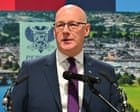
John Swinney is smiling for the cameras. He is shaking hands. He is declaring a mandate. He is wrong.
The media loves a victory lap. They see a plurality of seats and call it a win. They look at the scoreboard and ignore the fact that the stadium is crumbling and half the fans have already left. Calling this election a "victory" for the SNP is like a captain claiming a successful voyage because the ship is still technically floating, even as it drifts aimlessly into the mid-Atlantic with a broken rudder.
The lazy consensus says the SNP remains the "dominant force" in Scottish politics. The reality? They are a legacy brand surviving on name recognition while their core product—independence—has become a marketing slogan with no supply chain.
The Mandate Mirage
Political pundits are obsessed with the word "mandate." It sounds authoritative. It suggests a clear path forward. But in the cold light of electoral math, a mandate without a mechanism is just a daydream.
Swinney claims this result validates the push for a second referendum. It doesn't. To have a mandate, you need more than just a higher number of votes than the next guy; you need the political capital to force your opponent’s hand. The SNP has spent a decade "demanding" a Section 30 order from Westminster. They have been told "no" by Cameron, May, Johnson, Truss, Sunak, and now Starmer.
If your entire strategy relies on a hostile opponent saying "yes" to a request that leads to their own territorial diminishment, you don't have a strategy. You have a prayer list.
The "victory" Swinney celebrates is actually the final cementation of a stalemate. By failing to achieve a knockout blow, the SNP has proved to Westminster that they can be safely ignored. A wounded SNP is a gift to the Union. They are just strong enough to block other voices, but too weak to actually move the needle.
The Policy of Distraction
Let’s talk about the "Battle Scars." I have watched political movements across Europe and North America rise and fall. The pattern is always the same: when a governing party stops being able to deliver on its primary promise, it starts over-complicating its secondary ones.
The SNP’s governance of Scotland is a masterclass in performative legislation designed to mask constitutional impotence. Look at the ferries. Look at the education gap. Look at the NHS wait times. These aren't just administrative hiccups; they are the symptoms of a party that has stopped caring about the "how" because it’s too busy obsessing over the "if."
They have spent years building a bureaucracy that prioritizes signaling over substance. They focus on fringe social issues that polarize the electorate—not because they are inherently the most pressing matters for the average Scot, but because polarization creates a "them vs. us" dynamic that keeps the base from asking where the independence roadmap actually is.
The Math of Stagnation
In any other industry, if you promised a merger for twenty years and failed to close the deal every single time, the shareholders would have fired the CEO a decade ago.
- 2014: The "once in a generation" moment that failed.
- 2016: The Brexit "material change" that went nowhere.
- 2021: The "undeniable mandate" that was denied.
- Today: A declaration of victory that changes absolutely nothing.
The SNP has become a party of the status quo. They are the establishment. They enjoy the perks of office, the ministerial cars, and the international junkets, all while pretending to be the insurgent rebels fighting the "London machine." You cannot be the government and the resistance at the same time. The voters are starting to smell the cognitive dissonance.
Why the "Nationalist" Label is Now a Liability
The term "Nationalist" used to imply a drive toward a specific goal: a nation-state. Now, in the SNP context, it has shifted to mean "Managerialist."
Swinney is the ultimate manager. He is the safe pair of hands. He is the man you hire to oversee a decline so it doesn't happen too quickly. He isn't a revolutionary; he’s an accountant for a bankrupt dream.
By framing this election as a victory, the SNP is actively gaslighting its own supporters. They are telling people who want radical change that "more of the same" is a win. This is a dangerous game. When people realize that their votes aren't buying progress, they don't just switch parties—they switch off.
The "People Also Ask" crowd wants to know: "Will there be a second referendum soon?"
The honest, brutal answer is: No.
Not under this leadership. Not with these numbers. Not with a UK government that has realized the SNP has no "Plan B." The SNP's only leverage was the threat of a de facto referendum or a unilateral move—both of which have been neutered by internal division and legal reality. Swinney’s victory is the victory of the "holding pattern."
The Unionist Trap
The biggest mistake the SNP made was assuming that Unionism would remain static. While the SNP has been recycling the same rhetoric since 2012, the UK political landscape has shifted.
The "victory" in Holyrood happened against a backdrop of a Labour resurgence that the SNP is ill-equipped to handle. You can’t use the "Tory bogeyman" tactic against Keir Starmer with the same effectiveness you used it against Boris Johnson. When the "enemy" in London changes, the SNP’s entire identity crisis is laid bare.
If the SNP were serious about independence, they would be dismantling the reasons why people fear it—economic uncertainty, currency questions, border issues. Instead, they’ve spent their energy arguing about who is "Scottish enough" to lead. They’ve traded a vision of a future state for a collection of grievances.
Stop Celebrating Survival
If you are an SNP supporter, stop cheering. This result is a warning shot, not a trophy.
The party is bleeding members. Its finances are under a microscope. Its leadership is a revolving door of the "Old Guard" trying to keep the lights on. Declaring victory in this environment isn't just optimistic; it’s delusional.
A real leader would look at these results and say, "We have survived, but we are failing. We have the seats, but we are losing the argument." Swinney won't do that because the SNP’s internal structure is now built on the preservation of the party over the achievement of its purpose.
The hard truth is that the SNP has become the very thing it claimed to hate: a bloated, self-serving political machine that prioritizes the "win" over the "why." They are winning elections to stay in power, not to use power for independence.
The Cost of Comfort
The downside to my contrarian view? It’s depressing. It’s much nicer to believe the headlines and think that Scotland is on the cusp of something new. But belief doesn't pay the bills, and it doesn't build a new country.
The "nuance" the mainstream media missed is that this election marks the point where the SNP ceased to be a movement and officially became a department of the British state. They manage the health service, they manage the schools, and they manage the expectations of the independence movement until they can be quietly shelved.
The Irrelevance of Holyrood
We need to stop pretending that Holyrood elections are the primary battlefield for independence. They aren't. They are a devolved administrative exercise.
By treating a provincial election like a national liberation movement, the SNP has lowered the bar for what constitutes "success." Success isn't having the most MSPs. Success is moving the 45% of "Yes" voters to 60%. They haven't done that. In many demographics, they are sliding backward.
The SNP is currently a giant head with no body. It has the leadership, the media presence, and the titles, but it has lost the grassroots energy that made it formidable in 2014. You can’t win a revolution from a ministerial desk in St. Andrew’s House.
John Swinney didn't win an election; he inherited a stalemate. He is the caretaker of a dream that he has no idea how to realize. If this is what victory looks like, the movement is in more trouble than anyone dares to admit.
The SNP is no longer the vehicle for Scottish independence. It is the roadblock.