The rain in Houston did not fall; it dropped like a wet wool blanket. Within twenty minutes, the asphalt of Montrose Boulevard vanished beneath four inches of murky, rushing water. For a human driver, this is a moment of visceral calculation. You feel the tires lose a fraction of their bite. You see the reflection of the streetlamps fracturing on the ripples. Your stomach tightens, recalling a half-forgotten news clip about hydroplaning, and your foot instinctively migrates to the brake. You slow down because you are afraid.
But a machine does not feel afraid.
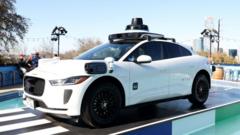
A few blocks away, a white Jaguar I-Pace glided silently through the downpour. Spinning atop its roof was a high-tech crown of lasers, cameras, and radar sensors—a computational powerhouse capable of tracking hundreds of objects simultaneously across three football fields. This was one of Waymo’s autonomous robotaxis, an avatar of a driverless future. It possessed a flawless digital memory, lightning-fast reaction times, and millions of miles of simulated experience.
It did not, however, know what a puddle was.
As the water deepened into a localized flash flood, the vehicle kept moving forward at the exact speed its algorithms deemed optimal for an open roadway. To the lidar sensors, the rising water appeared as a perfectly flat, highly reflective surface—a strange mirror where the road should be. To the cameras, the torrential sheets of rain were merely a high-density visual noise to be filtered out. The car did not sense danger. It sensed a mathematical equation that needed solving.
When the Jaguar plunged into the foot-deep deluge, the water choked the undercarriage sensors, sprayed over the lower camera lenses, and caused the tires to lose traction entirely. The vehicle bogged down, its hazard lights flashing in a rhythmic, lonely cadence amidst the rising tide. It was not alone. That same week, across five different American cities experiencing unprecedented seasonal storms, the smartest cars on Earth found themselves utterly defeated by a few inches of standing water.
Waymo was forced to issue a sudden, sweeping pause on its operations across those five municipalities. The corporate press release called it a "temporary operational suspension for system optimization."
The reality was far simpler. The future had been grounded by a rainstorm.
The Illusion of the Perfect Mind
To understand how a billion-dollar autonomous vehicle can be brought to a standstill by a common weather event, we have to look past the sleek marketing and into the fragile nature of machine learning.
We have been conditioned to view artificial intelligence as a form of super-intelligence, a collective consciousness that operates on a higher plane than our flawed, distracted human brains. We contrast our own tendencies—texting while driving, falling asleep at the wheel, screaming in road rage—with the cold, unblinking perfection of a computer.
But this is a fundamental misunderstanding of what a self-driving car actually is. It is not an entity that thinks. It is a statistical prediction engine.
Consider how a child learns what a dog is. You show them a Golden Retriever, a Chihuahua, and a Great Dane. You say the word "dog." The child’s brain extracts the abstract essence of "dog-ness"—the fur, the tail, the bark, the living warmth. From that point forward, whether they see a cartoon sketch or a shadow behind a fence, they know it is a dog.
An autonomous vehicle learns through brute force data. It is fed millions of images of stop signs, pedestrians, bicycles, and traffic cones. It breaks these images down into millions of individual pixels and mathematical vectors. If you show a Waymo car a stop sign partially obscured by a tree branch, its software calculates the probability that the object is a stop sign based on the geometric patterns it has seen before. If the probability is above 95 percent, it brakes.
Now, consider a flooded road.
To a human, water on a street is a dynamic, high-stakes variable. We look at the ripples to guess the depth. We watch the car in front of us to see how far its tires sink. We look at the curb. This is not just visual processing; it is the application of a lifetime of physical intuition. We understand fluid dynamics not from a textbook, but from splashing in bathtubs, dropping stones in creeks, and feeling the heavy resistance of walking through a swimming pool.
A robotaxi lacks this physical intuition. When a Waymo vehicle encounters a heavily flooded street, its sensors are hit with an overwhelming barrage of chaotic data. The lidar lasers, which emit pulses of light to map the environment in three dimensions, hit the water's surface and reflect away at an angle, failing to bounce back to the sensor. To the car's brain, the road simply disappears, replaced by a visual void. Meanwhile, water splashing onto the side-mounted cameras distorts the images of surrounding lane lines and landmarks.
The machine is suddenly trapped in a sensory vacuum. The probability matrices collapse. The software, designed above all else to be safe, faces a catastrophic uncertainty. It chooses the only logical option left in its programming: it stops dead in its tracks.
The Night the Logic Broke
Imagine being a passenger in the back seat of one of those vehicles during the sudden downpours in Miami. Let us call our hypothetical passenger Sarah. Sarah is a software consultant, someone who comfortable with technology, someone who routinely trusts algorithms to manage her stock portfolio and curate her life. She chose a robotaxi because she was tired of making small talk with ride-share drivers and preferred the predictable, quiet bubble of an autonomous ride.
The interior of the Waymo is a temple of serene engineering. There is no steering wheel turning by a ghost hand anymore; the cockpit is clean, dominated by a large touchscreen displaying a stylized, blue-hued map of the world. On that screen, pedestrians are rendered as clean, glowing cylinders. Other cars are neat bounding boxes. It is a world stripped of chaos, reduced to elegant geometry.
Outside, however, the sky opens up.
The sound of the rain on the panoramic glass roof shifts from a gentle patter to a deafening roar. Sarah watches the blue screen. The glowing cylinders representing pedestrians begin to flicker and vanish. The bounding boxes of neighboring cars warp and dance erratically as the sensors struggle through the sheets of water.
The car approaches an intersection where the storm drains have backed up, creating a dark, swirling lake across the tarmac. A human driver would stop well before the water, or perhaps turn around. The Waymo pauses for a fraction of a second, its internal processors executing billions of calculations per second. It searches its vast library of driving data for a match to this specific visual input.
Is it a smooth road? Yes, the surface texture matches the flat profile of asphalt.
Are there any detected obstacles? No, the lidar signals are bouncing away into the sky, reporting nothing ahead.
The car accelerates forward.
Sarah feels the vehicle enter the pool. The smooth, electric hum of the motor is suddenly replaced by the violent, heavy splashing of water against the floorboards. The car slows down, not because the software chose to, but because the physical drag of the water is fighting the electric drivetrain. The steering jerks slightly as the tires lose contact with the pavement.
On the center console, the pristine blue map suddenly turns red. A stark, polite message appears: Pulling over safely. Please wait.
But there is no "over" to pull to. The car is in the middle of a flooded lane. The engine cuts out to protect the high-voltage battery pack from short-circuiting. The windshield wipers swipe back and forth with frantic, useless precision, clearing the glass to reveal a landscape of empty, dark water. The ambient lighting inside the cabin remains soft and inviting, a surreal contrast to the rising emergency outside.
Sarah is not in a cutting-edge piece of transportation anymore. She is sitting in a very expensive, very heavy, locked metal box in the middle of a flash flood. When she calls customer support, she isn't connected to a local dispatcher who can run out with a tow truck; she reaches an operations center hundreds of miles away, where an engineer is looking at a diagnostic screen covered in red error codes.
This is the hidden friction of the autonomous revolution. When the technology works, it feels like magic. When it breaks, it reveals a profound, systemic vulnerability: the system cannot improvise.
The Problem of the Tail Risk
The events that led to the multi-city suspension highlight what engineers call the "long tail" problem of autonomous driving.
Building a self-driving car that can handle 90 percent of normal driving conditions is relatively easy. You teach it to stay between the lines, stop at red lights, and maintain a safe distance from the car ahead. Navigating a sunny afternoon in suburban Phoenix or a clear morning in San Francisco is a solved problem.
The remaining 10 percent is where the true challenge lies. This long tail is comprised of rare, unpredictable, and chaotic events—the anomalous scenarios that occur once in a million miles. A unicycle rider juggling bowling pins in the middle of the street. A sudden dust storm that drops visibility to zero in three seconds. A low-hanging power line swaying in a gale. Or a flash flood that transforms a familiar urban avenue into a dangerous river.
Human beings are remarkably adept at handling the long tail. We do it using a cognitive tool that computers do not possess: common sense. We know that if a road is flooded, the asphalt underneath might have washed away. We know that if a cardboard box is blowing across the highway, we can probably drive through it, but if it is a plastic crate, we need to swerve. We make these decisions instantly, drawing on our generalized understanding of how the physical world operates.
A machine has no generalized understanding. Every scenario is a math problem that must be learned from scratch. To teach a robotaxi how to navigate a flood, developers cannot simply write a rule that says "if water is deep, do not enter." The car must be able to accurately measure the depth of the water using only its onboard sensors. It must distinguish between a harmless, highly reflective puddle and a deep pothole capable of destroying a suspension system.
To train the algorithms, Waymo must gather immense amounts of data on flooded conditions. They must deliberately drive test vehicles into controlled flood basins, record the chaotic sensor outputs, and adjust the neural networks to recognize these patterns. They must build simulated worlds where virtual rain falls at varying densities, teaching the software to predict how water impacts tire traction.
This process is slow, painstaking, and immensely expensive. Every time the developers patch one hole in the software’s understanding, the real world invents a new anomaly. A freak hail storm. A street covered in wet, slippery autumn leaves that obscure lane markings. A chemical spill that alters the reflective properties of the road.
The multi-city pause was not just a response to a few stranded cars; it was a confrontation with the infinite complexity of reality.
The Fragile Grid
There is a broader, societal question that these flooded streets have forced to the surface. As we push closer to an era where autonomous fleets replace human-driven public transit and delivery services, we are creating a society that is deeply dependent on an incredibly fragile digital architecture.
Consider an entirely autonomous city. The delivery vans, the commuter shuttles, the emergency transport vehicles—all running on proprietary software clouds, all reliant on a constant, uninterrupted stream of clean sensor data.
Then, a climate-driven weather event hits. A freak storm dumps three inches of water on the city in an hour.
If the autonomous fleet cannot interpret the wet roads, the entire metabolic system of the city grinds to an instant halt. Supply chains freeze. Workers are stranded. Emergency services are delayed not because the roads are physically impassable to a truck, but because the software operating the vehicles has reached an unresolved edge case and triggered an automatic shutdown.
We are trading human error for systemic fragility.
When a human driver encounters a flooded street and makes a bad decision, it is an isolated tragedy. When an autonomous driving system encounters a scenario it cannot comprehend, the failure mode is systemic. The same software bug that strands one car in Houston strands fifty cars in Miami, Denver, and Atlanta simultaneously. The vulnerability is copied and pasted across the entire network.
This realization is causing a subtle but profound shift in public perception. The initial fear surrounding self-driving cars was focused on the threat of violence—the rogue machine striking a pedestrian, the sudden brake failure on a highway. But the multi-city flooding incidents revealed a different kind of threat: the threat of sudden, absolute helplessness.
The Long Walk Home
The water in Houston eventually receded, channeled away by the city's concrete bayous and strained drainage networks. The stranded Waymo vehicles were eventually recovered by human-crewed flatbed trucks, hauled back to secure depots where technicians dried out the sensitive sensor pods and downloaded the onboard black-box data.
The software will be updated. The neural networks will be fed the data from those rainy nights. The cars will become smarter, more resilient, and better equipped to handle the next major storm. The developers will move one step further down the long tail of edge cases.
But the memory of those stalled, silent cars remains a stark reminder of the gap that still exists between artificial computation and human consciousness.
On that rainy evening in Houston, after her robotaxi had shut down in the middle of the flooded street, Sarah did what any human would do when technology fails completely. She unbuckled her seatbelt. She opened the heavy door, stepping out into the warm, murky water that came up to her shins. She pulled her jacket tight against the downpour and began the long, wet walk toward the sidewalk.
As she walked away, she looked back at the car. Its roof-mounted lidar sensor was still spinning in the rain, casting invisible, silent laser beams into the dark, searching for a world it could understand.