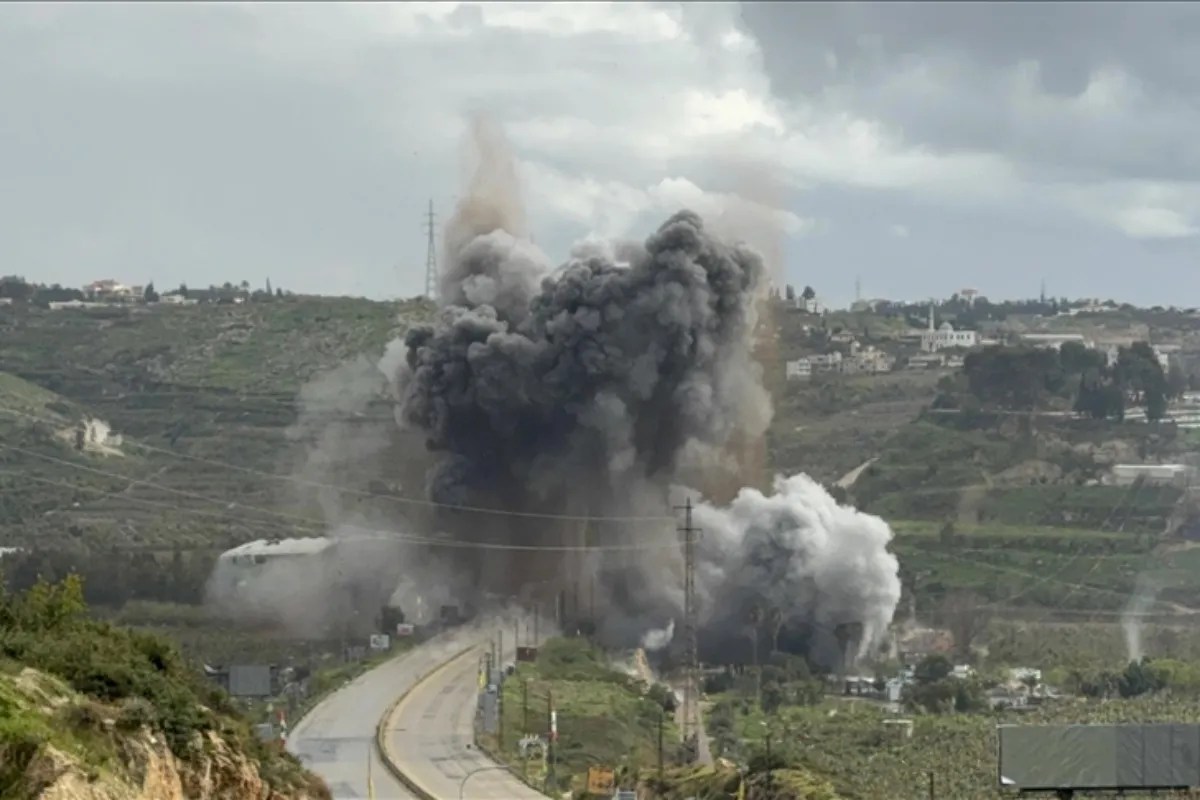
The sound does not start with a boom. It starts with a tearing noise, like heavy canvas being ripped in half right above your head.
For the people living along the fractured border between Lebanon and northern Israel, that sound is the true clock by which days are measured. You do not look at your watch to know when it is afternoon; you listen to the direction of the whistle. When the siren follows, it is already too late to plan. You simply run.
Recently, the sky fell sixteen times in a single day.
The official military communiqués from Hezbollah framed it as a calculated retaliation, a precise mathematical equation of violence responding to Israeli airstrikes. They listed the targets with clinical detachment: military positions, gathering points, technical equipment. But military blueprints do not capture the reality of what happens when iron meets earth. They leave out the smell of scorched pine, the blinding flash that turns a living room white for a fraction of a second, and the terrifying silence that settles over a neighborhood right after the dust clears.
To understand the weight of sixteen distinct attacks in a single sequence of hours, you have to look past the political chess board. You have to stand in the dust.
The Anatomy of an Hour
Imagine a kitchen in a small border community. A glass of water sits on a laminate table. It does not spill, but the surface of the water ripples.
The first strike hits an Israeli military outpost on a ridge nearby. The concussive wave travels through the limestone bedrock, vibrating up through the soles of anyone standing within three miles. It is a dull, thudding reminder that peace in this geography is an artificial construct.
Hezbollah’s operational logs noted that their salvoes used a mix of guided missiles, heavy artillery, and kamikaze drones. To a strategist, this represents a sophisticated effort to overwhelm defense systems like the Iron Dome. To a family huddled in a reinforced safe room, it sounds like a chaotic, unpredictable lottery.
The drones are the worst. Rockets are fast; they possess a terrifying momentum, but they are over quickly. Drones linger. They hum with a high-pitched, lawnmower whine that circles the hills, searching, waiting. You sit in the dark, tracking the sound through concrete walls, wondering if the operator miles away sees your roof on a thermal monitor.
The afternoon wore on, and the numbers climbed. Strike four. Strike seven. Strike eleven. Each one chip-chipping away at the illusion of security.
Northern Israel has become a landscape of empty swings and shuttered storefronts. Tens of thousands of civilians have been evacuated for months, turned into internal refugees inside their own country. The ones who remain are the stubborn, the old, and those who simply have nowhere else to go. They live a life punctuated by the frantic dash to shelters, their ears permanently tuned to the frequency of incoming artillery.
The View from the Other Ridge
Across the blue line, in the villages of southern Lebanon, the view of the sky is remarkably similar, even if the allegiance is reversed. The smoke rises from both sides of the fence.
When Hezbollah launches sixteen attacks, the immediate consequence is not victory; it is the absolute certainty of what comes next. The Israeli response is swift, heavy, and systematic. Jet engines roar over the Beqaa Valley and the border towns, dropping payloads that shake the very foundations of ancient stone houses.
This is the grim arithmetic of the border. Every action is a prologue. Every retaliation ensures its own sequel.
The fighters who load the rocket tubes operate in the shadows, moving through olive groves and underground tunnels carved into the hills. They view their actions as defensive, a necessary shield against an adversary possessing overwhelming air superiority. In their narrative, the sixteen strikes are a message written in fire: we are still here, we are not broken, and the northern front will remain an open wound.
But messages written in fire rarely select their readers carefully. They burn everything.
The Fragile Architecture of the Normal
Human beings can adapt to almost anything, which is perhaps the most beautiful and tragic thing about us. In the spaces between the sirens, life tries to reassert itself.
A farmer watches the smoke clear from a ridge and decides he has exactly twenty minutes to feed his goats before the next round begins. A shopkeeper sweeps shattered glass off his stoop, not because he thinks it won’t break again tomorrow, but because the act of sweeping is a way to deny the chaos control over his morning.
This is the invisible toll of a sixteen-strike day. It breaks the connective tissue of daily life. It turns neighbors into survivalists and turns the simple act of walking to a mailbox into a calculated risk assessment.
The military analysts talk about deterrence. They argue that by striking sixteen times, Hezbollah establishes a balance of terror that prevents a full-scale invasion. Conversely, Israeli commanders argue that only total destruction of these launching sites can restore peace to the north.
Both sides use logic that makes perfect sense inside a war room, yet sounds completely insane when spoken aloud in a graveyard.
The truth is that deterrence is a ghost. It is an idea that works until it doesn't, and when it fails, the cost is paid in flesh. The statistics will tell you that the iron dome intercepted a certain percentage, that artillery neutralized specific launchers, and that the damage was contained.
They do not measure the spike in a child's heart rate when a car backfires. They do not record the silent pact a husband and wife make as they sleep on the floor of a hallway, hoping that if the roof collapses, it happens quickly.
The sun eventually went down over Galilee, painting the hills in shades of deep purple and long, bruised shadows. The sixteenth strike had landed hours before. The smoke had thinned into a hazy mist that hung low in the valleys, blurring the border line until you couldn't tell where one country ended and the other began.
In the quiet of the night, the silence was louder than the explosions. It was a heavy, expectant stillness, the kind that holds its breath because everyone knows the sun will come up again tomorrow. And the sky does not forget how to tear.