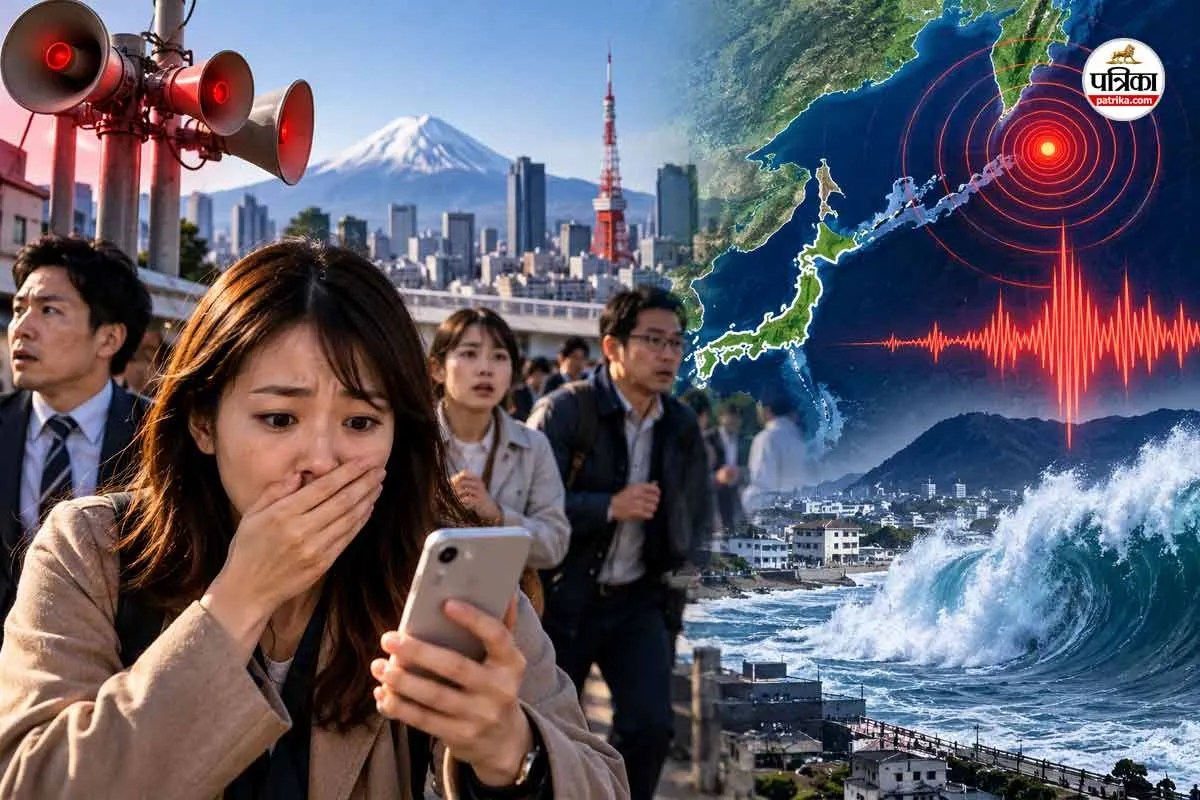
Silence.
Then a shriek that no human ear ever forgets. For another perspective, see: this related article.
If you have ever stood in a Tokyo convenience store, a quiet café in Yokohama, or a crowded train car in Osaka when that sound erupts from forty phones at once, your chest contracts before your mind even finishes reading the characters on the screen. It is not a ringtone. It is an air-raid klaxon compressed into a pocket-sized glass rectangle, engineered to bypass polite hesitation and slam straight into the amygdala.
Now imagine that screen flashing a number that does not merely warn of a bad afternoon, but implies the end of the world as you know it. Related insight on this matter has been published by USA Today.
Magnitude 9.9.
In seismology, magnitude is logarithmic, not linear. A 9.9 is not "a bit bigger" than a 9.0—the massive March 2011 Tohoku earthquake that triggered a devastating tsunami and nuclear crisis was a 9.0. A 9.9 sits in territory that pushes against the physical limits of how much strain a single fault rupture on Earth can release in one go. When an earthquake early warning system in Japan misfires and broadcasts an apocalyptic 9.9 alert—or triggers a false alarm of that scale—it does more than embarrass a meteorological agency. It rattles the fragile psychological contract between a terrified population and the machines meant to keep them alive.
I have sat through emergency phone alerts in Japan where the floor stayed completely still for five agonizing seconds while everyone stared at the ceiling, waiting for the plaster to crack and the chandeliers to swing. Your heart pounds against your ribs. Your breath goes shallow. Even when nothing happens, your body remembers the adrenaline dump for hours. When the alert claims a 9.9 is incoming, that adrenaline does not just spike; it turns into cold dread.
Let me be clear about how I use examples here. The characters you will meet in this story—Kenji, a late-shift subway dispatcher, and Haruka, a young mother cooking dinner in a tenth-floor apartment—are hypothetical composites created to show what a false 9.9 earthquake warning feels like on the ground in Japan. They are not real people from a single news clip, nor am I inventing seismic physics. Every detail about how Japan's Earthquake Early Warning system works, why false magnitude spikes happen, and what happens to human trust after an erroneous alarm is rooted in real engineering and documented human behavior.
The Anatomy of a Phantom 9.9
To understand how a warning system can scream 9.9 when the earth refuses to tear apart, you have to look at how fast a machine must guess.
An earthquake does not arrive all at once. Deep underground, rock slips and sends out waves. The faster, smaller compressional waves—called P-waves—race ahead of the slower, destructive shear waves (S-waves) and surface waves that actually topple buildings and buckle highways. Japan's Earthquake Early Warning system, run by the Japan Meteorological Agency alongside a dense network of seismographs across the archipelago, tries to catch those early P-waves near the epicenter, estimate the magnitude and location within seconds, and push out a warning before the heavy shaking hits miles away.
Speed is salvation. Speed is also a trap.
Think of a doctor trying to diagnose a heart attack from a single glance at a patient's shadow on a hallway wall before the patient even walks into the room. If a single sensor picks up electrical noise, a localized glitch, a calibration hiccup, or an anomalous signal that the algorithm briefly interprets as a massive rupture across a huge fault zone, the math can explode. When an automated pipeline estimates magnitude from sparse early data and projects a runaway rupture, a glitch can inflate a tiny tremor—or a non-event—into a monster number like 9.9.
By the time human analysts and secondary stations verify what is actually happening, the automated alert has already leaped across cell towers and television broadcasts. Machines act in milliseconds. Doubt takes minutes.
But the real problem lies elsewhere: not in the math alone, but in what happens to a city during the thirty seconds between the shriek and the realization that nothing is shaking.
Thirty Seconds in a Hypothetical Apartment
Picture Haruka—our hypothetical mother—standing over a pot of boiling broth on the tenth floor of a high-rise in Kawasaki. It is 7:42 p.m. Her six-year-old son is sitting on the rug putting together wooden train tracks.
The klaxon hits.
Three phones buzz and scream on the counter—hers, her husband's, and a spare device left charging near the window. The kanji flashes red and sharp: an extreme earthquake warning, magnitude 9.9.
Haruka does not stop to check the meteorological agency's website. Nobody in that kitchen has time to debate algorithm thresholds. Her hand snaps to the stove burner, twisting it off before she even registers the heat. She lunges across the rug, scoops her son up by the waist, and drops to her knees beside a heavy oak table, pulling him against her chest and covering the back of his head with one forearm.
Her son starts crying—not because the floor is moving, because her voice came out sharp and frightened.
One second passes. Two. Five. Ten.
The pot of broth stops bubbling and begins to cool. Outside the double-paned glass, the city lights keep glowing in steady rows. No rumble rises through the soles of her slippers. No pendulum swings. Twenty seconds stretch into thirty, and the silence inside the apartment grows heavier than any tremor.
In that stillness, a second wave of emotion hits Haruka. Relief first, shaky and dizzying. Then a strange, hollow anger. She had just lived through a phantom catastrophe. Her heart rate is still above a hundred and thirty beats per minute, her palms are sweating, and her son is clinging to her shirt asking if their home is going to break.
Down at the station—in our hypothetical dispatch booth—Kenji is watching screens light up with halted train indicators and panicked calls from commuters who jumped out of their seats in terror. Even when automated braking systems on high-speed rail lines engage cautiously during high-threat alerts, every false alarm carries a steep price: delayed trains, frayed nerves, and a quiet erosion of certainty.
Why False Alarms Hurt More Than You Think
People who do not live in earthquake country sometimes shrug off a false warning. "Better safe than sorry," they say. "No one got hurt."
That attitude misses how human brains budget fear.
Psychologists and disaster researchers have watched this pattern play out across warnings of all kinds—wildfire evacuations, missile alerts, severe weather sirens, and seismic alarms. Fear is a finite currency. When an alert warns of a 9.9—an event that suggests catastrophic destruction—and the dishes in the cupboard do not even clink, the brain registers a mismatch between the alarm's volume and the world's reality.
Do that once, and people stay cautious. Do that repeatedly, or experience a wildly exaggerated false alarm, and people begin to second-guess the klaxon.
Next time the phone screams, someone waits five seconds before diving under the table. Someone else glances out the window first instead of turning off the gas stove. A commuter stays in their seat instead of bracing. In a real earthquake—even a moderate-to-strong one like a 6.5 or 7.2 right beneath a dense urban center—five seconds of hesitation can be the difference between getting under cover before the ceiling fixtures fall and getting caught standing up.
There is also the quiet exhaustion of living under constant threat. Japan sits atop converging tectonic plates where major quakes are not a remote possibility; they are a recurring chapter of national history. Citizens carry emergency kits, anchor bookshelves, teach schoolchildren how to drop, cover, and hold on, and check hazard maps. That vigilance takes real emotional energy. A false 9.9 alert spends that energy on a ghost.
Let's be honest about the uncertainty involved in seismic forecasting, too. Even the best sensors on Earth cannot predict the exact second a fault will break weeks or days ahead of time, and early-warning estimates made in the opening seconds of a quake are inherently provisional. Admitting that early magnitude estimates can overshoot—and that a 9.9 false alert exposes how fragile real-time sensor fusion can be—is not an attack on engineers. It is a necessary reality check. Precision under extreme time pressure is one of the hardest engineering problems on the planet.
What Separates a Glitch From a Breakdown
When a false alert of 9.9 magnitude makes headlines, two opposing reactions usually collide online. One side mocks the technology as broken and useless. The other side defends every line of code as an unavoidable cost of saving lives.
Both reactions miss the nuance.
A warning system is not broken merely because it errs once; it is tested by how fast it catches its own mistakes, how transparently it explains them, and how carefully it cross-checks extreme readings before panicking millions of people. Think of a smoke detector in a kitchen. If it goes off every time you toast bread, you start taking the battery out. If it stays silent during a real fire because it wanted a second opinion for too long, you have a different tragedy.
The art of public warning lives on that razor's edge between hair-trigger speed and sanity-checking accuracy. When an algorithm spits out an extreme number like 9.9 that sits near or beyond plausible physical limits for a given local signal, multi-station confirmation and anomaly filters matter enormously. A single rogue reading should raise a red flag inside the control room before it sets off every phone in a prefecture.
Yet there is a human side to the fix as well. Public education has to evolve alongside the technology. Citizens need clear, calm guidance on what an alert means, how to read intensity versus magnitude, and why a brief period of no shaking after an alert is not a reason to treat the next warning like a joke.
Consider what happens next: after the apologies are issued, the logs are audited, and the headlines fade, the real test arrives the next time a phone buzzes in the night.
Will the people in that room reach for safety without flinching, or will they pause for a beat, wondering if the machine is crying wolf again?
In a country built over restless stone, trust is the most delicate structure of all—and unlike steel and concrete, you cannot reinforce it with rebar once it cracks.
The klaxon will sound again someday. When it does, the hardest thing to steady won't be the floor. It will be the room inside our own heads.


