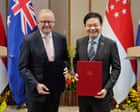
Anthony Albanese just shook hands on a "guarantee" that Singapore will keep the taps open during a global energy crisis. The media is calling it a win for national security. The government is calling it a bedrock of our liquid fuel stability.
They are both wrong.
The notion that a diplomatic "pledge" from a city-state 6,000 kilometers away provides actual energy security is not just naive; it is a dangerous abdication of sovereignty. We are celebrating a pinky-promise while our actual fuel infrastructure is being dismantled. If you believe a piece of paper signed in a posh meeting room will override the brutal mechanics of a global supply chain collapse, you haven't been paying attention to how the world actually works.
The Physical Reality of Empty Tanks
Australia has effectively outsourced its survival. We currently hold a fraction of the mandated 90 days of fuel reserves on-shore. The rest? It’s "tickets"—contracts for oil held elsewhere, often in the very countries we expect to ship it to us when the world goes sideways.
Singapore is a refining hub, not an oil producer. They are a middleman. When the Singapore Prime Minister says they won't cut us off, he is speaking about intent, not capability. If the Malacca Strait is blockaded or if global shipping insurance premiums skyrocket to $500,000 a day during a conflict, that pledge isn't worth the ink used to sign it.
We are relying on a "just-in-time" delivery model for a commodity that runs every truck, tractor, and ambulance in the country. This isn't a strategy. It's a prayer.
Why the "Pledge" Logic Fails the Stress Test
Let’s look at the mechanics of a real crisis. In a scenario where global oil supplies are choked, every nation pivots to "Singapore First." It is the law of the jungle.
- The Sovereign Priority: No leader survives a domestic energy blackout to honor an export agreement with a neighbor. If Singapore’s own lights are flickering, the fuel stays in Singapore. History is littered with "unbreakable" treaties that evaporated the moment a domestic population started rioting over prices.
- The Shipping Bottleneck: We don't own the tankers. Most of the fleet bringing refined product to Australia is foreign-owned and foreign-flagged. In a high-risk maritime environment, those ships won't sail to Sydney or Melbourne just because a Prime Minister asked nicely. They will go where the profit—or the protection—is highest.
- The Refining Death Spiral: Australia has shuttered almost all its domestic refining capacity. We are now a "refined product" importer. We don't just need crude; we need the finished product. By tethering ourselves to Singapore, we have accepted a permanent state of dependency on a single geographic chokepoint.
The Fantasy of the "Largest Petrol Source"
The headlines boast that Singapore is our largest source of petrol. That should be a cause for alarm, not a point of pride. In any other business context, having a single point of failure for your most critical input is considered gross mismanagement.
In the 1970s, the oil shocks proved that diversification is the only hedge. Australia has gone in the opposite direction. We have centralized our risk. We have traded the hard, expensive work of domestic industrial resilience for the cheap, easy optics of diplomatic handshakes.
I have watched boards of directors make similar mistakes for decades. They optimize for the "base case"—the world where everything stays normal—and ignore the "tail risk." They chase the lower cost of an offshore provider and ignore the massive hidden cost of a supply chain break. Australia is currently being run like a company that sold its backup generators because the power hasn't gone out in five years.
The Hydrogen and EV Distraction
The government loves to pivot the conversation to the "Green Energy Transition" whenever someone points out our liquid fuel vulnerability. They suggest that because we are moving toward EVs and hydrogen, we don't need to worry about diesel and jet fuel.
This is a category error.
Even under the most aggressive transition timelines, our heavy transport, agriculture, and defense sectors will remain dependent on liquid fuels for decades. You cannot harvest wheat with a fleet of battery-electric combines that don't exist yet. You cannot fly a long-haul transport mission on a "maybe" for hydrogen technology.
By framing fuel security as a "legacy issue" that will be solved by the transition, we are creating a "vulnerability gap." We are exiting the old world before the new one is built, leaving us exposed in the middle.
The Cost of Real Security
True security isn't found in a Singaporean boardroom. It’s found in concrete and steel on Australian soil.
If we were serious about national resilience, we would be doing three things immediately:
- Mandating Physical On-Shore Reserves: Not "tickets." Not paper contracts. Physical tanks filled with diesel and petrol located within our borders.
- Subsidizing Domestic Refining: Yes, it is inefficient. Yes, it is more expensive than importing from Singapore. That is the price of an insurance policy. We need the capability to turn crude into fuel ourselves, regardless of the global market.
- Building a National Tanker Fleet: We need Australian-flagged vessels manned by Australian crews that can be directed by the government in a crisis.
Instead, we are choosing the path of least resistance. We are accepting a verbal guarantee from a trading partner and calling it a day.
Stop Asking if They Will Cut Us Off
The question isn't whether Singapore wants to supply us. The question is whether they can.
When a kinetic conflict breaks out or a major maritime artery is severed, the "rules-based order" disappears in an afternoon. In that world, fuel doesn't go to the person with the best diplomatic relationship. It goes to the person who has the tanks, the refineries, and the ships to protect them.
We have none of the above.
We are a continent-sized island that has forgotten how to be self-reliant. We are betting our entire economy on the hope that the world will remain peaceful and the shipping lanes will remain open forever.
Reliance is not a strategy. A pledge is not a pipeline. It is time to stop pretending that a handshake in Singapore has secured our future. It has only highlighted how naked we truly are.
Build the tanks or prepare for the lights to go out. There is no third option.