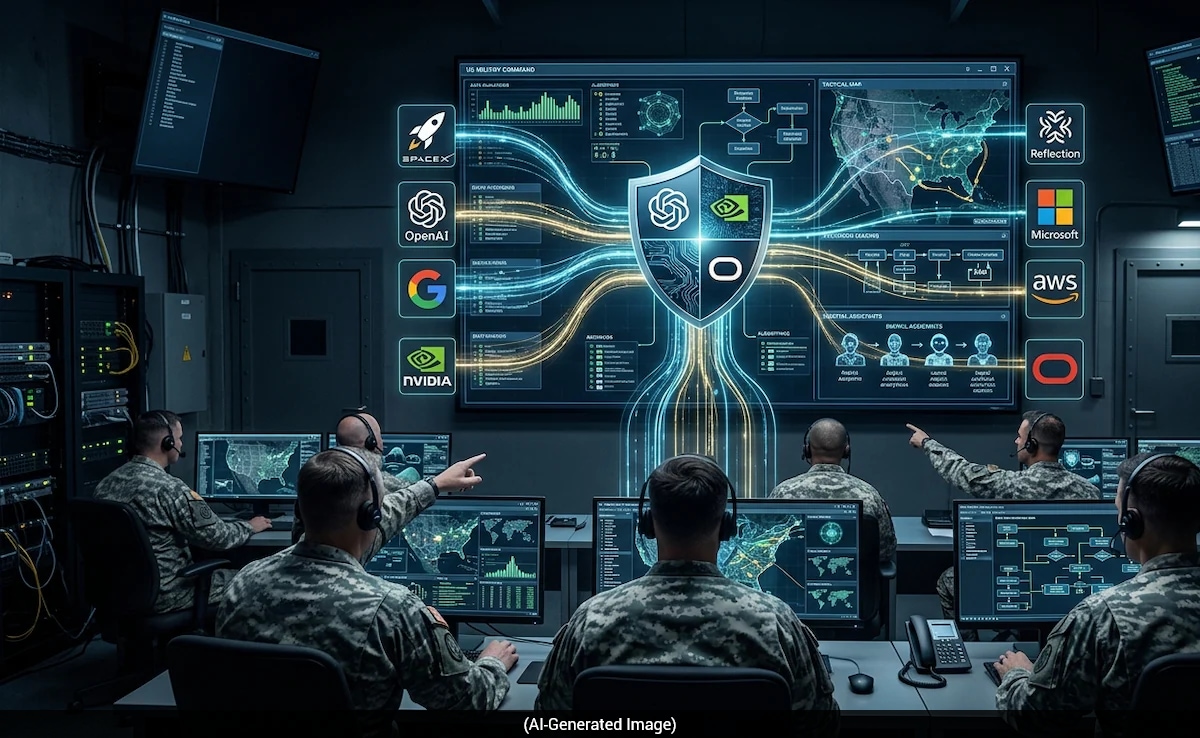
The American defense apparatus is undergoing a forced migration. For decades, the Pentagon relied on a stagnant collection of legacy contractors, firms that mastered the slow, bureaucratic dance of cost-plus contracting. That era is dead. Today, the Department of Defense is outsourcing its cognitive labor to the primary architects of the internet. Google, SpaceX, and OpenAI are not merely serving as vendors. They are becoming the nervous system of modern kinetic engagement. This shift marks the end of the traditional military-industrial complex and the birth of a faster, more volatile reality where the distance between a software engineer in Mountain View and a target in a contested zone has effectively vanished.
The Software Transition
Bureaucracy moves at the speed of paper; algorithms move at the speed of light. Military leaders realized that their multi-billion dollar hardware fleets were becoming increasingly obsolete against low-cost, automated threats. A swarm of cheap, off-the-shelf drones guided by sophisticated vision models can neutralize a naval vessel that took ten years to build. The Pentagon had two choices: build their own software teams—an impossible task given salary disparities—or sign blank checks to the corporations that already own the data pipes of the world. If you found value in this post, you should read: this related article.
They chose the latter. By bringing firms like Google and OpenAI into the fold, the military gains immediate access to foundational models trained on the sum of human knowledge. These firms have refined their ability to identify patterns, translate dialects, and predict logistical bottlenecks at a scale the Department of Defense could never achieve internally. It is an act of desperation framed as modernization.
The SpaceX Factor
SpaceX operates differently. While other firms offer specialized software, Elon Musk’s operation provides the physical backbone of the new theater of operations. Starlink has turned satellite internet into a tactical utility, offering persistent, low-latency connectivity in environments where signals were previously jammed or unavailable. This is not just about logistics. It is about total environmental awareness. For another look on this story, see the latest update from Gizmodo.
Ground forces now operate with a level of visibility that once belonged exclusively to high-altitude reconnaissance aircraft. The reality of this integration is stark. When a civilian infrastructure project provides the primary communications channel for military units, the distinction between civilian and combatant assets evaporates. It changes how enemies view those satellites. It changes how the military views those companies. If the hardware is a private commodity, the war becomes a service-level agreement.
The Ethics of Optimization
The push for automation raises a fundamental question. Can a machine ethically manage lethal force? Critics often lean on science fiction tropes of runaway intelligence, but the genuine risk is much more mundane. It is the risk of optimized failure.
Engineers at companies like OpenAI are trained to minimize error in consumer-facing products. They optimize for engagement, accuracy, or creative output. When you apply these same optimization functions to a theater of war, the parameters shift. A model might be trained to reduce collateral damage through precision, but if the training data is tainted by biased historical operations or faulty intelligence, the machine simply accelerates the errors. The efficiency of the algorithm becomes the velocity of the tragedy.
Companies often frame these partnerships as dual-use. They argue that the same software protecting electrical grids or detecting financial fraud can secure military networks. That is a convenient narrative. The reality is that once an intelligence model is fine-tuned for tactical warfare, it belongs to that domain. There is no clean separation between the commercial tool and the weaponized version once the proprietary code is altered.
The Procurement Paradox
Government contracts used to be about prestige and steady revenue. Today, the prize is data. These technology companies are not just looking for government money. They are looking for the unique, real-world data sets that only a military entity can generate. They want to see how their models perform under extreme jamming, how they process raw sensor data from a battlefield, and how they react to unconventional threats.
This creates a dangerous feedback loop. The military adopts a technology because it is advanced. The technology advances further because it consumes the data generated by the military. The Pentagon becomes increasingly dependent on these vendors, while the vendors gain an insurmountable lead in technical capability by effectively using the entire world as their testing ground.
Smaller, specialized firms that once competed for defense work are being pushed to the margins. They lack the capital to train the massive models these companies provide, and they lack the influence to navigate the labyrinthine security clearance requirements that keep these partnerships exclusive. We are moving toward a monoculture in defense technology where only a handful of firms have the scale to survive, and the Pentagon is trapped in a vendor lock-in that will define the next fifty years of procurement.
The New Frontline
The frontlines are no longer physical lines on a map. They are server racks in data centers and cloud infrastructure regions. When a cloud provider decides to push a software update, they are effectively modifying the operational capacity of active military units.
This creates a hidden liability. If a civilian cloud service goes down due to a massive distributed denial-of-service attack or a catastrophic internal software bug, a significant portion of the military’s tactical decision-making support disappears. The resiliency that the Pentagon spent decades building into hardened, offline systems is being replaced by the fragility of distributed, internet-reliant networks. We are trading long-term institutional stability for the short-term benefit of rapid feature updates.
Soldiers in the field are effectively becoming beta testers for high-stakes software that was originally designed to optimize advertisements or generate prose. The iteration cycle of a startup is weeks; the iteration cycle of a military doctrine is years. When these two timelines collide, the friction is significant. Commanders are finding that their expensive, high-tech tools require constant connectivity and frequent patches, turning their equipment into a maintenance burden that demands a steady stream of engineers from the vendor.
The End of Neutrality
There is a finality to these contracts that is difficult to ignore. The era of the "neutral" technology giant is over. You cannot claim to be a global platform for all humanity while simultaneously being a core architect of one nation’s military dominance.
These firms are making a calculation. They have determined that the long-term potential for revenue and influence within the defense sector outweighs the risk of alienating their global user base. They are counting on the fact that governments will always need more, faster, and better intelligence. They are correct. The military is not going to revert to analog systems, and they are not going to build their own software empires. They will continue to surrender control of their systems to the firms that have the most compute.
The defense apparatus is effectively being bought, one software patch at a time. The firms at the center of this transition are not just participating in the defense sector. They are defining its trajectory, forcing a pace of development that rewards raw speed over institutional caution. The consequences of this choice will be felt long before the code is fully deployed, as the very nature of military readiness is fundamentally rewritten by the demands of the algorithm.