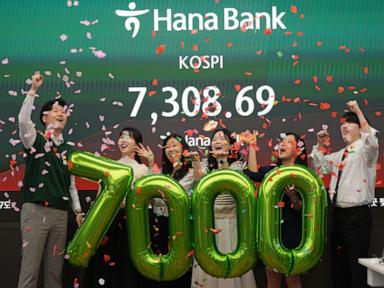
The floor of the Korea Exchange doesn’t roar like it used to. The physical chaos of shouting traders has long since been replaced by the hum of servers and the soft clicks of mechanical keyboards in glass-walled offices in Yeouido. But the silence is deceptive. Beneath the surface, the adrenaline is surging.
For years, the South Korean Kospi was a sleeping giant, often overshadowed by the high-octane volatility of the Nasdaq or the steady climb of the Nikkei. Investors spoke of the "Korea Discount"—a stubborn trend where South Korean companies were undervalued compared to their global peers. But look at the charts today. Something has changed. The giant is waking up, and it is being jolted awake by the same electric current powering the rest of the world: Artificial Intelligence.
Consider Ji-hoon, a hypothetical retail investor sitting in a coffee shop in Gangnam. He represents thousands like him. For years, he kept his savings in safe, boring bonds or perhaps a bit of real estate. Then came the explosion of generative AI. He watched as Nvidia became the most important company on the planet. He realized that the brain of every AI model—the sophisticated HBM (High Bandwidth Memory) chips—has a "Made in Korea" stamp on its soul.
The Memory of Machines
The rally isn't just a number on a screen. It is a physical reality born in the clean rooms of Suwon and Icheon. To understand why the Kospi is climbing, you have to understand the sheer desperation of the global tech industry. Every tech titan in Silicon Valley is currently engaged in an arms race, and South Korea owns the ammunition factory.
Standard memory is like a wide, flat road. It works, but it gets congested when you try to move too much data at once. HBM is a skyscraper. It stacks memory layers vertically, connected by microscopic pillars of light and electricity. This allows data to move at speeds that were unthinkable a decade ago.
When foreign institutional investors look at the Kospi, they aren't just buying "tech shares." They are buying a stake in the infrastructure of the future. The massive influx of foreign capital—billions of dollars flowing into the Seoul market—is a vote of confidence in the specific engineering prowess of companies like SK Hynix and Samsung Electronics. These aren't just corporations; they are the gatekeepers of the AI era.
The Weight of a Nation
There is a unique pressure that comes with being the world’s workshop. In South Korea, the performance of the Kospi is a matter of national pride and individual survival. Unlike the diversified economies of Europe, the Korean market is top-heavy. When the chipmakers swing, the entire index dances.
This creates a high-stakes environment for the average citizen. When the AI boom drives a rally, it isn't just about billionaire CEOs getting richer. It's about pension funds growing. It's about the "Ants"—the nickname for Korea’s dedicated retail investors—finally seeing a return on their patience.
The invisible stakes are found in the late-night lights of office buildings where engineers are working 80-hour weeks to shave a nanosecond off a processing cycle. They know that the lead Korea holds in HBM is fragile. Micron is chasing them. American domestic production is being subsidized. The rally is a celebration, yes, but it is also a deadline.
Why the Discount is Dissolving
For a long time, the world looked at Korean stocks with a squint. Concerns over corporate governance and the "Chaebol" structure—large, family-run conglomerates—kept prices lower than they should have been. But AI has a way of clarifying priorities.
When a technology comes along that promises to reorganize human civilization, investors stop worrying about the nuances of board seats and start looking at who can actually ship the product. The demand for AI hardware is so voracious that the traditional "Korea Discount" is being incinerated by the heat of the foundry.
The narrative has shifted from "Can we trust the structure?" to "Can they make enough chips?"
The answer, so far, has been a resounding yes. The technical lead maintained by Korean firms in the memory sector is not just a result of hard work; it is the result of decades of hyper-specialization. They bet on the importance of memory long before the world knew what a Large Language Model was. Now, the world is paying up.
The Ripple Effect
The rally in tech shares acts like a stone thrown into a pond. The initial splash happens in semiconductors, but the ripples reach much further.
When the big players grow, the entire ecosystem expands. Small-to-medium enterprises that provide the chemicals, the ultraviolet lithography components, and the testing equipment are seeing their valuations soar. This is the "hidden" Kospi. These are the companies that don't make the international headlines but are essential to the supply chain.
For the person on the street, this manifests as a sense of renewed momentum. The post-pandemic gloom that hung over Seoul’s financial district is lifting. There is a palpable energy in the way people discuss their portfolios. The conversation has moved from "Is the market going to crash?" to "How much of the AI revolution do I actually own?"
The Fragility of the Spark
It would be a mistake to think this climb is effortless. The AI boom is a hungry beast. It requires massive amounts of energy, specialized cooling systems, and an endless supply of rare earth minerals. Any hiccup in the global supply chain, or any cooling of the AI hype cycle, could send the Kospi back into its slumber.
There is also the geopolitical tension that hums in the background like a low-frequency noise. South Korea sits in a complex position, balanced between its primary security ally, the United States, and its massive trading partner, China. The tech rally is happening in a world that is increasingly fragmented. Every chip exported is a political statement.
Investors are aware of this. They are buying in, but they are doing so with their eyes wide open. They know that they are not just investing in a company; they are investing in a country's ability to navigate a precarious century.
Beyond the Numbers
Numbers are cold. A 2% rise in an index is a statistic. But a 2% rise in the Kospi after a decade of stagnation is a narrative of redemption.
It represents the validation of an economic model that many critics said was outdated. It proves that in the digital age, physical manufacturing—the actual, difficult work of manipulating atoms—is more valuable than ever.
We often talk about the "cloud" as if it is a mystical, ethereal place where our data lives. It isn't. The cloud is a series of massive, air-conditioned buildings filled with humming racks of silicon. And a significant portion of that silicon was born in the heart of the Korean Peninsula.
The rally is a reminder that even in a world of software and algorithms, the hardware still matters. The soul of the machine is made of sand, heat, and the incredible precision of human ingenuity.
The "Ants" are still watching the screens. The engineers are still in the clean rooms. The servers are still humming. The pulse of the market is steady, for now, driven by the realization that the future isn't coming—it's being manufactured, one layer of high-bandwidth memory at a time.
The lights in Yeouido stay on late into the night. They are reflecting off the glass, casting long shadows across the Han River, marking the rhythm of a nation that has finally found its frequency in the age of intelligence.