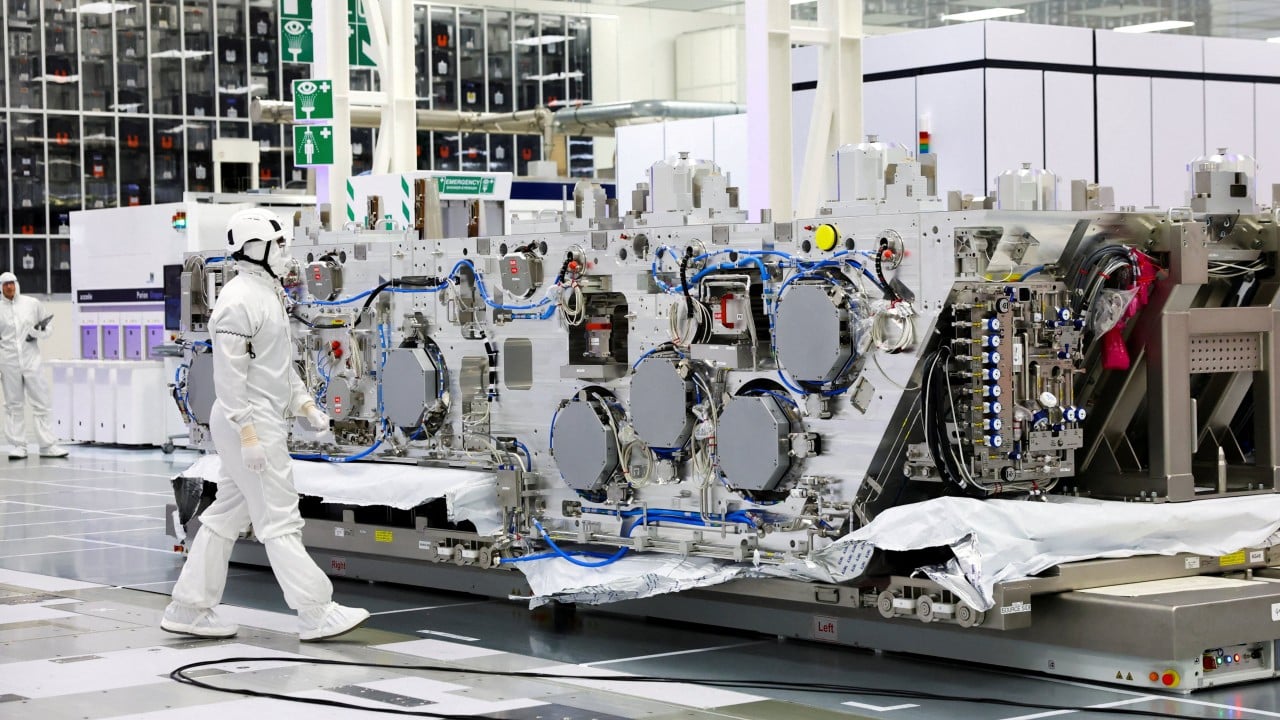
The global race for computing supremacy just took a sharp, unexpected turn. At the ISC 2026 conference in Hamburg, Germany, a previously unlisted Chinese supercomputer named LineShine debuted at the absolute top of the TOP500 rankings, ending nearly a decade of American dominance. Reaching a sustained speed of 2.198 exaflops, the machine outperformed the previous American champion, El Capitan, by more than 20 percent. The real shock waves, however, are not coming from the raw numbers, but from the architectural blueprint inside the chassis. China did not just beat the United States at its own game; it did so by changing the rules entirely.
For the past several years, Washington assumed its sweeping export controls on advanced graphics processing units (GPUs) would effectively freeze Beijing out of high-performance computing development. That assumption proved dangerously flawed. While American exascale systems like El Capitan, Frontier, and Aurora rely heavily on specialized chips from AMD and Intel to handle heavy mathematical lifting, LineShine achieved its historic performance using an entirely custom, home-grown CPU architecture.
The Architecture of Evasion
To understand how Beijing pulled this off, one must look at the specific composition of the hardware installed at the National Supercomputing Centre in Shenzhen. The entire system is built around the custom LingKun platform, running on 304-core Huawei LX2 processors. It contains no GPUs.
Instead of relying on the massive parallel processing power of accelerators that the United States successfully blocked through commerce department sanctions, Chinese engineers linked together an astonishing 13,789,440 conventional processor cores. These cores operate at a modest 1.55 GHz, connected by a proprietary network fabric called LingQi, and managed by a domestic operating system known as Kylin OS.
This brute-force, CPU-only approach was widely considered obsolete by western system architects. Conventional wisdom dictated that building an exascale machine without high-speed accelerators would require too much physical space and an unsustainable amount of electricity. LineShine defies that consensus, though it comes with a massive cost in utility bills. The system draws roughly 42.2 megawatts of power to maintain its top speed, making it an incredibly energy-hungry beast compared to its American counterparts.
The geopolitical implications of this hardware choices are profound. By designing and manufacturing a competitive architecture completely free of American intellectual property, China has demonstrated that export restrictions can accelerate domestic self-reliance rather than merely delaying it.
The Hidden Data War and Bureaucratic Silence
There is a parallel narrative to LineShine that explains why it suddenly appeared without warning. For years, the computing sector suspected that China was hiding multiple exascale systems to avoid provoking further US sanctions. Systems at places like Wuxi and Guangzhou were rumored to have broken the exascale barrier long ago, but Chinese institutions stopped submitting their benchmarks to the official TOP500 committee in 2017.
LineShine broke that silence for a highly specific reason. Unlike previous crown-jewel systems funded entirely by state military or defense grants, this machine was built by the Shenzhen Cloud Computing Center, utilizing a pool of commercial and local resources. Because it lacked direct national security funding strings, its operators felt comfortable submitting the results to international bodies to showcase their technological capabilities.
This disclosure reveals a deep institutional confidence within the Chinese semiconductor sector. They are no longer hiding their progress because they no longer fear that new restrictions can stop them.
The AI Distortion Factor
While the performance numbers are legitimate, the ranking exposes a deeper schism in how modern computing power is measured and utilized. The High Performance Linpack (HPL) benchmark, which the TOP500 list has used as its primary yardstick since 1993, measures double-precision floating-point theorem execution. This math is vital for traditional scientific workloads like climate modeling, nuclear stockpile simulations, and astrophysics.
It is not, however, how modern artificial intelligence is built.
AI model training relies on mixed-precision calculations, an entirely different type of mathematical workload. When tested on the HPL-MxP benchmark, which tracks this AI-relevant capability, LineShine dropped significantly to fourth place. Its CPU-heavy design simply lacks the specialized optimization for deep learning that American GPU-based systems possess.
Furthermore, the most powerful computing clusters in the West are no longer found in government laboratories. Tech giants like Microsoft, Amazon, Google, and xAI are constructing massive, private infrastructure networks packed with tens of thousands of specialized chips. Elon Musk’s xAI Colossus cluster in Tennessee is a prime example. These corporations have absolutely no interest in running standard academic benchmarks or submitting their proprietary hardware statistics to a public list. If these commercial hyper-scalers actually chose to index their private systems, the official public rankings would look radically different.
A Fractured Global Supply Network
The split at the top of the computing hierarchy points toward a permanent bifurcation of global technology. For decades, high-performance computing was an international collaborative effort. A system might feature American processors, Japanese memory modules, and European cooling systems.
That interconnected model is dead. We are looking at two distinct ecosystem models developing in isolation from one another.
The Western model continues to push the limits of dense accelerator architectures, trying to maximize performance per watt while wrestling with complex cooling and supply constraints for specialized silicon. The Chinese model, as exemplified by LineShine, relies on massive scaling of independent, domestically fabricated components, building out expansive facilities that prioritize strategic independence over power efficiency.
This separation creates a dangerous lack of visibility. When both nations used the same commercial components, intelligence agencies could accurately estimate a rival's computational capabilities simply by tracking shipping manifests and corporate sales reports. With China designing its own proprietary network interconnects and custom instruction sets, tracking their true computational ceiling has become an opaque guessing game.
The true test of a supercomputer is not the trophy it wins on a testing track, but the actual real-world output it delivers inside the laboratory. The United States still holds a commanding lead in the absolute volume of systems deployed across the top tier of the list, retaining three of the top four spots with El Capitan, Frontier, and Aurora. Yet, dismissing LineShine as an inefficient anomaly misses the broader picture. China has proven it can build top-tier high-performance infrastructure from scratch, using nothing but its own supply chains. The silicon wall that Washington tried to build has been breached, and the strategy behind it requires urgent reexamination.