Ocean water is not blue when you descend far enough. It is the color of a bruise. Down there, hundreds of feet below the restless whitecaps of the Atlantic, light ceases to exist as a memory and becomes a theoretical concept. The hull of a nuclear-powered submarine does not merely float; it endures. It squeezes against a crushing weight of water, a metallic spine holding back the void, powered by a controlled miniature star humming quietly in the dark.
Inside that steel tube, silence is a discipline. Sailors whisper not because they are afraid, but because sound travels like a whip across the bulkheads. Every heartbeat, every footstep on the rubberized floor tiles, is measured. Then, the order comes down from a voice that has traveled across encrypted frequencies from a desk thousands of miles away.
It is a moment that exists entirely outside of normal time.
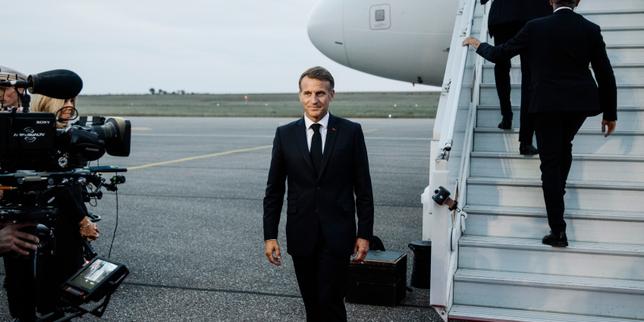
When Emmanuel Macron stepped aboard a nuclear ballistic missile submarine—known to the French Navy as a SNA or SSBN, depending on its specific deadly cargo—he was stepping into the most solitary apex of state power. Most leaders see military hardware lined up neatly on asphalt during national holidays, painted for cameras and scrubbed for public relations. They stand on reviewing stands, waving at passing turrets.
This was entirely different. This was visceral.
Imagine the atmosphere in the control room as the vessel hovers in the abyssal plains. The president of a nuclear-armed nation does not simply watch an event; he becomes part of an unbroken chain of ultimate authority. He is holding the invisible thread that connects geopolitics to absolute physics.
The missile launched that day was an M51, a towering pillar of composite materials and rocket fuel capable of carrying multiple thermonuclear warheads across intercontinental distances. But on a test flight, its warheads are empty of fire, carrying instead telemetry boxes packed with sensors and wires. It is a ghost shot, designed to prove that the mechanical choreography of deterrence still functions down to the millisecond.
To understand why a head of state would make this unannounced, clandestine descent into the deep, you have to look past the political theater and into the psychology of command.
Deterrence is an abstract architecture. It is built on words, treaties, codes, and unspoken threats exchanged between capitals separated by oceans. Leaders spend their terms talking about defense budgets, alliances, and readiness percentages. These are numbers on a spreadsheet. They are clean. They are civilized.
A nuclear launch is none of those things.
When the countdown reaches zero in the belly of a submerged leviathan, the air in the compartment shifts. Compressed air hisses with the force of a tectonic release. The missile is violently ejected from its silo by gas pressure, shooting upward through the brine like a breaching whale. Once it clears the surface and hits the atmosphere, its first-stage solid rocket motor ignites with a roar that shakes the ocean itself, carving a column of white fire into the sky before vanishing into the stratosphere.
It is an exhibition of sheer, unadulterated violence packaged as restraint.
Macron’s unexpected presence on that vessel was a message written in fire and water. In an era where European security has been violently upended by the return of continental war, the architecture of peace is frequently tested. Leaders in capitals from Paris to Berlin find themselves navigating a landscape where old certainties have frayed. Diplomacy relies on conversation, but ultimate sovereignty relies on the capacity to say no—and to back it up with a force so total that hesitation becomes unthinkable.
For years, the nuclear deterrent maintained by France—known historically as the Force de Dissuasion—has operated on the principle of strict sufficiency. It is not designed to conquer; it is designed to deter. It is a shield forged from the realization that if you possess the means to utterly destroy an aggressor's vital centers, the aggressor will never take the first step.
Yet, keeping that shield sharp requires touching the blade.
When a president watches the sea erupt as a fifty-ton missile breaks the waves, he is confronting the terrifying reality of his own signature. The codes carried in the leather briefcase that never leaves a leader's side are not administrative stamps. They are keys to a vault that should never be opened. By witnessing the test firsthand, the French leader stepped away from the sanitized briefings of the Élysée Palace and confronted the raw mechanics of national survival.
Consider what it takes for a crew to maintain this readiness month after month. These sailors live in perpetual twilight, breathing recycled air, sleeping in tight, stacked bunks where the hum of the reactor is the only lullaby. They miss birthdays, anniversaries, and the changing of seasons. They train relentlessly for emergencies that everyone hopes will never materialize. Their entire existence is an exercise in paradoxical purpose: they exist so they never have to act.
When the missile cleared the horizon, leaving behind a fading trail of white exhaust and the smell of ozone drifting over the water, the submarine did not celebrate. There were no cheers in the control room. The tension simply shifted gears, returning to the steady, watchful hum of the deep. The periscopes dipped. The hatches remained dogged down. The vessel melted back into the grey expanses of the ocean, disappearing like a shadow passing through a dark room.
Back on the surface, the political world would buzz with commentary, analyzing the geopolitical subtext of the unannounced visit, measuring the signals sent to allies and adversaries alike. Analysts would dissect the timing, the symbolism, and the strategic doctrine.
But down there, beneath the crushing weight of the sea, the reality was much simpler. It was about steel, fire, and the heavy burden of keeping the dark at bay.