In the marbled corridors of Brussels, where the air often smells faintly of damp wool and bureaucratic compromise, power rarely announces itself with a shout. It arrives quietly. It wears a dark, unpretentious suit. It carries no notes.
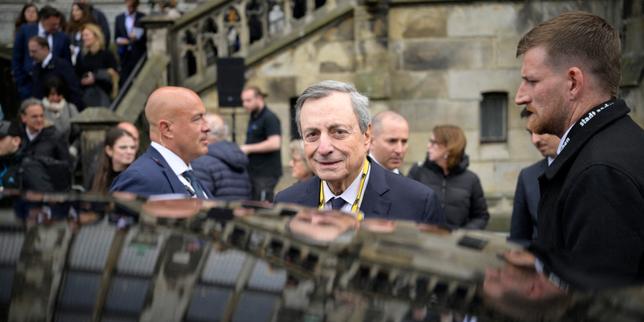
Mario Draghi is sitting in a room three blocks away from the European Commission, and though he no longer holds the formal title of Prime Minister, nor sits at the apex of the European Central Bank, the men and women who do are quietly adjusting their clocks to his watch.
To understand why a retired central banker remains the most consequential architect of a continent, you have to look past the press releases and step into the reality of a European morning.
Picture a mid-sized industrial manufacturer in Turin, a third-generation family business that builds precision gears for automated assembly lines. The owner, a man named Marco whose fingernails still carry traces of machine oil despite his title, arrives at his desk before seven. On his screen are three reports. One details the rising cost of industrial power, which is nearly triple what his competitors pay across the Atlantic. Another outlines the new regulatory compliance filings required just to export a crate of steel pinions to Germany. The third is a speech given in a sterile conference hall by a man with silver hair and glasses pushed low on his nose.
Marco does not know Mario Draghi personally. He has never shaken his hand. Yet Draghi’s words dictate whether Marco’s factory will survive the decade.
For months, the blueprint has been hiding in plain sight. Draghi delivered a comprehensive report on European competitiveness—a dense, uncompromising diagnostic of a continent sleepwalking into economic irrelevance. Most policy documents are written to be shelved. They are diplomatic exercises designed to offend no one while achieving nothing.
This one was different. It read like an autopsy report delivered while the patient was still breathing.
Consider what happens when a continent of four hundred and fifty million people decides to regulate the future rather than invent it. We spent the last decade building fences of compliance while our rivals across the Pacific and the Americas built platforms of scale. We protect our workers so thoroughly that we risk leaving them with nothing to produce. We preach green transition while starving our industries of the cheap energy required to build the very turbines and panels we desperately need.
Draghi looked at this paradox and called it by its name.
He called it structural suicide, rendered polite by committee consensus.
To feel the weight of this, you have to remember the summer of 2012. The euro was fraying at the edges. Markets were circling like vultures. Governments were paralyzed by sovereign debt crises, and the common currency looked less like an economic union and more like a high-stakes poker game where everyone was cheating.
Then came the five words that changed modern financial history.
Whatever it takes.
He didn't need a legislative act. He didn't need a constitutional convention. He needed only credibility, absolute conviction, and the terrifying willingness to stare down global bond markets until they blinked. He saved the euro not by printing endless money, but by erasing the doubt that the project would be allowed to fail.
Now, the crisis is different, which makes it infinitely harder to fight. There is no dramatic market panic, no screaming headlines about spreads widening on Italian bonds, no frantic weekend summits in Brussels. The decay is slow. It is the quiet bleeding of market share in artificial intelligence, in biotechnology, in advanced computing, in clean energy manufacturing.
It is the sound of a brilliant young computer scientist in Milan packing a suitcase for a one-way flight to Seattle.
When Draghi wanders through the European capitals now, his message is relentless. Europe faces a simple, brutal choice. Invest massively, integrate deeply, and strip away the internal friction that turns a single market into twenty-seven separate bureaucratic obstacle courses, or accept a slow, dignified slide into a pleasant museum for wealthy tourists.
The resistance to this message is institutional and stubborn. Small nations worry about losing their vetoes. Wealthy northern states guard their fiscal prudence like misers protecting gold coins under a mattress, terrified of mutualized debt. Bureaucrats protect their turf with the fierce dedication of medieval guilds.
Yet the gravitational pull of Draghi's roadmap is undeniable.
Every time a European commissioner stands before the press to announce a new industrial strategy, the ghost of his logic hovers behind them. Every time a reluctant chancellor or president agrees to a joint defense procurement initiative or a streamlining of green permits, they are paying tax to the reality he mapped out.
The Sphinx of Rome, as some French commentators like to call him, does not care about applause. He sits in the background, expressionless, watching the political class slowly realize that the alternative to his vision is a future dictated entirely by Washington and Beijing.
Back in Turin, Marco shuts down his laptop as the evening shift takes over the floor. The hum of the CNC machines fills the air, rhythmic and heavy. He wonders if his grandchildren will still be cutting metal here, or if the factory will be a logistics warehouse for foreign parts.
The answer is being written right now in Brussels. Not by politicians looking toward the next election, but by the quiet architect who already knows that history does not wait for committee approval.