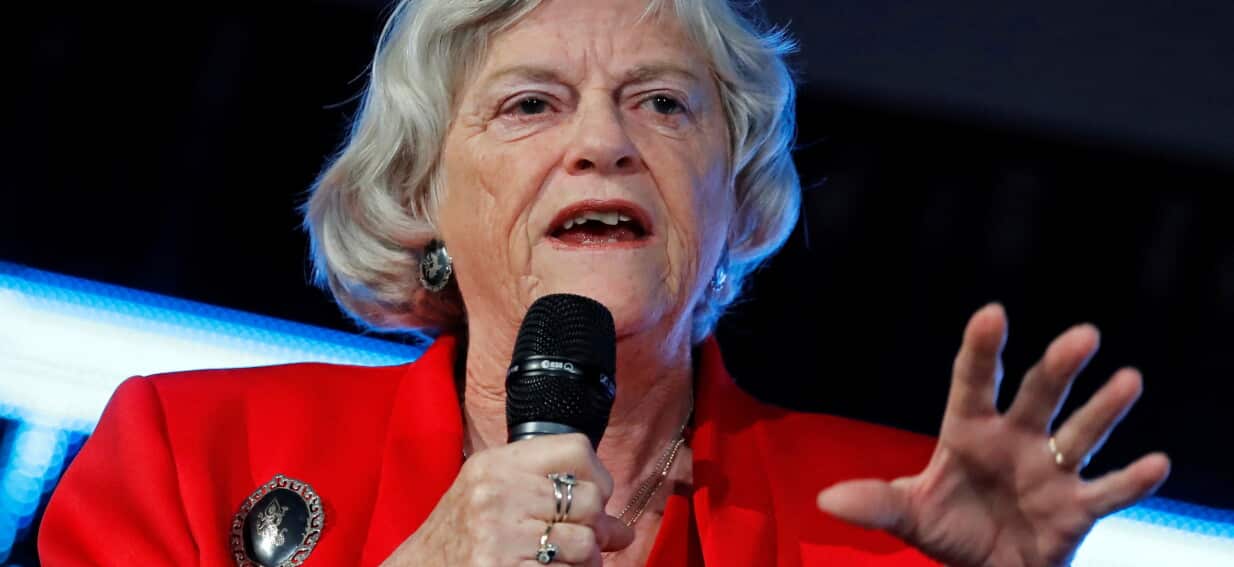
The camera light blinks out, and the screen fades to black.
It is just after 8:00 AM on a damp Wednesday morning in the Devon countryside. Inside her bungalow, nestled on the rugged edge of Dartmoor National Park, seventy-eight-year-old Ann Widdecombe has just finished speaking to a TalkTV streaming audience. For decades, her voice—uncompromising, sharp, and instantly recognizable—had cut through the polite noise of British public life. Today, she is in her sanctuary, a home she called "Widdecombe’s Rest." A wooden plaque bears the name at the end of the gravel driveway, offering the promise of peace.
By midday, that peace is shattered.
At 12:19 PM, a television producer calls her mobile phone to coordinate an afternoon broadcast. She answers. It is a routine chat, the briefest logistical check-in.
Then comes the silence.
By the time other television researchers try to reach her just a few hours later, the calls ring out. No answer. The next morning, paramedics push through the doors of her quiet bungalow and find her. She has sustained catastrophic head injuries.
In a county like Devon, where life moves at the slow pace of the tides and homicides are rare anomalies, the shock is visceral. But as the yellow police tape is strung across the wild Dartmoor gorse, the tragedy transforms from a local horror into a national crisis. What initially looked like a terrible, isolated tragedy is suddenly pulled into the dark machinery of state security.
The Pivot in the Dark
For the first forty-eight hours, the official narrative is one of cautious restraint. Devon and Cornwall Police issue steady, calming updates: there is "no information to suggest" this is a terrorism-related incident. The public is urged not to speculate. We are told to breathe.
But on Monday, the tone shifts completely.
A suspect, a twenty-eight-year-old white British man, is tracked down in South Yorkshire—nearly three hundred miles north of Widdecombe's quiet cottage. When he is first detained, it is on suspicion of murder. But behind closed doors, "new information and evidence" suddenly lands on the desks of investigators.
The local police force steps aside. National Counter Terrorism Policing takes the wheel. The suspect is rearrested under the Terrorism Act, accused of the "commission, preparation, or instigation of acts of terrorism."
This pivot changes everything.
It turns a quiet country murder into a mirror reflecting Britain’s deepest, most exhausting anxieties. When a prominent political figure is targeted, the crime is never just against the flesh and blood of the victim. It is an assault on the invisible agreement that holds a democratic society together: the belief that we can argue, passionately and fiercely, without paying for our convictions with our lives.
A Career Written in Friction
To understand why this hit the British psyche with such force, you have to understand who Ann Widdecombe was. She was not a retired backbencher fading gracefully into the background. She was a lightning rod.
For twenty-three years as a Conservative MP, she stood as the unapologetic champion of a bygone Britain. She opposed abortion, stood firmly against gay marriage, and loudly advocated for the return of the death penalty. To her supporters, she was a woman of towering, rare principle. To her detractors, she was a dinosaur, a relic of an intolerant past.
Yet, she possessed a strange, uniquely British quality that allowed her to cross over from polarizing politician to national treasure.
Who else could transition from the halls of Westminster to dragging a samba across the floor of Strictly Come Dancing? Millions who detested her voting record watched her with affectionate amusement. She became a caricature of herself—the stern, pantomime governess of the nation.
But the friction never truly stopped.
She stepped back into the fray with Nigel Farage's Brexit Party, and later, Reform UK, acting as the party’s immigration and justice spokesperson. She spoke about borders, sovereignty, and identity—the most volatile, highly combustible topics in modern politics.
She did not hide behind security details or high walls. She lived in a bungalow on Dartmoor with her name on the driveway.
The Shadow Over Public Life
Consider the reality of being a public figure in Britain today.
We often think of politicians as insulated elites, protected by layers of bureaucratic armor. The truth is far more exposed. In the UK, the tradition of constituency surgeries and public accessibility means that those who govern are often just a plastic table and a folding chair away from the people they represent.
But that accessibility has a devastating cost.
Widdecombe’s death is not an isolated tremor. It is part of a sickening pattern. In 2016, Labour MP Jo Cox was murdered in the street by a far-right extremist. In 2021, Conservative MP Sir David Amess was stabbed to death in a church by an Islamic State sympathizer.
Now, we add another name to this tragic list.
When Home Secretary Shabana Mahmood stood in the House of Commons to address the tragedy, her words carried a heavy, exhausted weight. "Politics is a calling," she said. "But it should not be a dangerous one."
But it is dangerous. The suspect in this case was reportedly unknown to "Prevent," the UK’s anti-extremism early-warning program. He was a ghost in the system. How do you protect someone from an invisible threat that materializes in a remote country village on a quiet Wednesday afternoon?
The Price of Free Speech
Following the attack, Reform UK announced it was putting 24-hour security in place for all its senior figures. Nigel Farage, who has previously faced physical confrontations on the campaign trail, met with security officials to discuss the safety of his team.
This is the invisible tax on democracy.
When politicians must travel with bodyguards, when they must look over their shoulders before entering a village hall, the space for open debate shrinks. The conversation becomes guarded. The distance between the public and their representatives grows wider, filled with bulletproof glass and suspicion.
We are left with a haunting, quiet image: a bungalow on the edge of the mist-shrouded moors, where a woman who spent fifty years talking to the nation was suddenly, brutally silenced. The investigation will continue, the courtroom trials will follow, and the legal facts will eventually be laid bare.
But the true damage is already done. Every time a voice is extinguished in violence, a piece of the public square is lost, leaving us all a little more isolated, a little more fearful, and much closer to the dark.