The ink on the ledger recorded four thousand lives, but the paper never smelled of woodsmoke or wet clay. It never captured the particular sound of a mother’s voice breaking in the dark of a clinic in North Kivu, nor the way the dust settles over a road when the trucks finally stop rolling. Statistics are tidy things. They fit neatly into columns on Geneva spreadsheets and cable news tickers. They offer the comforting illusion that a tragedy can be measured, boxed, and shelved.
Reality is messier. It arrives as a sweat-soaked sheet on a camp cot. It smells of chlorine, damp earth, and fear.
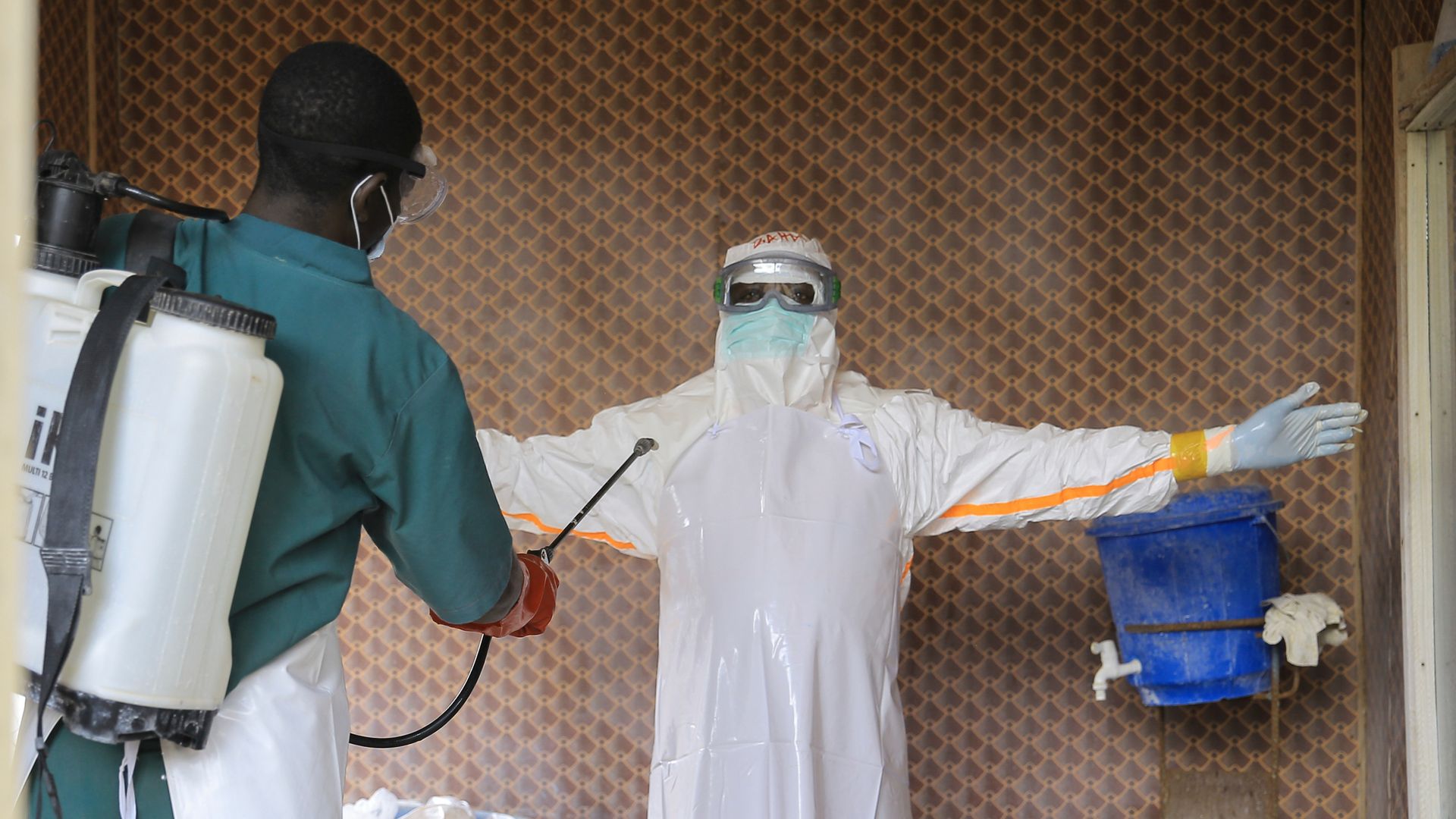
To understand what happened when the Democratic Republic of Congo confronted one of the most lethal outbreaks of the Ebola virus in human history, you have to look past the macro numbers. You have to step inside the red zone. Imagine, for a moment, the weight of a heavy rubber visor fogging up with your own breath while someone you are trying to save reaches out with a shaking hand. You cannot touch them with bare skin. You can only offer the barrier of latex and the quiet reassurance of your voice, filtered through layers of synthetic fabric.
Trust is fragile. In communities where the state has historically appeared mostly as an extractor of taxes or a bearer of bad news, strangers arriving in moon-suit gear bearing talk of invisible contagion are met with suspicion. For generations, people in these eastern provinces learned to rely on family, on traditional healers, and on the quiet resilience of their villages to weather the storms of history. When health workers appeared overnight, speaking foreign dialects or bearing the stamps of distant capitals, the instinctive reaction was not obedience. It was retreat.
Consider the ordinary rhythms of village life that suddenly became vectors of peril. Funerals in this region are not mere administrative events; they are the spiritual glue binding the living to their ancestors. To wash the body of a loved one is an act of supreme devotion, a sacred obligation passed down through centuries. Yet, in the calculus of a filovirus, that same act becomes a catastrophe. The virus thrives on intimacy. It lives in the fluids of the body, waiting for an open hand, a tear wiped from a cheek, a final embrace.
When public health mandates required safe and dignified burials—meaning teams in protective gear scooped up the dead and placed them in sealed body bags before the family could perform the rites—the grief turned to rage. People whispered that the disease was a phantom invented by outsiders, or a weapon of politics, or a cruel fiction designed to tear families apart at their moment of deepest vulnerability. Who could blame them? Fear is a rational response to an invisible enemy that kills faster than the medicine can arrive.
The math of the outbreak tells a devastating story of scale. More than four thousand souls lost in an epidemic that dragged on through years of insecurity, civil unrest, and fractured infrastructure. This was not a controlled laboratory environment. This unfolded across territories crisscrossed by armed militias, where clinics were occasionally attacked by gunmen who believed the medical response was a cover for darker agendas. Doctors and nurses walked through crossfire. Contact tracers tracked invisible chains of transmission through bustling markets and dense forests, often hunted by mistrust as much as by the pathogen itself.
Every single one of those four thousand deaths represents an unwritten future. A farmer who knew the soil better than anyone else in the valley. A teacher whose students still waited for class to resume. A midwife who had delivered half the children in her district. When they vanished, the community suffered an amputation. The collective memory of a generation eroded quietly beneath the weight of the fever.
Yet, within that same darkness, something remarkable took root. The turning point of the epidemic did not arrive because of a new technological breakthrough from a distant laboratory, though advanced vaccines and therapeutics certainly altered the physics of survival. The real shift happened when the response changed its language.
Local doctors, nurses, and community leaders took the helm. They walked into village squares without the terrifying armor of foreign biosecurity teams, sitting with elders, drinking tea, listening to grievances, and answering questions in the local tongues. They did not lecture; they conversed. They acknowledged the legitimate terror of families who had seen loved ones enter treatment centers only to leave in sealed sacks. They brought traditional healers into the fold, turning potential adversaries into frontline sentinels who could spot the early signs of fever before the virus took deep root.
Science is only as powerful as the human bridge built to carry it. Without that bridge, the most potent vaccine in the world remains a bottle sitting in a cold chain warehouse while people die in the hills.
History repeats its patterns until we learn to listen to the whispers before they become screams. Outbreaks will return, born from the friction between human expansion and fragile ecosystems, nurtured by poverty and the neglect of remote populations. The next time the alarm sounds, the true measure of our readiness will not be found in the speed of our supply chains or the sophistication of our genomic sequencing. It will be found in the depth of our listening.
The ledger is closed for this chapter, but the dust has not yet settled on the roads of Kivu. If you stand quietly near the edge of the market in Beni or Butembo, past the chatter of commerce and the roar of motorcycle taxis, you can still hear the echoes of the missing. They remind us that behind every epidemiological curve lies a human story, unfinished and waiting for us to care enough to remember.