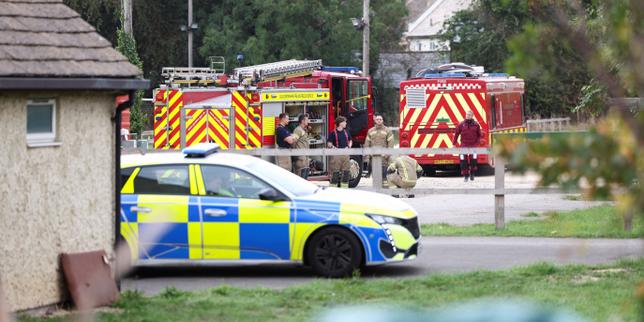
Five men arrested in the shadow of a British military installation utilized by American air forces have triggered an urgent security reckoning across Western intelligence circles. The incident, which drew swift commentary from figures including Donald Trump regarding alleged intentions to cause major damage, cuts straight to a deeply uncomfortable truth. The perimeter barriers protecting some of the most sensitive strategic assets in the transatlantic alliance remain vulnerable to modern asymmetric threats.
The immediate public reaction focused heavily on the political soundbites. Politicians love a clean narrative of foreign menace and foiled plots. Intelligence analysts, however, look past the rhetoric to examine the systemic rot beneath the surface. How close did these individuals actually get to operational assets? What tools did they possess? More importantly, why did local security protocols fail to intercept them before they reached the immediate perimeter of a high-value installation? If you enjoyed this post, you should read: this related article.
The Anatomy of a Perimeter Breach
Military bases housing foreign air wings are not standard commercial facilities. They are hubs of global power projection, housing intelligence assets, logistics networks, and advanced tactical aircraft. Yet, the physical geography surrounding these installations often resembles rural farmland rather than a fortified redoubt. Miles of open fields, public rights-of-way, and secondary roads intersect right up to the boundary lines.
Securing thousands of acres of perimeter terrain is an impossible logistical puzzle for standard military police units. Budget cuts, personnel shortages, and shifting defense priorities have hollowed out base security details. Security relies heavily on automated sensors, closed-circuit surveillance systems, and rapid-response patrols. When those systems experience latency or human error, the margin for error evaporates instantly. For another angle on this development, refer to the latest update from The Washington Post.
The suspects arrested near the British site did not need advanced military hardware to execute their reconnaissance. They needed patience, civilian clothing, and an understanding of patrol schedules. Modern sabotage rarely begins with a cinematic assault. It starts with weeks of quiet observation, mapping blind spots where thermal cameras fail to penetrate dense hedgerows or rolling fog.
Geopolitical Shockwaves and Political Posturing
When high-profile political figures weigh in on security incidents of this magnitude, the risk profile shifts overnight. Assertions that the detained individuals intended to cause catastrophic damage serve multiple agendas. For political operators, it underscores the constant, invisible war being waged against Western infrastructure. For military commanders, it provides immediate political cover to demand emergency budget increases and expanded surveillance authorities.
Yet, public hyperbole obscures the mundane reality of modern espionage and sabotage recruitment. State-sponsored intelligence services frequently outsource lower-level reconnaissance and disruption tasks to local proxies, criminal networks, or ideological extremists. These operatives are cheap, deniable, and entirely disposable. They do not wear uniforms or carry state-issued credentials. They blend seamlessly into the local population, exploiting the open nature of democratic societies to gather intelligence right outside the wire.
The United Kingdom has long served as an unsinkable aircraft carrier for United States global operations. That status makes British soil a primary theater for hostile intelligence activity. Russian, Iranian, and non-state actors treat the British countryside as a target-rich environment where surveillance is constant and counter-intelligence resources are stretched to their absolute limits.
The Illusion of Fortress Europe
For decades, military planners operated under the assumption that conventional air bases were safe from direct domestic attack. Cold War doctrines focused on long-range missile defense and sophisticated cyber-warfare, leaving physical base security in a complacent middle ground. The rise of cheap commercial drones, encrypted communication apps, and decentralized proxy networks shattered that assumption.
An air base is only as secure as its weakest external corridor. When local police forces and base security details operate under separate command structures, communication gaps routinely occur. Jurisdiction boundaries create bureaucratic friction. If a suspicious vehicle is spotted on a public road adjacent to a restricted zone, determining who has the authority to stop, search, and detain the occupants often involves a tangled chain of command that moves far too slowly for a fast-moving threat.
Intelligence officers working within counter-terrorism units have warned about these gaps for years. Their warnings typically languish in unread reports until an incident forces the issue into the headlines. Arrests are treated as proof that the system works. In reality, an arrest at the fence line means the threat made it all the way to the objective before being stopped.
Closing the Back Door to Strategic Assets
Upgrading base security requires a fundamental shift in mindset. Physical barriers and increased patrols are no longer sufficient. Intelligence agencies must aggressively map the domestic networks that support these hostile actors before they ever reach the perimeter. Counter-sabotage operations require deep infiltration of local digital channels, financial tracking of suspicious cash flows, and tighter coordination between municipal police and national security services.
The alliance between Washington and London depends on mutual trust in operational security. When an incident exposes vulnerabilities near critical air assets, the pressure to reform security protocols becomes overwhelming. The five men in custody may represent only the visible tip of a much larger reconnaissance effort operating in plain sight across the British countryside.
The next breach will not wait for policy reviews to conclude