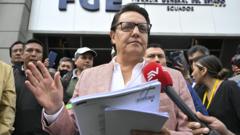
The democratic facade of Ecuador fractured permanently on a Tuesday evening in August 2023, when presidential candidate Fernando Villavicencio was cut down by gunfire outside a Quito campaign rally. Years of institutional decay, drug cartel infiltration, and political betrayal culminated in those fatal bullets. Prosecutors formally charged high-ranking political figures, including former Interior Minister José Serrano, with orchestrating the assassination. This development exposes how deeply organized crime had penetrated the machinery of the Ecuadorian state long before the trigger was pulled.
The Mechanics of Betrayal
Criminal enterprises do not execute high-profile political figures without internal security breakdowns. According to the Attorney General’s Office, the plot required precise coordination. Security gaps had to be identified, mapped, and communicated to the assassins.
Investigators assert that state actors utilized institutional access to monitor the candidate's movements. This was not merely a street-level gang hit executed by desperate foot soldiers. It was a calculated structural elimination that required inside knowledge. When political authority and cartel interests merge, the state's protective apparatus transforms into an execution vector.
The involvement of figures like Serrano, who once commanded the nation's internal security apparatus, points to a chilling reality. The guardians of public order had become compromised by transnational trafficking networks.
Anatomy of a Corrupted State
To understand how Ecuador arrived at this juncture, one must examine the institutional rot revealed by massive judicial probes like the Metastasis case. Cartels did not simply bribe low-level patrolmen. They bought judges, politicians, and prison directors.
When drug traffickers dictate policy, anti-corruption watchdogs become existential threats. Villavicencio was not just a politician running for office. He was an investigative journalist who spent decades documenting the precise pathways of illicit money and state capture.
- State Capture: Cartels embedded associates within legislative bodies.
- Security Complicity: High-ranking officials leaked operational schedules to contract killers.
- Judicial Impunity: Key witnesses and imprisoned suspects met violent ends behind bars before they could testify.
This environment of absolute impunity allowed the architects of the assassination to operate openly across borders. While some suspects sit in foreign custody or evade capture abroad, the structural vulnerabilities that permitted the murder remain largely unaddressed.
The Broader Regional Implications
Ecuador's descent serves as a warning for democratic institutions across Latin America. When cocaine cartels acquire billions in capital, they out-resource traditional law enforcement agencies. They treat governance as a business expense.
The charges against former officials mark a symbolic milestone, yet they also highlight the limitations of prosecutorial reach. Bringing indicted individuals back from foreign jurisdictions involves complex diplomatic hurdles. Meanwhile, public trust in democratic institutions continues to erode under the weight of ongoing violence.
Justice in this context requires more than indictments. It demands a root-and-branch restructuring of investigative agencies, intelligence services, and correctional facilities. Until the political economy of corruption is dismantled, the threat of state-sanctioned violence against reformists will persist.
The courtroom battles in Quito will test whether the judiciary possesses the independence to prosecute powerful political elites. Every ruling sets a precedent for whether accountability can pierce the armor of high office.
As the legal proceedings grind forward, the systemic conditions that allowed a presidential candidate to be hunted in broad daylight are still active beneath the surface of Ecuadorian politics.
Ecuador: Court finds 5 guilty for murder of Ecuadorian presidential candidate Fernando Villavicencio
This video provides important context regarding the initial judicial rulings and convictions of the direct perpetrators involved in the high-profile assassination case.
http://googleusercontent.com/youtube_content/1