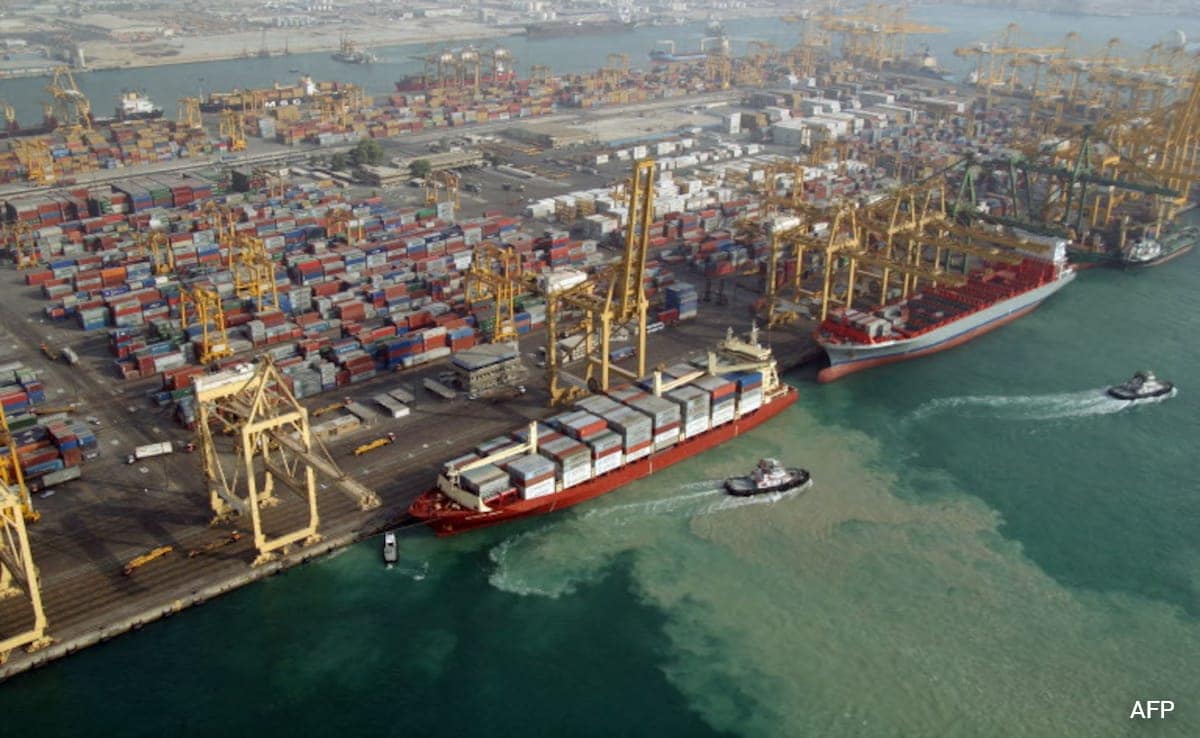
The heat in Dubai does not just sit on your skin; it presses into your chest, thick with salt and the smell of marine diesel. If you stand near the deep-water berths of Jebel Ali Port, the horizon blurs into a haze where the gray hulls of massive container ships merge with the sky. Cranes swing with mechanical indifference, moving millions of tons of cargo every single day. Most of it is mundane. iPhone screens, fast-fashion sneakers, car parts, and cheap plastic toys.
But sometimes, inside a standard twenty-foot metal box, sits something that can change the balance of power in a war zone thousands of miles away.
A recent intelligence report exposed a quiet, terrifyingly efficient pipeline. Iran has been utilizing Dubai’s sprawling logistics hubs as a laundering mat for restricted Chinese military technology. On paper, it looks like standard corporate commerce. In reality, it is a high-stakes shell game designed to bypass international sanctions and feed a hungry drone and missile program.
To understand how this happens, you have to look past the official press releases and dive into the mechanics of a modern ghost economy.
The Paper Trail That Disappears
Consider a hypothetical procurement officer in Tehran. Let us call him Javad. Javad does not order guidance systems from a Chinese defense contractor using a state bank account. That would trigger red flags across Western compliance networks before the ink even dried on the wire transfer.
Instead, Javad uses layers.
First, a front company is registered in a jurisdiction with lax oversight. Then, another company is set up in a free-trade zone in the United Arab Emirates. This secondary company exists only on a piece of paper in a sleek Dubai skyscraper, sharing an address with hundreds of other ghost entities.
When a shipment of advanced electronic components—say, specialized semiconductors or miniature gyroscopes used in unmanned aerial vehicles (UAVs)—leaves a port in Shanghai, its manifest does not read "Military Logistics Command, Iran." It reads "Consumer Electronics Wholesaler, Dubai."
The cargo arrives in the UAE. It is unloaded, processed, and theoretically destined for a local warehouse. But it never stays long. Within days, the paperwork is swapped. The origin is obscured, the destination is altered, and the crates are loaded onto a smaller dhow or a regional cargo vessel heading straight across the Persian Gulf to an Iranian port like Bandar Abbas.
By the time Western intelligence agencies spot the transaction, the parts have already been soldered onto the circuit boards of Shahed drones.
The Frictionless Hub
Dubai has spent decades building itself into the economic crossroads of the world. It is a miracle of modern logistics. You can move goods, money, and people through the city faster than almost anywhere else on earth. But the exact features that make it a paradise for legitimate global trade also make it an ideal playground for illicit actors.
The sheer volume of traffic provides the perfect camouflage. Jebel Ali handles over fourteen million containers a year. Customs inspectors, no matter how well-trained or well-equipped, cannot open every box. They rely on risk profiles, documentation, and automated systems.
If the paperwork looks clean, the box moves.
Furthermore, the financial infrastructure of the region allows for rapid, opaque capital flight. While traditional banks have tightened their anti-money laundering controls under immense pressure from the United States and Europe, the shadow financial system remains robust. Cash, gold, and unregulated trade-based money laundering schemes keep the gears greased.
This is not a failure of Dubai’s system; it is a exploitation of its success. The city thrives on being open to everyone. When you open your doors to the entire world, you cannot always control who walks through them.
The Invisible Stakes
It is easy to get lost in the dry vocabulary of geopolitics. Words like export controls, dual-use technology, and secondary sanctions sound clinical. They belong in academic journals and policy briefings. They feel entirely disconnected from human suffering.
They are not.
The Chinese components moving through this Gulf pipeline are not destined for museum shelves. They are the brains inside weapons systems. When an explosive-laden drone strikes an electrical substation in Kyiv during the dead of winter, cutting off power to thousands of families, the technology that guided that drone likely passed through a sunny port in the UAE. When regional proxies launch ballistic missiles at commercial shipping lanes in the Red Sea, the sensors that locked onto those targets were bought with money laundered through shell companies in Dubai.
The cost of this logistical loophole is paid in civilian infrastructure, lost lives, and global instability.
For years, Western diplomats have played a game of whack-a-mole. They identify a front company, place it on a blacklist, and celebrate a victory. But before the press release is even distributed, three new companies are registered under different names with the same ultimate beneficial owners. The bureaucratic machinery of international law moves at a glacial pace. The shadow networks move at the speed of a fiber-optic wire transfer.
A System Built on Blind Spots
The reality is that stopping this flow requires more than just political will; it requires a fundamental restructuring of how global trade is monitored. Right now, the burden of enforcement falls largely on private companies—freight forwarders, shipping lines, and compliance officers at tech firms.
Imagine being a compliance clerk in a mid-sized electronics firm. You receive an order for 10,000 dual-use microchips from a distributor in Dubai. The distributor provides all the necessary documentation. They sign end-user certificates promising the chips will only be used for civilian medical equipment. Do you block the sale and lose millions in revenue based on a hunch? Or do you process the order, trust the paperwork, and move on to the next file?
Most choose the paperwork.
This systemic vulnerability is exactly what Iran capitalizes on. They do not need to break the system; they just need to navigate its blind spots. They know that in the corporate world, efficiency almost always triumphs over suspicion.
The Horizon
The sun sets over the Persian Gulf, painting the water in shades of bruised purple and industrial orange. The dhows keep moving. The containers keep stacking.
As long as there is a demand for restricted technology in Tehran, and as long as global trade hubs prioritize frictionless commerce over ironclad security, the silent flow will continue. The networks will adapt. The names on the office doors in Dubai will change, but the cargo inside the hulls will remain exactly the same.
The world watches the explosions on the news, analyzing the wreckage of drones and missiles after they hit their targets. But the real conflict is won and lost long before that, in the quiet offices and bustling ports where a change of a single line on a shipping manifest can alter the course of a war.