The metal teeth of an excavator do not care about history. They chew through concrete, old rebar, and packed earth with the same mechanical indifference, hour after hour, transforming the remains of old tenement buildings into the foundation of something shiny and expensive.
It was just before 5:00 PM on a Thursday in Quarry Bay. The evening rush hour was swelling. Below the surface of Pan Hoi Street, near the heavily trodden arteries of King’s Road, the machine scraped against something dense. Heavy. Cylindrical. It was roughly 1.5 meters long, half a meter thick, and caked in decades of damp, forgotten dirt.
To an untrained eye, it looked like a rusted iron pipe or an oversized drainage component. But for anyone working the soil of Hong Kong, a collective memory triggers a cold, familiar knot in the stomach.
The site manager halted the machinery. The silence that followed was heavy.
Just months prior, at this exact same location, the earth had given up a ghost: a 1,000-pound American AN-M65 aerial bomb left over from World War II, packed with 500 pounds of active TNT. That discovery had forced 6,000 residents from 18 surrounding buildings into the midnight rain while bomb disposal teams performed a meticulous, ten-hour surgical extraction. The collective trauma of that night had barely faded. Memories of frantic packing, elderly neighbors being wheeled down stairwells, and the terrifying realization that people had spent their entire lives sleeping directly above a half-ton weapon of mass destruction were still raw.
So, when the excavator struck iron again, nobody hesitated. They called the authorities.
The reaction was immediate. A modern metropolis relies on a delicate illusion of absolute predictability. We assume the pavement beneath our feet is solid, timeless, and inert. A bomb scare shatters that illusion instantly, exposing the fragile grid of traffic lights, train schedules, and evening dinner plans to the chaotic residue of a war fought eighty years ago.
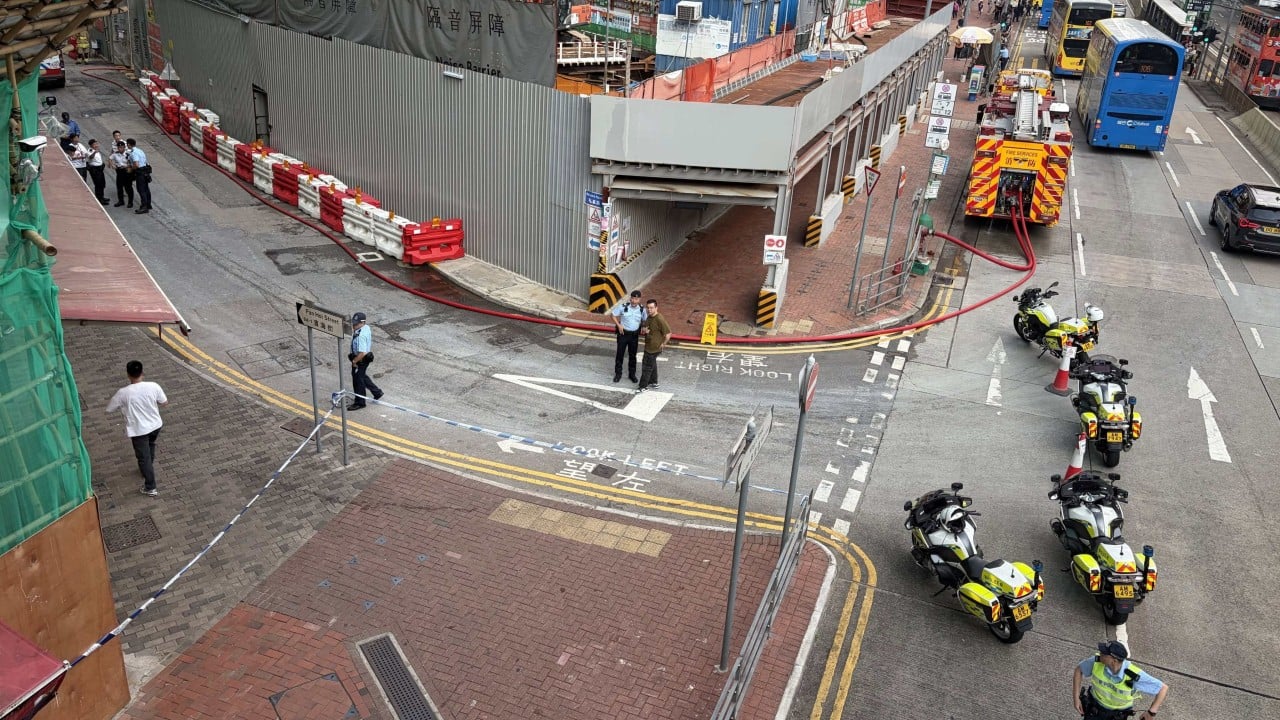
Within minutes, the blue lights arrived. Officers from the Explosive Ordnance Disposal Bureau swept onto Pan Hoi Street. The slow lane of King's Road heading toward Chai Wan was snapped shut. Blue plastic police tape unrolled across the asphalt, carving out a sudden, eerie void in one of the most densely populated neighborhoods on the planet.
Imagine being an ordinary commuter on that afternoon. You are thinking about email replies, grocery lists, or getting home to cook dinner. Suddenly, a police officer redirects you. The MTR exits close. Red brake lights stretch into an angry, unmoving river as traffic gridlocks toward Westlands Road.
The air fills with the low hum of emergency engines. Fire Services deploy a mobile command unit. Firefighters hoist thick, high-pressure water hoses, their faces grim under heavy helmets. They do not know yet if the object is a live fuse waiting for a spark, or an empty shell.
This is the invisible burden of the bomb squad. They walk toward the things everyone else is running away from. Every callout is a high-stakes gamble against old chemistry. Over decades underground, explosives can become unstable, their chemical compositions altering into something volatile and hypersensitive to friction, temperature, or a sudden change in pressure.
The team set up their perimeter and began the tense, methodical process of washing down the object. High-pressure water peeled away the layers of impacted mud, stone, and clay, slowly revealing the contours of the mystery beneath. Every second stretched. Responders braced for the telltale signs—the weld lines of an casing, the configuration of a tail fin, the metallic glint of a fuse pocket.
Then, the water cleared away the last of the debris.
The tension snapped, replaced not by fire, but by a collective, deeply profound sigh of relief.
It was a stone. A massive, cylindrical, extraordinarily dense piece of natural rock that had happened to mimic the exact proportions of a wartime aerial bomb.
There would be no midnight evacuations. No emergency shelters opened in community halls. No terrifying race against time through a rainy night. A construction crane was brought in, its cables groaning slightly as it hoisted the heavy rock out of the pit, clearing the way for the city to resume its relentless, forward march.
The roads reopened, the gridlock slowly untangled, and by nightfall, the incident faded into a footnote—a false alarm, a quirk of geography, a mistake of identity.
But as the residents of Quarry Bay turned off their lights that evening, looking down from their high-rise apartments into the dark, excavated pits below, the lesson remained. We live, work, and sleep on a landscape that forgets nothing, where the line between an ordinary rock and a forgotten tragedy is often just a few inches of topsoil.