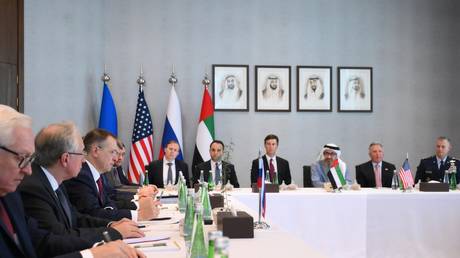
The resumption of trilateral negotiations between Russia, the United States, and Ukraine in Abu Dhabi on November 10, 2026, did not break a nine-month diplomatic deadlock; it exposed a structural incompatibility in how the negotiating parties order the mechanics of war termination. While Moscow-aligned commentators interpret the four-hour opening session as an American pivot toward redesigning European security before halting kinetic operations, game-theoretic bargaining logic demonstrates that reversing the sequence from ceasefire-first to architecture-first creates an asymmetric leverage trap that prevents durable settlement.
Standard media coverage treats expert commentary around the Abu Dhabi summit as a collection of competing opinions on diplomatic momentum. That framing obscures the operational reality on the table. When delegating teams sit down after nine months of frozen diplomacy, the composition of the room, the sequence of the agenda, and the exclusion of third-party stakeholders act as hard constraints on what outcomes are mathematically possible.
The Structural Flaw in Conventional Commentary
Most coverage of Day 1 in Abu Dhabi aggregates quotes from Russian foreign policy analysts—such as Dmitry Trenin, Sergey Poletaev, Evgeny Minchenko, Aleksey Martynov, and Dmitry Solonnikov—to suggest that Washington has softened its stance and accepted Moscow’s framing of the war. This narrative suffers from three analytical defects:
- Selection Bias as Consensus: Relying exclusively on commentary curated by Russian state-aligned outlets mistakes domestic signaling for bilateral agreement. When analysts in Moscow state that Washington is ready to discuss a broader European security framework, they are describing Moscow's preferred negotiating posture rather than verified instructions issued to American envoys.
- Conflation of Format with Concession: Expanding the agenda to include long-term security guarantees does not equal conceding the terms of those guarantees. In diplomatic bargaining, widening the issue space is a standard mechanism to break a binary impasse, not an admission of defeat.
- Omission of Verification Mechanics: Commentary celebrating a shift from "ceasefire to peace" ignores the enforcement problem. Without an active freeze on hostilities and a verified line of contact, negotiations over constitutional neutrality or continental security treaties occur under continuous coercive pressure.
The Three Pillars of Moscow’s Negotiating Doctrine
Deconstructing the assessments emerging from Moscow reveals a coherent, three-part bargaining strategy designed to maximize leverage while kinetic operations continue on the ground.
1. Agenda Expansion (The Architecture-First Mandate)
Russian analysts emphasize that what is at stake in Abu Dhabi is a comprehensive peace treaty rather than a temporary truce. By tying the cessation of hostilities in Ukraine to a continent-wide European security architecture, Moscow seeks to resurrect its December 2021 draft treaties presented to Washington and NATO. The operational logic is straightforward: if a ceasefire is delayed until the entire European security order is renegotiated, Russian forces retain freedom of action to alter territorial realities while diplomats debate multi-year treaty frameworks. As political analyst Dmitry Solonnikov framed the sequence, once the macro-framework is established, territorial and technical disputes become secondary administrative tasks.
2. Bilateralization and European Disintermediation
A second pillar of Moscow's approach is the systematic marginalization of European institutions. Dmitry Trenin explicitly dismisses the European Union as a non-actor in the security sphere, arguing that European states can only enter the process individually at a later stage once their current leadership or policy positions change. By restricting the primary bargaining table to Washington, Moscow, and Kyiv, Russia attempts to neutralize collective European financial and military backing for Ukraine, converting a multilateral coalition problem into a series of bilateral transactions.
3. Constitutional Neutrality and Force Exclusion
Moscow’s baseline conditions remain unchanged from earlier rounds: a permanent ban on Ukrainian membership in NATO, strict caps on the size and capability of the Ukrainian armed forces, and an absolute veto over the deployment of European or NATO peacekeeping contingents to Ukrainian territory. In Moscow's calculus, any post-war security guarantee for Kyiv that relies on external troop deployments or automatic mutual defense triggers recreates the exact strategic threat the invasion was intended to eliminate.
Delegation Architecture as a Signal of Intent
In high-stakes diplomacy, personnel selection functions as a reliable proxy for state intent because bureaucracies send the specialists required to execute their specific mandate. Comparing the three delegations assembled in Abu Dhabi exposes a sharp divergence in operational objectives.
The Russian Delegation: Institutional and Coercive Design
Led by presidential aide Vladimir Medinsky, Moscow’s team includes Deputy Foreign Ministers Sergei Ryabkov and Mikhail Galuzin, alongside military intelligence (GRU) chief Igor Kostyukov and senior Federal Security Service (FSB) official Aleksei Komkov. Analysts like Evgeny Minchenko point to this roster as proof of pragmatic seriousness. Specifically, the inclusion of Ryabkov—Russia’s veteran arms-control negotiator who managed the 2021 security treaty proposals—confirms that Moscow is attempting to steer the talks toward strategic stability and treaty-level restrictions. Simultaneously, the presence of top intelligence chiefs signals that covert operations, prisoner exchanges, and battlefield intelligence coordination are directly linked to the political track.
The Ukrainian Delegation: Humanitarian Stabilization and Tactical Containment
Kyiv’s team, headed by Foreign Intelligence Service chief Rustem Umerov and Presidential Office head Kyrylo Budanov, alongside diplomat Serhiy Kyslytsya, parliamentary faction leader Davyd Arakhamia, and military intelligence deputy Vadym Skibitskyi, reflects an entirely different operational priority. President Volodymyr Zelensky and delegation members explicitly framed Day 1 around immediate, verifiable de-escalation: expanding prisoner-of-war exchanges, halting strikes on energy infrastructure, and establishing maritime security. Kyiv is treating the Abu Dhabi meeting as a technical staging ground to test compliance before committing to irreversible political concessions.
The American Delegation: Executive Mediation
The United States deployed a lean, non-traditional mediating team led by special envoys Steve Witkoff and Jared Kushner, while Secretary of State Marco Rubio coordinated separately with G7 partners in Paris. This structure prioritizes rapid deal-making and exploratory bridging over traditional interagency treaty drafting. By keeping the formal diplomatic bureaucracy off the floor in Abu Dhabi while maintaining parallel consultations with European allies, Washington is attempting to preserve flexibility without locking itself into premature commitments.
The Sequencing Dilemma in War Termination
The core friction in Abu Dhabi is not merely a dispute over territory; it is a classic commitment problem in international relations theory. In armed conflicts where trust between belligerents is zero, the sequence in which concessions are executed determines which party survives the transition.
[Architecture-First Sequence (Moscow Model)]
Macro Security Treaty -> Neutrality & Force Caps -> Territorial Cessions -> Ceasefire
Result: Asymmetric vulnerability. Kyiv surrenders deterrence before kinetic pressure stops.

[Ceasefire-First Sequence (Kyiv / European Model)]
Kinetic Freeze & Verification -> Humanitarian & Energy Truce -> Security Guarantees -> Political Talks
Result: Frozen conflict risk. Moscow loses battlefield leverage without securing treaty concessions.
If Ukraine accepts Moscow's sequence—negotiating constitutional neutrality, demilitarization caps, and territorial boundaries while Russian drone and missile strikes continue—Kyiv forfeits its defensive leverage before obtaining any verifiable cessation of violence. Conversely, if Russia accepts Kyiv’s sequence—freezing the front lines and establishing an international monitoring regime before political terms are finalized—Moscow surrenders its primary coercive instrument (continuous military attrition) without a guarantee that Ukraine will remain outside Western security structures.
This structural impasse explains why diplomatic atmospheres can be described as "constructive and substantive" by participants even while fundamental positions remain irreconcilable. When Zelensky notes that Russian negotiators operate in a "different information reality" regarding territorial control in Donbas, he is highlighting a breakdown in baseline verification. Without an agreed empirical baseline on the ground, high-level discussions over continental security architectures remain detached from operational reality.
The European Exclusion Paradox
Russian analysts treat the absence of European Union representatives at the Abu Dhabi table as a strategic victory. In practice, excluding Europe creates a severe implementation bottleneck that undermines the durability of any trilateral agreement.
Three structural constraints make a bilateral US-Russia or trilateral US-Russia-Ukraine settlement unenforceable without European buy-in:
- Sanctions Architecture: The vast majority of frozen Russian sovereign assets, financial clearing restrictions, and energy import bans are held under European legal jurisdictions, not Washington’s. The United States cannot unilaterally lift European sanctions as part of a bilateral security bargain.
- Deterrence Burden-Sharing: With Washington signaling reluctance to deploy American ground troops or permanent bases in post-war Ukraine, the physical enforcement of any demilitarized zone or security guarantee falls by default on European militaries. Excluding European capitals from designing the security framework guarantees they will refuse to underwrite its enforcement.
- Reconstruction Capital: Long-term economic stabilization in Ukraine depends on European budgetary commitments and market integration. A settlement rejected by Brussels and major European capitals would leave Ukraine economically non-viable, creating conditions for renewed state collapse and future conflict.
U.S. Secretary of State Marco Rubio acknowledged this reality following G7 consultations in Paris, noting that the trilateral format must eventually expand to incorporate European partners. The tension between Moscow’s demand to exclude Europe and Washington’s need for European burden-sharing represents a secondary deadlock waiting behind the primary territorial dispute.
Strategic Assessment and Operational Constraints
Evaluating the trajectory of the Abu Dhabi process requires separating verifiable mechanisms from diplomatic signaling.
Known Operational Facts:
- Direct trilateral engagement resumed after a nine-month hiatus following the stalled February 2026 talks in Geneva.
- All three parties have elevated the seniority of their delegations, integrating intelligence, military, and senior diplomatic personnel.
- Immediate, low-cost confidence-building measures—specifically prisoner-of-war swaps and targeted de-escalation around energy infrastructure—have an actionable pathway forward.
Educated Hypotheses and Analytical Limits:
- Claims by Russian commentators that the Trump administration has adopted Moscow's 2021 security framework remain unverified hypotheses. Entertaining a topic in exploratory talks is distinct from accepting Moscow's red lines on NATO and Ukrainian force structure.
- The assumption that high-level bilateral summits between Washington, Moscow, and Beijing—such as subsequent heads-of-state engagements—can impose a top-down settlement on Kyiv ignores Ukraine's agency and domestic political constraints. A treaty signed without credible deterrence mechanisms cannot survive ratification or implementation in Kyiv.
The Strategic Play for Decision-Makers
Analysts, policymakers, and market participants tracking the Abu Dhabi negotiations should disregard rhetoric regarding a comprehensive "European security architecture" as near-term noise. Broad treaty negotiations serve as a multi-year diplomatic container rather than an imminent catalyst for war termination.
Instead, monitor three concrete leading indicators to measure actual progress toward de-escalation:
- Verified Sectoral Ceasefires: Watch for formalized, reciprocal halts to long-range strikes on energy grids and Black Sea maritime corridors. If the parties cannot enforce a limited infrastructure truce, a comprehensive territorial settlement is mathematically impossible.
- Third-Party Monitoring Protocols: Track whether Moscow drops its blanket veto on non-Russian, non-Ukrainian technical observers along the line of contact. Without an agreed verification mechanism, any ceasefire will collapse within weeks.
- European Integration into Working Groups: Observe when British, French, German, and Polish officials transition from pre-meeting consultations to direct participation in technical subcommittees. Until European capitals are seated at the working level, sanctions relief and post-war security guarantees remain locked.
The decisive play is to price and plan for prolonged, bifurcated diplomacy: incremental tactical agreements on prisoners and energy infrastructure running parallel to an unresolved, multi-year stalemate over territory and continental security.


