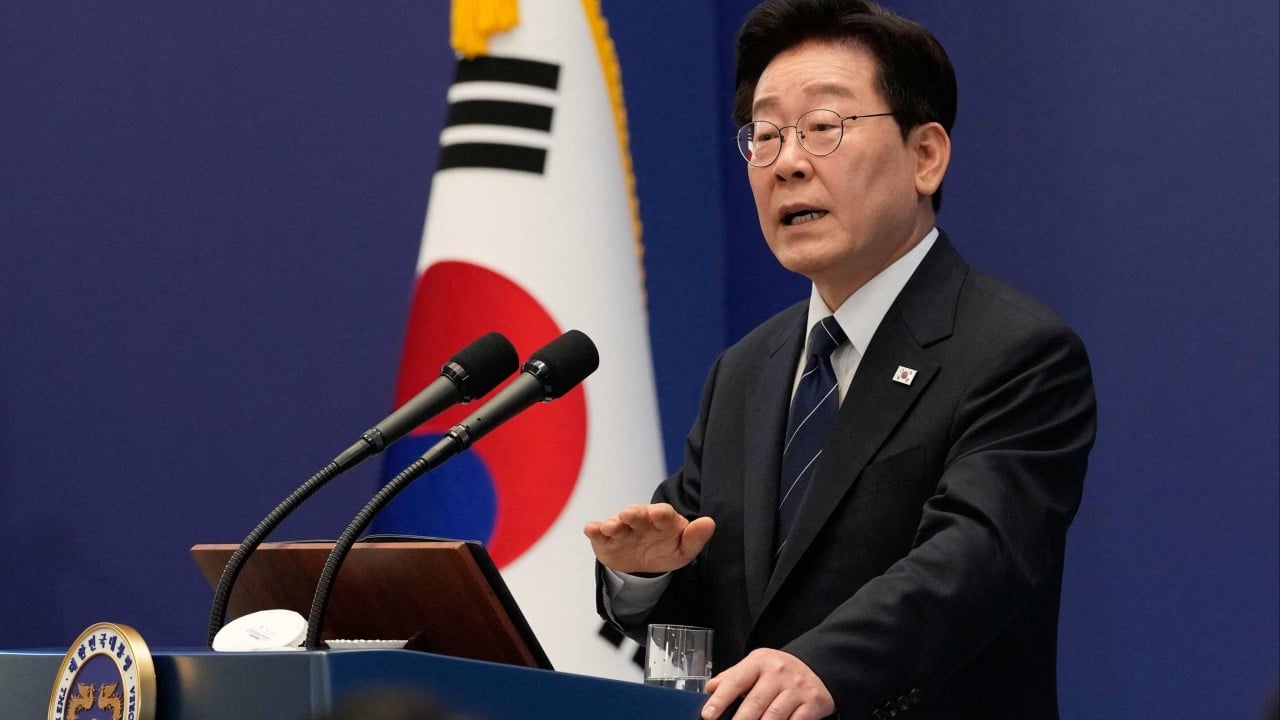
The headlines are screaming about a crisis in the US-South Korea alliance. Commentators across Washington and Seoul are hyperventilating over the Blue House declining a direct American request for military support in the Middle East, specifically regarding operations tied to Iranian proxies and shipping lane security. The lazy narrative writes itself: South Korea is drifting away, cowering under Chinese economic coercion, or abandoning its democratic anchor for short-term mercantile interests.
It is a completely superficial read of geopolitics.
I have watched foreign policy pundits panic over every tactical divergence for a decade, missing the structural reality of modern middle powers. Seoul is not defecting from the West. It is finally growing up.
To understand why rejecting Washington on this specific intervention is a masterclass in strategic competence, you have to strip away the emotional baggage of alliance mythology. The prevailing consensus assumes that an ally must say yes to every deployment request to prove loyalty. That is feudalism, not statecraft. In a multipolar world, a blind yes is a liability.
The Geography Trap Washington Ignores
Let us look at the hard logistics. South Korea is an export-driven peninsula surrounded by nuclear-armed adversaries. Over seventy percent of its crude oil flows directly through the Strait of Hormuz. More importantly, its primary existential threat sits directly across the 38th Parallel and in the Taiwan Strait, where China watches every asset movement with predatory calculation.
When Washington asks Seoul to project military power into the Middle East, it is asking a frontline state to drain its readiness reserves for a secondary theater. That is bad military strategy disguised as diplomacy.
The security architecture of East Asia is razor-thin. If North Korea perceives that Seoul has hollowed out its domestic air defense or naval escort capacity to patrol Persian Gulf shipping lanes, the calculus of deterrence shifts overnight. South Korea's ultimate contribution to global stability is keeping the Korean Peninsula locked down and stable. Every destroyer pulled out of the Yellow Sea to play gendarme in the Gulf of Oman is an unforced error that invites regional aggression closer to home.
Alliance Management Through Boundaries
We need to kill the myth that alliances require total ideological and tactical uniformity. NATO spent decades dysfunctional because European capitals outsourced their defense while Washington over-committed. The US-South Korea mutual defense treaty was signed in 1953 to deter a specific land invasion, not to serve as a blank check for global maritime policing.
When a junior partner says no to a senior partner, it triggers panic in the commentariat. But mature alliances survive friction; fragile ones shatter over it. Seoul's refusal is calculated to send a very specific signal: South Korea's economic footprint and defense capabilities are global, but its core military focus remains non-negotiable.
By drawing a hard boundary, Seoul actually strengthens its long-term utility to Washington. An ally that can manage its own region without requiring constant babysitting is infinitely more valuable than a client state that overextends itself into strategic bankruptcy.
The Trade Reality Check
Let us address the elephant in the room: Beijing. The mainstream analysis loves to claim that South Korea is appeasing China by staying out of Middle Eastern entanglements. This ignores how global supply chains actually operate.
South Korea's chaebols rely on global stability, not Chinese benevolence. Seoul’s semiconductor fabs and battery plants are deeply integrated into the Western technology blockade against Beijing. Refusing a US request in the Middle East does not buy goodwill in Beijing; it simply prevents unnecessary friction in a region where South Korean economic exposure is already delicate.
Good economic statecraft requires diversification of risk. You do not volunteer for kinetic operations thousands of miles away when your primary trade partner is your neighbor across the Yellow Sea and your primary security guarantor is across the Pacific. You thread the needle. Seoul is threading it with surgical precision.
The Real Danger of Blind Compliance
If Seoul had buckled under diplomatic pressure and deployed forces to the Middle East, the domestic political blowback would have been catastrophic. South Korean society has zero appetite for foreign quagmires. A government that sends its troops into a volatile Middle Eastern flashpoint without a direct, existential mandate would face immediate domestic rebellion, creating political instability that would weaken the very alliance Washington seeks to preserve.
Stability at home is the prerequisite for projecting power abroad. When a government protects its domestic consensus, it protects the alliance itself.
Stop viewing international relations through the lens of high school cafeteria loyalty. South Korea's rejection of this request is not a betrayal. It is the sound of a middle power calculating its own survival, protecting its strategic depth, and refusing to bleed for someone else's mission creep.
The next time Washington asks for a blank check, expect Seoul to say no again. And thank God for it.



