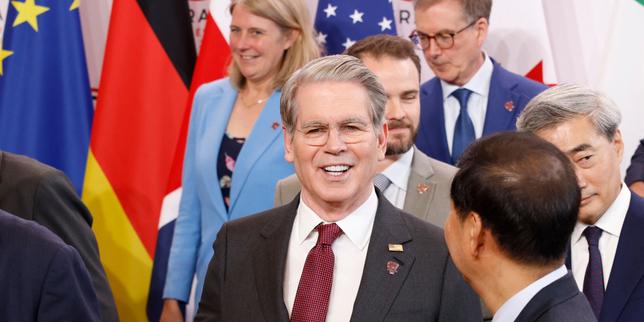
The media is throwing another collective tantrum because American diplomats fought tooth and nail to scrub the literal words "changement climatique" from the latest G7 joint communiqué. The narrative is already written, copy-pasted across a hundred newsrooms: Washington is regressing, the West is paralyzed, and the planet is doomed by semantic cowardice.
It is a neat, comforting story. It is also entirely wrong.
Obsessing over whether a non-binding international memo contains the magic phrase "climate change" is the ultimate form of bureaucratic theater. For decades, global summits have operated on a broken premise: that linguistic consensus equals physical progress. It does not. In fact, the hyper-fixation on symbolic vocabulary has become the single greatest obstacle to actual, measurable decarbonization.
By forcing the conversation away from polarizing, broad-brush terminology, we finally strip the virtue-signaling away from international policy. We replace empty rhetorical victories with cold, hard economic reality. It is time to stop mourning the loss of a phrase and start looking at the mechanics of what actually moves capital.
The Illusion of the Magic Word
Mainstream commentators treat international communiqués like religious texts. They believe that if a word is omitted, the underlying reality ceases to exist in the minds of policymakers.
Let us look at the mechanics of how these documents are actually negotiated. I have spent years watching delegations haggle over commas in draft texts while the real world moves on. A single paragraph can take fourteen hours of coffee-fueled bickering. When a nation demands the removal of "climate change," the superficial critique is that they are denying science.
The structural reality is different. "Climate change" has become a geopolitical lightning rod that triggers automatic, defensive domestic political positioning. When you force a state to sign a document plastered with politically charged framing, you guarantee one of two outcomes:
- They refuse to sign, stalling broader economic agreements.
- They sign a completely watered-down version that commits to nothing but future meetings.
Removing the vocabulary of the activist class forces delegations to negotiate on structural tangibles: energy grid resilience, supply chain security, trade tariffs, and capital allocation.
Consider the transition of the global energy mix. A coal-fired power plant is not retired because a group of politicians in a resort town agreed that global warming is bad. It is retired because the levelized cost of energy (LCOE) for utility-scale solar and battery storage has plummeted below the marginal cost of keeping that coal plant running.
The data backs this up. The International Energy Agency (IEA) regularly tracks clean energy investment. The capital flowing into renewable deployment, electric vehicle supply chains, and nuclear modernization has broken records year after year. This massive capital reallocation is not happening because of communiqué adjectives. It is happening because of the U.S. Inflation Reduction Act, Europe’s CBAM (Carbon Border Adjustment Mechanism), and massive industrial subsidies in Asia. These are hard national economic policies driven by industrial strategy and energy security, not a shared love for environmental vocabulary.
The Fatal Flaw of Symbolic Consensus
Why do we keep falling for the myth of the joint statement? Because it is easy to measure. A journalist can look at a text, run a Ctrl+F search for "climate change," and declare victory or defeat in five seconds.
This creates a dangerous moral hazard. It allows governments to hide abysmal environmental track records behind beautiful prose.
| Country Profile | Communiqué Stance | Real-World Action |
|---|---|---|
| The Virtue Signaler | Demands aggressive climate language in every international treaty. | Fails to reform local zoning laws; continues to subsidize domestic fossil fuel consumption to appease voters. |
| The Mercenary Realist | Blocks ideological terminology to protect domestic political flanks. | Pours hundreds of billions into domestic clean energy manufacturing and grid modernization for national security reasons. |
When we evaluate international relations through the lens of language, we reward the Virtue Signaler and penalize the Mercenary Realist. This is backwards. The atmosphere does not care about the preamble of a G7 document. It only cares about megatons of carbon equivalents emitted into the troposphere.
When the U.S. delegation strips specific environmental branding from a text, they are often preserving the ability to execute bilateral deals that actually matter. It is a pragmatic trade-off: sacrifice the headline-friendly vocabulary to secure agreements on cross-border data flows, intellectual property protection, or critical mineral supply chains. Without those trade and security frameworks, you cannot build the physical infrastructure required to transition the global economy anyway.
Dismantling the Corporate and Diplomatic Consensus
Every year, the World Economic Forum and similar bodies publish surveys identifying climate inaction as the top global risk. The corporate world responds by hiring armies of consultants to draft sustainability reports packed with the exact phrases the G7 just left out.
This has created a parallel universe of metric manipulation. Look at the explosion of the ESG (Environmental, Social, and Governance) rating industry. Analysts quickly discovered that companies could drastically improve their ESG scores simply by changing the wording of their annual reports, without changing a single supplier or upgrading one piece of machinery.
The G7 text negotiation is the exact same game played at a macroeconomic scale.
Imagine a scenario where the G7 signs a document promising to "eradicate climate change through holistic global synergy." The media celebrates. Stock markets react with a short-term bump for green funds. Then, behind closed doors, member states immediately approve new natural gas pipelines to ensure their voters do not freeze during the next winter election cycle.
That is not a hypothetical scenario; it is the history of the last fifteen years of global climate diplomacy.
The contrarian approach acknowledges a uncomfortable truth: Energy security and economic dominance are the only true drivers of state behavior. If you want a country to deploy wind turbines, you do not convince them that the weather is changing. You convince them that relying on imported liquefied natural gas makes them vulnerable to foreign blackmail. You show them that domestic manufacturing of clean technology creates high-paying jobs in rust-belt districts that swing elections.
By removing the ideological branding from the G7 statement, the conversation naturally shifts to these raw economic levers. It forces a brutally honest assessment of what nations are actually willing to pay for.
The Downside of Disruption
To be intellectually honest, this pragmatic approach has a distinct vulnerability. Stripping the moral imperative from diplomatic texts removes a powerful public relations tool used by developing nations.
Small island states and developing economies rely on the explicit language of international treaties to shame wealthy nations into honoring financial commitments, such as the Loss and Damage Fund. When the G7 flushes that language down the drain, it becomes significantly harder for vulnerable populations to hold industrial superpowers accountable in the court of public opinion. It reduces global diplomacy to a transactional arena where only those with massive market power have a voice.
But let us not pretend the alternative was working. Wealthy nations have consistently failed to meet their promised climate finance targets anyway, regardless of how flowery the communiqués were. Relying on the moral conscience of an industrial superpower is a losing strategy. Relying on their economic self-interest is the only play that has ever yielded results.
Stop Asking the Wrong Questions
The public discourse around these summits always centers on a flawed question: "How do we get every superpower to agree on the severity of the crisis?"
This question assumes that consensus must precede action. History shows the exact opposite is true. Action happens when the cost of inaction becomes economically unbearable for the ruling class.
Instead of tracking how many times a phrase appears in a G7 memo, analysts should be looking at hard, transactional metrics:
- The capital expenditure (CapEx) trends of major global utilities.
- The volume of sovereign wealth fund investment moving into deep-tech hardware and grid scale storage.
- The cross-border tariff structures applied to high-carbon industrial imports.
When a superpower refuses to put "climate change" on paper, it is not a defeat. It is a signal that the era of cost-free diplomatic posturing is ending. It means the language has finally acquired real-world economic consequences, and nations are no longer willing to sign blank checks just to look good in a Sunday headline.
Stop looking at the words. Watch the capital.