Rain was streaking the heavy glass windows of the Turnberry resort in Scotland when the negotiators finally sat down. It was 2025. Outside, the Atlantic surf battered the coastline, a restless backdrop to a conflict that had quietly choked transatlantic commerce for years. Inside, officials from the European Union and the United States were trying to dismantle a invisible wall of tariffs that had turned simple commodities into economic weapons.
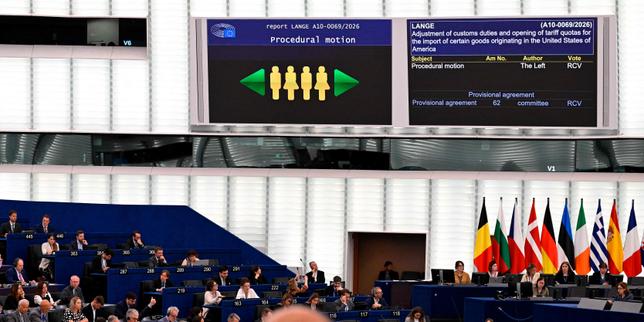
A year has passed since that meeting. Today, the European Union gave its official green light to solidify the truce born in the Scottish highlands. To the bureaucrat in Brussels or Washington, this is a matter of administrative processing, a line item ticked off in a sterile conference room. But to understand why a tariff on metal matters, you have to look far away from the halls of power. You have to look at the docks, the distilleries, and the factory floors where the math of international politics translates into human survival.
The Weight of the Invisible Wall
Consider a hypothetical steelworker named Marc, operating a forge in the industrial heartlands of eastern France. Marc does not read the official journal of the European Union. He does not track the diplomatic movements of trade commissioners. What Marc knows is the sound of a factory floor when the orders stop coming.
When the tariff wars erupted years ago, sparked by disputes over steel, aluminum, and aerospace subsidies, the reaction was swift and punitive. Governments do not fire missiles in trade wars; they fire percentages. A twenty-five percent tax here. A retaliatory tariff there.
To a consumer, a tariff sounds abstract. It sounds like a problem for accountants. In reality, it acts as an invisible embargo. When the United States levied taxes on European steel, Marc’s factory saw its American client base vanish overnight. It was not because the quality of their metal had degraded. It was because a pen stroke in Washington had artificially inflated their prices beyond competitiveness.
The retaliation from Europe was equally precise, targeting iconic American goods. Bourbon, motorcycles, and agricultural products suddenly faced steep walls at the European ports. For a distillery in Kentucky or a farmer in Iowa, the European market became a closed book. Two continents, deeply intertwined by history and culture, began slowly turning their backs on one another, one percentage point at a time.
The Ghost at the Negotiating Table
The agreement struck at Turnberry was not born out of sudden altruism. It was born out of exhaustion and necessity. For twelve months, a fragile truce held. The tariffs were suspended, allowing businesses on both sides of the ocean to breathe, to plan, and to invest without the constant fear that the rules of the game would change overnight.
The recent green light from the European member states is the formalization of this breathing room. It is an acknowledgment that in the modern global economy, isolation is a luxury no one can afford.
But why did it take a year to move from a handshake in Scotland to a formal endorsement in Brussels?
The answer lies in the friction of democracy. A trade agreement is not a singular decree. It is a mosaic of competing interests. French farmers, German automakers, Italian luxury brands—all of them have distinct vulnerabilities. While a German car manufacturer desperately wanted American tariffs on steel removed to lower production costs, a domestic steel producer wanted protection from foreign flooding.
Negotiation is the art of distributing dissatisfaction evenly. The Turnberry framework succeeded not because it made everyone rich, but because it managed the fear of loss. It created a mechanism where steel and aluminum could flow more freely, provided they met strict environmental and origin standards, preventing third-party countries from using the agreement as a backdoor to dump cheap, subsidized metal into the Western market.
The Anatomy of a Truce
To see the direct impact of this political machinery, one must look at how quickly trade patterns adapt when the pressure relents.
- The Metal Flow: European steel exports to the United States rebounded by a significant margin within the first six months of the temporary suspension, revitalizing communities that rely on heavy industry.
- The Consumer Echo: Prices for specialized machinery, which rely on specific grades of transatlantic alloy, stabilized, halting the inflationary creep that had been passed down to everyday buyers.
- The Diplomatic Pivot: By resolving the internal bickering, the Western alliance freed up diplomatic energy to address larger, structural shifts in the global supply chain, particularly regarding critical minerals and renewable energy technology.
The mechanism approved this week ensures that these benefits are not ripped away at the end of the month. It provides predictability. For a business, predictability is more valuable than a sudden windfall. Predictability is what allows a company to hire another worker, buy another piece of equipment, or sign a five-year lease on a warehouse.
The Untamed Waters Ahead
Yet, anyone who believes this green light represents a permanent peace does not understand the volatile nature of modern politics. The agreement is a scaffolding, not a finished building. It relies on continued alignment between leadership structures that are subject to the whims of voters.
The underlying tensions have not vanished. The dispute over aerospace subsidies, which lasted for nearly two decades before being mothballed, still lingers in the background like a dormant virus. The fundamental disagreement on how to regulate digital giants and carbon emissions remains an open wound.
What happened this week was an act of economic preservation. It was a choice to protect the fragile economic recovery of the post-pandemic era rather than double down on the nationalist rhetoric that defined the late 2010s. It proves that even in an era dominated by decoupling and supply-chain balkanization, the gravity of mutual self-interest can still pull major powers back to the table.
The true test of the Turnberry accord will not be measured by the praise it receives in press releases this week. It will be measured in the quiet confidence of the market over the next three years. It will be measured by whether factories keep their lights on, whether cargo ships continue to cross the Atlantic riding low in the water with freight, and whether the invisible walls stay down.
Late in the evening on the docks of Rotterdam, cranes are moving. They lift massive containers of American machinery components, swinging them gently onto the concrete wharfs of Europe. A year ago, those containers would have sat in a logistical limbo, entangled in a web of retaliatory duties. Tonight, they slide into the back of waiting trucks, moving seamlessly into the bloodstream of the continent while the city sleeps.