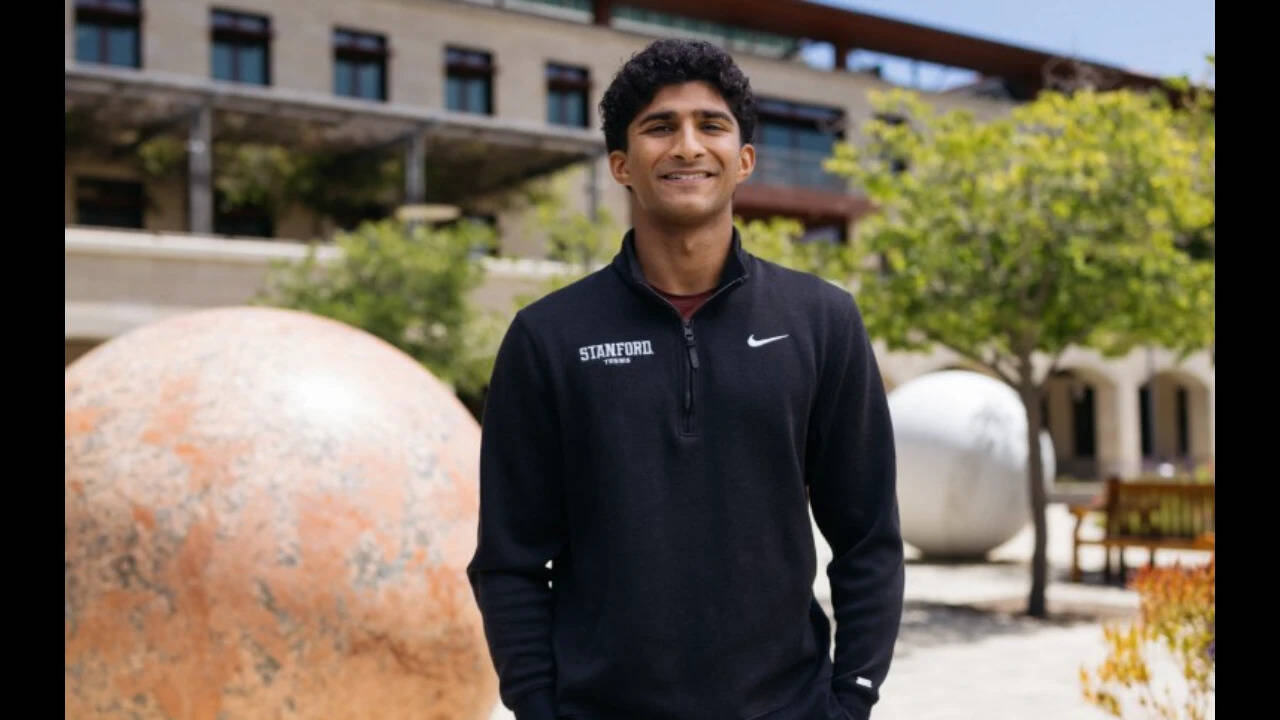
Most junior tennis champions follow a predictable script. They dominate the ITF circuit, skip traditional high school, sign with an agency, and jump straight into the brutal world of the ATP tour. For a minute, it looked like Samir Banerjee would do exactly that.
After winning the 2021 Junior Wimbledon singles title and climbing to the number two junior ranking in the world, the New Jersey native was operating in a hyper-focused tennis bubble. No high school prom. No senior year hangouts. Just a constant grind of international travel and baseline rallies.
But instead of diving headfirst into the pros, Banerjee chose a different path. He went to college. Specifically, he chose Stanford University, joining the men's tennis team and enrolling in the Science, Technology, and Society (STS) program. It wasn't just a detour to get a degree; it completely transformed how he looks at his own sport.
By the time he graduated, Banerjee hadn't just helped lead the Cardinal to an Atlantic Coast Conference (ACC) championship. He actually built an algorithm designed to break down years of tennis serve data across different court surfaces, discovering the precise mathematical threshold required to win at the highest level.
The Math Behind the 60 Percent Threshold
The project started in a classroom, not on a court. While taking Stats 100: Mathematics of Sports, a statistics class taught by lecturer Gene Kim, Banerjee found a way to merge his academic requirements with his daily life on the tour. He spent hours analyzing massive data sets tracking tennis servers over multiple seasons on grass, clay, and hard courts.
His goal was simple. Find out what separates winning serve performances from losing ones.
The algorithm focused heavily on the impact of first-serve percentages and subsequent point conversion rates. When you play tennis at a high level, everyone knows a good serve matters. But the data gave Banerjee a hard, unyielding number.
If he maintained a first-serve percentage above 60 percent in any given match, his probability of winning skyrocketed.
It sounds basic, but having an exact data-backed benchmark changes how a player manages risk on the court. Instead of just hammering first serves as hard as possible, the analytics argue for a calculated balance of speed, spin, and placement to keep that percentage from dipping.
Moving From an Island to a Team
Transitioning to college tennis meant dealing with a massive psychological shift. Junior tennis is famously isolating. You travel with a coach or a parent, and every single point is entirely about your own career, your own ranking, and your own ego.
At Stanford, that isolation vanished. Banerjee joined a tight-knit squad, anchored himself in the Kappa Alpha fraternity, and had to learn how to play for something bigger than his personal singles record.
The adjustment wasn't seamless, but it forced huge personal growth. He had to put the program's objectives above his individual goals. That team-first mentality paid off on the court. An ITA All-American and two-time All-Pac-12 first-team selection, Banerjee amassed 27 ranked singles wins during his collegiate career, eventually reaching a career-high national singles ranking of number seven. He was a central piece of the 2025 roster that secured the ACC title and pushed Stanford to its first NCAA semifinal appearance since 2003.
Merging Data with Raw Athletic Instinct
The broader lesson from Banerjee's time at Stanford lies in his major. The Science, Technology, and Society program isn't a standard computer science track. It is an interdisciplinary major that forces students to look at how technical systems, data, and social dynamics collide.
Banerjee built his curriculum out of a mix of statistics, computer science, management science, engineering, and the humanities. That diverse coursework is exactly what allowed him to build the server algorithm. He didn't just look at numbers in a vacuum; he understood the human engineering and physical variables behind those numbers.
A lot of old-school coaches still dismiss data. They rely entirely on "gut feeling" and visual scouting. On the flip side, pure data analysts often don't understand the physical pressure of serving out a match at 5-4 in the third set with the wind howling. Banerjee occupied the rare space right in the middle. He had the elite athletic instincts of a Wimbledon champion and the analytical tools of a Stanford data scientist.
Next Moves for the Stanford Grad
With his degree wrapped up, Banerjee isn't heading to a Silicon Valley tech firm to write code for a living. He is heading to Florida to train and make his return to the professional tennis circuit full-time.
He already has a solid foundation. He reached a career-high ATP singles ranking of world number 347, and he has captured three ITF World Tennis Tour singles titles on hard courts, including wins in Singapore, Dallas, and Argentina.
The professional tour is a brutal gauntlet, but Banerjee returns to it with an edge most of his competitors lack. He knows exactly what his body needs to do, and thanks to his own code, he knows exactly what the math demands.
If you want to apply a similar data-driven approach to your own competitive endeavors, start with these steps.
- Identify your core metric: Stop tracking fifty different variables. Find the one or two lead indicators—like Banerjee's 60 percent first-serve mark—that genuinely correlate with winning.
- Track across environments: Don't assume your data stays constant. Analyze how your performance shifts based on the surface, the environment, or the specific opposition.
- Balance risk and consistency: Use your data to establish a baseline. If forcing a higher intensity drops your success rate below your critical threshold, dial back the aggression in favor of consistency.